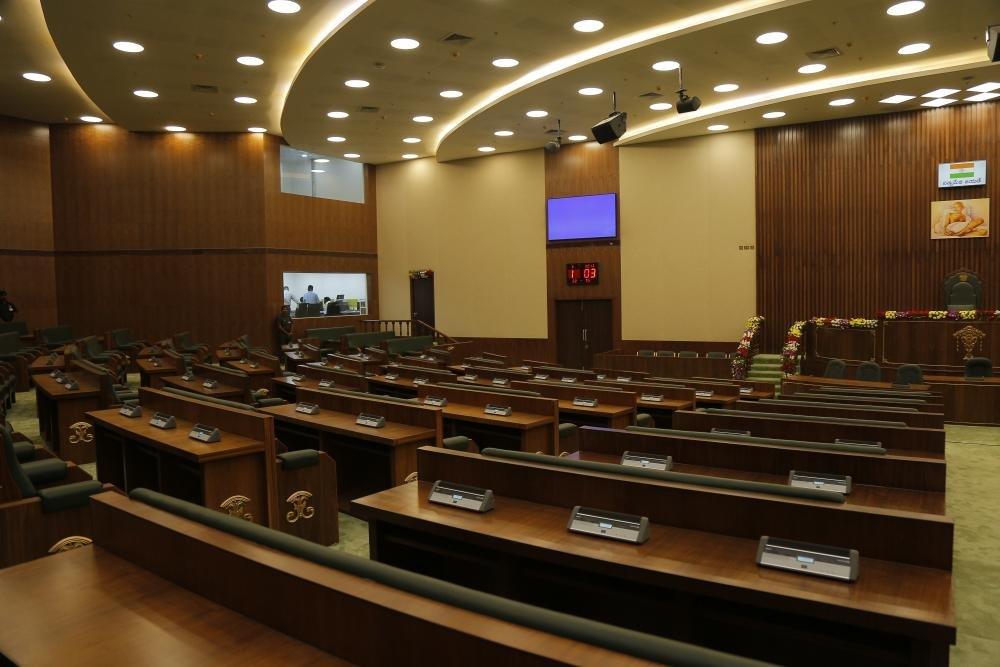
Photo: Andhra Pradesh Legislative Assembly, Kdslk, CC0

APPSC Group-I Mains 2020 · Paper III: Polity, Constitution, Governance, Law & Ethics
APPSC Group 1 Mains 2020 Paper III with model answers
Held in December 2020 (Notification 27/2018). 15 questions with an internal choice (a) or (b), 10 marks each, so 30 questions in all. Tap a question for its model answer.
Tap a question to open its model answer on its own page. Every model answer is free. Answers are by Learn with Anil (Jupudi Anil Kumar), not by APPSC; facts as of October 2026.
Paper III: Polity, Constitution, Governance, Law & Ethics
30 questions, 10 marks each
- Q1(a)How was the Constituent Assembly formed that framed the Indian constitution? Critically evaluate the Constitution of India as framed by the Constituent Assembly.
10 marks · The Constitution and our rights · How the Constitution was made and its main features
- Q1(b)Define Judicial Review with special reference to the classification given by Justice Syed Shah Mohamed Quadri. Describe the importance and scope of Judicial Review.
10 marks · Courts and judicial review · Judicial review: courts checking laws and orders
- Q2(a)Why did we adopt federalism with a strong central government? Explain the important provisions that create a strong central government.
10 marks · Centre and States: sharing power and money · Federalism: a strong Centre, Centre–State friction and cooperation
- Q2(b)Define Privileges of state legislature and classify it into two broad categories.
10 marks · Parliament and State Legislatures · State Legislatures, Legislative Councils and privileges
- Q3(a)Describe the main features of the 73rd and 74th amendment of the Indian Constitution.
10 marks · Panchayats and municipalities · 73rd and 74th Amendments: what panchayats and municipalities get
- Q3(b)Explain the role of Governor in states by focusing on its powers and functions.
10 marks · Centre and States: sharing power and money · The Governor's role and powers
- Q4(a)Differentiate between the powers of the Lok Sabha and the Rajya Sabha on the basis of the following parameters: functions and control over election. Explain, with reasons, the powers that are exercised only by the Lok Sabha.
10 marks · Parliament and State Legislatures · Lok Sabha and Rajya Sabha: make-up and powers
- Q4(b)Explain any five salient features of the Indian Constitution
10 marks · The Constitution and our rights · How the Constitution was made and its main features
- Q5(a)Define judicial activism with special reference to PIL and SAL. Judicial activism has had manifold impact on the political system. Justify the statement adding suitable arguments.
10 marks · Courts and judicial review · Public Interest Litigation (PIL) and judicial activism
- Q5(b)Describe the salient features of the Rural and Urban Local Governance under the 73rd and 74th Constitutional Amendment Act.
10 marks · Panchayats and municipalities · 73rd and 74th Amendments: what panchayats and municipalities get
- Q6(a)Define public administration and explain its evolution in India.
10 marks · Running the government: administration, policies and civil services · What public administration is and its history (Kautilya to British rule)
- Q6(b)Differentiate between the administrative ideas in Kautilya's Arthashashtra and the Mughal administration.
10 marks · Running the government: administration, policies and civil services · What public administration is and its history (Kautilya to British rule)
- Q7(a)Define ‘developmentʼ as explained by Prof. Amartya Sen. Explain the characteristics of the new development thinking, and also mention the four areas where the government has to play a crucial role.
10 marks · Running the government: administration, policies and civil services · Government development policies and why implementation falls short
- Q7(b)Describe the role of NGOs and Civil Services in Democracy.
10 marks · Running the government: administration, policies and civil services · Civil services: role, reforms and integrity
- Q8(a)Give the reason for the UN to partner with the civil society. Explain the importance of civil societies. Under which Acts are the NGOs in India legally registered?
10 marks · Good governance and the citizen's voice · Civil society and NGOs
- Q8(b)What is RTI? What rights are available under RTI Act 2005? If RTI is a Fundamental Right, then why do we need an Act to give us this Right?
10 marks · Good governance and the citizen's voice · Right to Information (RTI) and Public Service Act
- Q9(a)Describe the work of the statutory bodies with example and mention in which countries they are set up. Explain quasi-judicial bodies, providing two examples from India.
10 marks · Running the government: administration, policies and civil services · Statutory, regulatory and quasi-judicial bodies (commissions, tribunals)
- Q9(b)What is social audit? What are its objectives and advantages?
10 marks · Good governance and the citizen's voice · Social audit
- Q10(a)Why does the Indian Government make use of the e-governance strategy? Mention the several initiatives in the journey from e-governance vision to implementation. How can we say that the Indian government is accountable, responsive and legitimate government?
10 marks · Good governance and the citizen's voice · Good governance, e-governance and Citizen's Charter
- Q10(b)Explain the major governmental interventions in the social sector with special reference to Health and education.
10 marks · Running the government: administration, policies and civil services · Government development policies and why implementation falls short
- Q11(a)Define ethics, with reference to ethics in Indian tradition. Mention five principles to manage ethics in public service.
10 marks · Ethics for public servants · Ethics basics; integrity and accountability in public and private life
- Q11(b)What are the necessity and importance of labour laws? Are Indiaʼs labour law reforms only a gift for factories or do workers benefit too?
10 marks · Everyday laws: civil, criminal, labour, cyber and tax · Labour laws
- Q12(a)What do you understand by the values of an entity? What is the need for value education? Discuss how gender inequality came to be recognised as inequality in the Indian context and the kind of responses that this recognition produced.
10 marks · Ethics for public servants · Human values: family, education, gender equality, great leaders
- Q12(b)Explain the Lokpal and Lokyukta Act.
10 marks · Ethics for public servants · Public-service ethics: codes, leadership, corruption, Lokpal, international ethics
- Q13(a)Define moral attitude and explain the four qualities of moral attitude. What are the factors that shape political attitude?
10 marks · Ethics for public servants · Attitude, persuasion and emotional intelligence
- Q13(b)Explain the concept of emotional intelligence with special reference to the three main models of emotional intelligence. How are emotional intelligence applied in administration and governance?
10 marks · Ethics for public servants · Attitude, persuasion and emotional intelligence
- Q14(a)Define public service broadly. How do the virtues of trustworthiness and fortitude get manifested in public service? Explain with examples. Suggest three preventive measures of corruption.
10 marks · Ethics for public servants · Public-service ethics: codes, leadership, corruption, Lokpal, international ethics
- Q14(b)What is the role of family, society and educational institutions in inculcating values?
10 marks · Ethics for public servants · Human values: family, education, gender equality, great leaders
- Q15(a)Explain the different types of cybercrimes and the importance of cyber laws in India.
10 marks · Everyday laws: civil, criminal, labour, cyber and tax · Cyber laws and cyber crime
- Q15(b)How does time and space effect ethics in private and public relationships? Illustrate.
10 marks · Ethics for public servants · Ethics basics; integrity and accountability in public and private life
All Mains PYQs, year-wise and subject-wise
Every model answer on these pages is free to read. The Tool Kit adds four PDF books for Mains Papers I–IV: every previous question sorted by syllabus, with practice questions. It is in the ₹149 All-in-One Pass, with every previous paper of every exam on the site, practice quizzes, timed tests, mock test series and study books.
₹149 · valid for 12 months from the day you pay, on every exam · pay by UPI, card or net banking