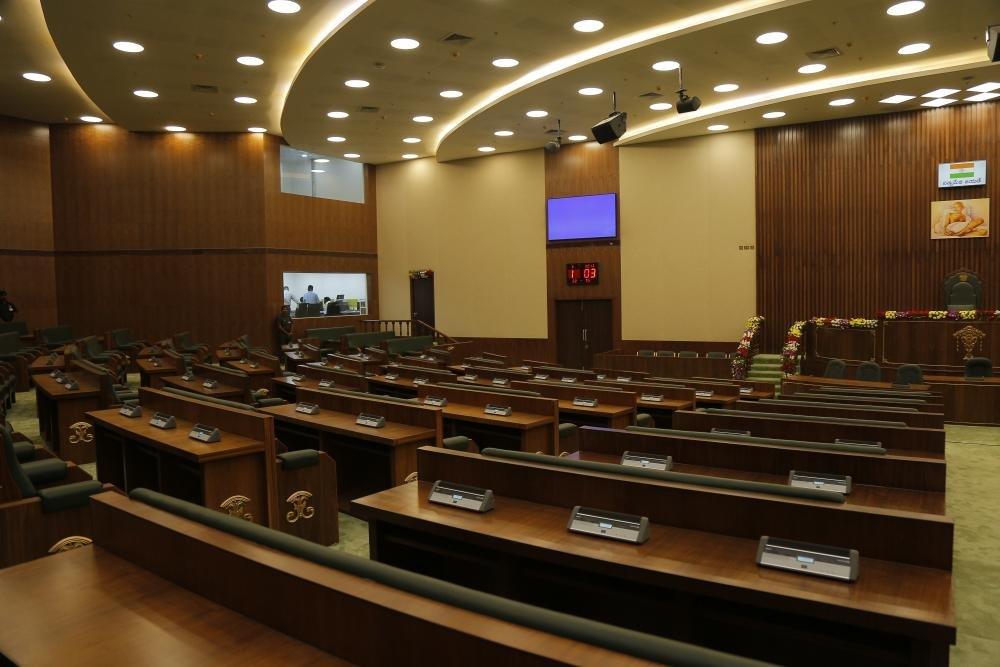
Photo: Andhra Pradesh Legislative Assembly, Kdslk, CC0

APPSC Group-I Mains 2020 · Paper III
2020 Paper III · Q1(a): model answer
Polity, Constitution, Governance, Law & Ethics · The Constitution and our rights. Held in December 2020 (Notification 27/2018).
How was the Constituent Assembly formed that framed the Indian constitution? Critically evaluate the Constitution of India as framed by the Constituent Assembly.
Syllabus: The Constitution and our rights · How the Constitution was made and its main features
Constituent AssemblyCabinet Mission PlanBag of borrowingsConstitutionalism
The idea of a Constituent Assembly was first put forward by M.N. Roy (1934); the Congress officially demanded one in 1935, and the British accepted the demand in principle in the August Offer (1940). The Assembly was finally constituted in November 1946 under the Cabinet Mission Plan. In just under three years it framed the Constitution, adopted on 26 November 1949, whose merits and flaws have been debated ever since.
1. Formation of the Constituent Assembly
- Strength: a total of 389 seats: 296 for British India (292 from the eleven governors' provinces and 4 from the chief commissioners' provinces) and 93 for the princely states.
- Allocation: seats were shared among the provinces and princely states roughly in proportion to population (about one seat per ten lakh people) and divided among the General, Muslim and Sikh communities.
- Indirect election: members of the provincial assemblies elected the representatives by proportional representation through the single transferable vote in July–August 1946. The Congress won 208 seats, the Muslim League 73 and small groups and independents 15; princely-state members were to be nominated by the rulers.
- Working: it first met on 9 December 1946 (the League boycotted it), elected Dr Rajendra Prasad President and set up the Drafting Committee under Dr B.R. Ambedkar on 29 August 1947. After Partition its strength fell to 299.
- Andhra members: Alladi Krishnaswami Ayyar (Drafting Committee), N.G. Ranga, Durgabai Deshmukh and Pattabhi Sitaramayya.
- 1934 M.N. Roy proposes a Constituent Assembly
- 1940 August Offer accepts the demand in principle
- 1946 Cabinet Mission Plan; elections in July–August; first sitting on 9 December
- 1947 Objectives Resolution adopted (22 January); Drafting Committee set up (29 August)
- 1949 Constitution adopted on 26 November
- 1950 Constitution comes into force on 26 January
2. Strengths of the Constitution as framed
- Democratic content: universal adult franchise from the very first general election, a bold step for a poor and largely non-literate new nation.
- Rights with remedies: justiciable Fundamental Rights backed by Article 32, which Ambedkar called the "heart and soul" of the Constitution, and Directive Principles to guide a welfare state.
- Social revolution: abolition of untouchability (Art 17) and safeguards for SCs, STs and minorities; Granville Austin called it "first and foremost a social document".
- Balanced institutions: parliamentary government, an independent judiciary and a federation with a strong Centre suited to a newly partitioned country.
3. Criticisms and the counter-view
| Criticism | Counter-view |
|---|---|
| Not representative: indirectly elected on a limited franchise | Members came from every region, community and shade of opinion |
| Not sovereign: created by a British plan | The Indian Independence Act, 1947 made it a fully sovereign body; it adopted the Constitution in the name of "We, the people of India" |
| Congress-dominated: "the Assembly was the Congress and the Congress was India" (Austin) | The Congress was a broad coalition; non-Congress experts such as Ambedkar held key posts |
| Lawyer-dominated: Ivor Jennings called it a "lawyers' paradise" | Precise drafting was needed for a large, diverse federation |
| A "bag of borrowings", largely a copy of the 1935 Act | Borrowed provisions were adapted to Indian needs; Ambedkar said there is nothing to be ashamed of in borrowing |
| Un-Gandhian: neglected village panchayats | Article 40 directs the State to organise panchayats; the 73rd Amendment (1992) gave them constitutional status |
These criticisms are only partly valid. Decisions were taken by consensus and accommodation rather than by majority votes, and the drafts were openly debated clause by clause.
In conclusion, the Assembly's legitimacy rests less on how it was elected than on what it produced: a democratic, rights-based Constitution that has endured for over 75 years. As Ambedkar warned, its success depends on those who work it, that is, on constitutional morality.
The other choice in Q1
Answer either one in the exam.
- Q1(b)Define Judicial Review with special reference to the classification given by Justice Syed Shah Mohamed Quadri. Describe the importance and scope of Judicial Review.
10 marks · Courts and judicial review · Judicial review: courts checking laws and orders
Every model answer on these pages is free to read. The Tool Kit adds four PDF books for Mains Papers I–IV: every previous question sorted by syllabus, with practice questions. It is in the ₹149 All-in-One Pass, with every previous paper of every exam on the site, practice quizzes, timed tests, mock test series and study books.
₹149 · valid for 12 months from the day you pay, on every exam · pay by UPI, card or net banking