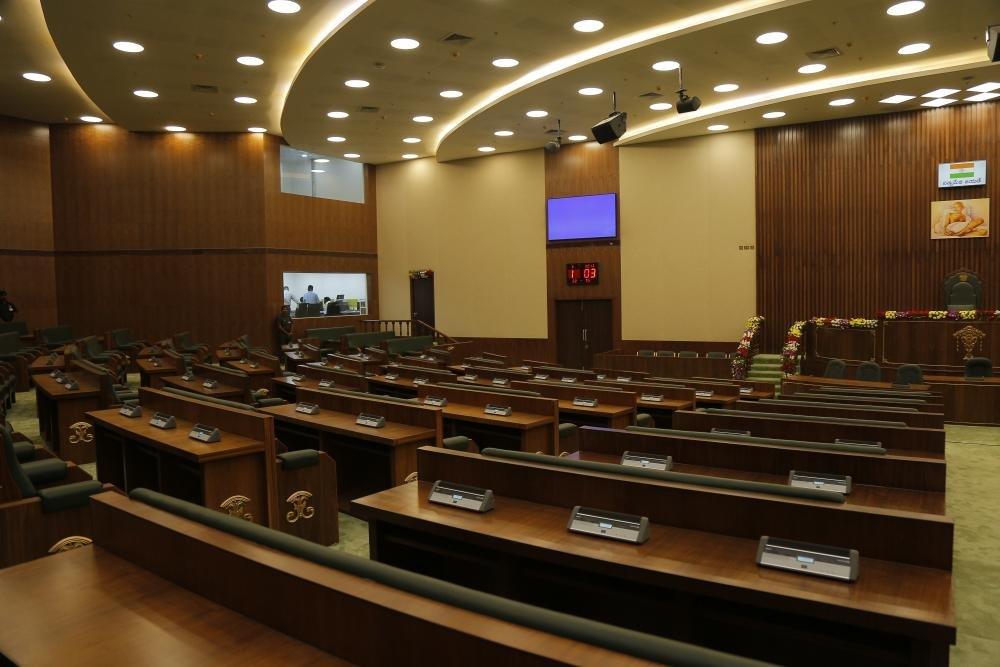
Photo: Andhra Pradesh Legislative Assembly, Kdslk, CC0

APPSC Group-I Mains 2020 · Paper III
2020 Paper III · Q8(b): model answer
Polity, Constitution, Governance, Law & Ethics · Good governance and the citizen's voice. Held in December 2020 (Notification 27/2018).
What is RTI? What rights are available under RTI Act 2005? If RTI is a Fundamental Right, then why do we need an Act to give us this Right?
Syllabus: Good governance and the citizen's voice · Right to Information (RTI) and Public Service Act
Right to InformationArticle 19(1)(a)Public authorityInformation Commission
Right to Information (RTI) is the citizens' right to access information held by or under the control of public authorities. The RTI Act, 2005 (in force from 12 October 2005), born of the MKSS movement in Rajasthan, replaced the never-notified Freedom of Information Act, 2002. It aims at transparency and accountability, treating the citizen as the real owner of public information.
1. Rights available under the RTI Act
- Right to information (Section 2(j)): to inspect works, documents and records; take notes, extracts or certified copies; take certified samples of material; and obtain information in electronic form.
- Time-bound reply: within 30 days, or 48 hours if life or liberty is involved; information is free if the deadline is missed, no reasons need be given and BPL applicants pay no fee.
- Right to appeal: first to a senior officer in the department and then to the Central or State Information Commission (Sections 18–19), such as the AP State Information Commission.
- Proactive disclosure (Section 4): public authorities must publish details of their functions, budgets, officers and decisions on their own.
- Narrow exemptions: only those listed in Sections 8 and 9; even exempt information can be disclosed if the public interest outweighs the harm (Section 8(2)).
2. If RTI is a Fundamental Right, why do we need an Act?
The Supreme Court has read the right to know into Article 19(1)(a): State of UP v. Raj Narain (1975), S.P. Gupta (1981) and Union of India v. ADR (2002). Yet a law is needed because:
- An abstract right: a judicially recognised right is enforceable only through costly, slow writ petitions under Articles 32 and 226.
- Machinery: the Act creates Public Information Officers, time limits, fees, appeals and Information Commissions, making the right quick and cheap.
- Defined limits: it spells out "reasonable restrictions" (Art 19(2)) through specific exemptions, balancing transparency with security and privacy.
- Positive duties: Fundamental Rights mainly restrain the State, while information access needs duties of record-keeping, disclosure and penalties.
- Wider reach: the Act covers bodies substantially financed by government, and the Supreme Court held the Chief Justice's office to be a public authority (Subhash Chandra Agarwal, 2019).
| Basis | Fundamental Right (Art 19(1)(a)) | RTI Act, 2005 |
|---|---|---|
| Source | Judicial interpretation | Law made by Parliament |
| How enforced | Writ petition in a High Court or the Supreme Court | Simple application to a PIO |
| Cost and time | Costly and slow | Small fee; 30-day limit |
| Restrictions | Broad "reasonable restrictions" | Specific exemptions (Sections 8, 9) |
| Machinery | Courts only | PIOs, appellate officers, Information Commissions |
3. Concerns
- Autonomy: the RTI (Amendment) Act, 2019 lets the Centre fix the tenure and salaries of Information Commissioners.
- Privacy exemption: the DPDP Act, 2023 changed Section 8(1)(j) to exempt personal information more widely, raising fears of dilution.
- Implementation: vacancies and backlogs in commissions, and attacks on RTI activists.
In conclusion, RTI turns citizens into partners in participatory democracy; independent Information Commissions and proactive disclosure keep this right to know meaningful.
The other choice in Q8
Answer either one in the exam.
Every model answer on these pages is free to read. The Tool Kit adds four PDF books for Mains Papers I–IV: every previous question sorted by syllabus, with practice questions. It is in the ₹149 All-in-One Pass, with every previous paper of every exam on the site, practice quizzes, timed tests, mock test series and study books.
₹149 · valid for 12 months from the day you pay, on every exam · pay by UPI, card or net banking