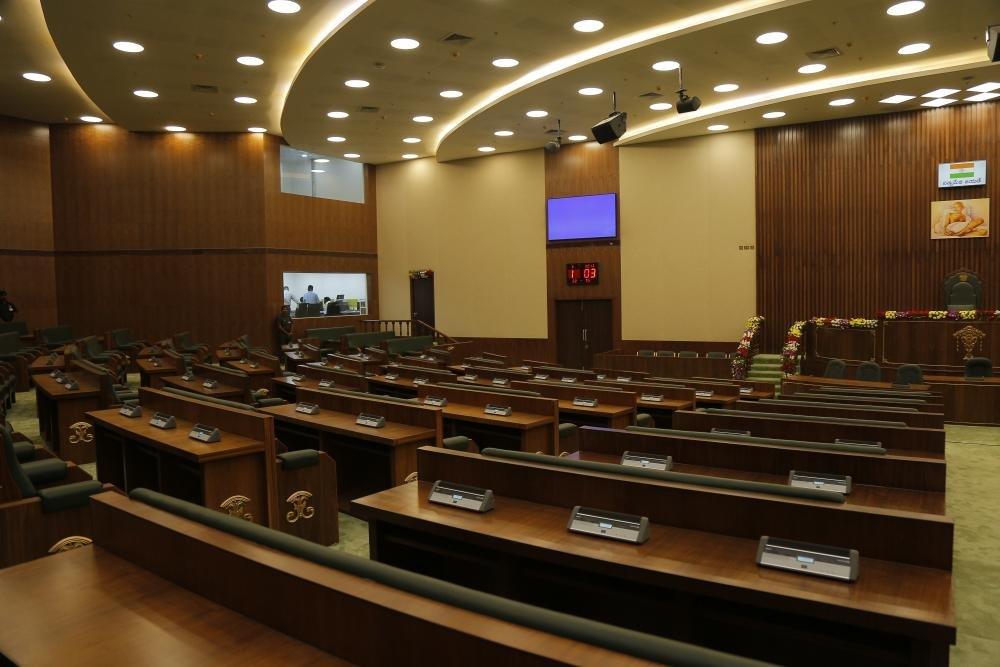
Photo: Andhra Pradesh Legislative Assembly, Kdslk, CC0

APPSC Group-I Mains 2020 · Paper III
2020 Paper III · Q9(a): model answer
Polity, Constitution, Governance, Law & Ethics · Running the government: administration, policies and civil services. Held in December 2020 (Notification 27/2018).
Describe the work of the statutory bodies with example and mention in which countries they are set up. Explain quasi-judicial bodies, providing two examples from India.
Syllabus: Running the government: administration, policies and civil services · Statutory, regulatory and quasi-judicial bodies (commissions, tribunals)
Statutory bodiesRegulatory authoritiesQuasi-judicial bodiesNatural justice
Statutory bodies are created by an Act of Parliament or a State Legislature, which defines their composition, powers and functions. They differ from constitutional bodies, created by the Constitution itself (like the Election Commission), and from executive bodies set up by a government resolution (like NITI Aayog). Quasi-judicial bodies, whether statutory or constitutional, also have the power to adjudicate like a court.
| Type | Created by | Examples |
|---|---|---|
| Constitutional | The Constitution | Election Commission, UPSC, Finance Commission, CAG |
| Statutory | Act of Parliament or a State Legislature | NHRC, SEBI, CVC, NDMA, Lokpal |
| Executive | Government resolution | NITI Aayog (2015) |
| Quasi-judicial | Constitution or statute, with power to adjudicate | NGT, Consumer Commissions, CAT, Information Commissions |
1. Work of statutory bodies, with examples
- Regulation: SEBI (1992) for securities markets, TRAI (1997) for telecom and the CCI (Competition Act, 2002) for fair competition.
- Protection of rights: the NHRC (Protection of Human Rights Act, 1993), the National Commission for Women (1990 Act) and the NCPCR (2005 Act).
- Vigilance and anti-corruption: the CVC (2003 Act) and the Lokpal (2013 Act).
- Disaster management: the NDMA (Disaster Management Act, 2005).
- Andhra Pradesh: the AP State Human Rights Commission and the AP Electricity Regulatory Commission (1999, under the AP Electricity Reform Act, 1998).
Such bodies bring expertise, continuity and freedom from day-to-day political pressure, and they remain accountable through annual reports laid before the legislature.
2. Countries where they are set up
- Universal institution: statutory bodies are found in almost every modern state.
- Commonwealth democracies: they are especially common in the UK (e.g., Ofcom), Australia, Canada and New Zealand.
- Asia: Singapore calls them "statutory boards", and Malaysia also uses them widely.
- USA: similar "independent regulatory commissions", such as the Securities and Exchange Commission and the Federal Trade Commission.
3. Quasi-judicial bodies
These are non-court bodies empowered to adjudicate disputes, determine rights and impose penalties. They follow natural justice and court-like procedures but are not bound by strict rules of evidence or the Civil Procedure Code, offering speedy, expert and cheap justice.
- National Green Tribunal (NGT Act, 2010): decides environmental disputes, aiming to dispose of cases within six months; appeals lie to the Supreme Court.
- Consumer Disputes Redressal Commissions (Consumer Protection Act, 2019): three tiers, at district, State and national levels, settle consumer complaints.
- Other examples: the Central Administrative Tribunal (Art 323A) and Information Commissions; L. Chandra Kumar (1997) kept tribunal decisions open to High Court review.
In conclusion, such bodies make governance more specialised and accessible; they need autonomy, timely appointments and adequate staff to remain effective.
The other choice in Q9
Answer either one in the exam.
- Q9(b)What is social audit? What are its objectives and advantages?
10 marks · Good governance and the citizen's voice · Social audit
Every model answer on these pages is free to read. The Tool Kit adds four PDF books for Mains Papers I–IV: every previous question sorted by syllabus, with practice questions. It is in the ₹149 All-in-One Pass, with every previous paper of every exam on the site, practice quizzes, timed tests, mock test series and study books.
₹149 · valid for 12 months from the day you pay, on every exam · pay by UPI, card or net banking