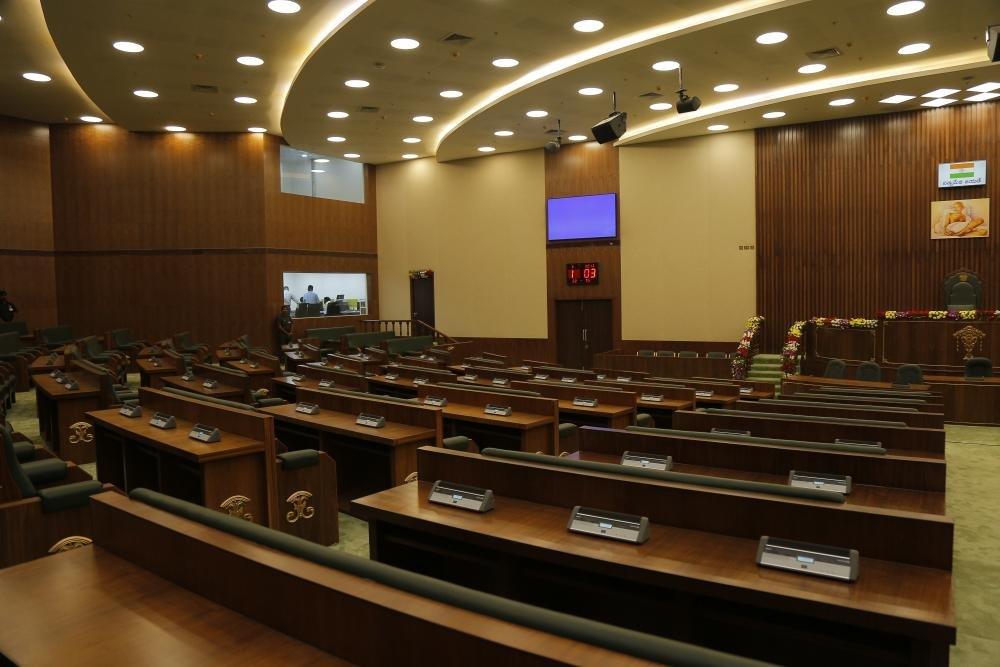
Photo: Andhra Pradesh Legislative Assembly, Kdslk, CC0

APPSC Group-I Mains 2020 · Paper III
2020 Paper III · Q9(b): model answer
Polity, Constitution, Governance, Law & Ethics · Good governance and the citizen's voice. Held in December 2020 (Notification 27/2018).
What is social audit? What are its objectives and advantages?
Syllabus: Good governance and the citizen's voice · Social audit
Social auditGram SabhaJan sunwaiSSAAT
Social audit is a process in which the people, especially the intended beneficiaries, verify the implementation of a programme by comparing official records with ground reality and discussing the findings publicly, usually in the Gram Sabha. Pioneered by the MKSS's jan sunwais (public hearings) in Rajasthan in the 1990s, it is mandatory under Section 17 of MGNREGA, 2005, and Section 28 of the National Food Security Act, 2013 provides for it in the PDS.
1. Objectives
- Transparency: public disclosure of records such as muster rolls, bills, vouchers and beneficiary lists.
- Accountability: implementing agencies answer directly to the people they serve.
- Participation: beneficiaries take part in planning, monitoring and evaluation.
- Verification: checking the quantity and quality of works and the eligibility of beneficiaries.
- Grievance redressal: complaints are heard in public and corrective action is taken.
2. Advantages
- Detects leakages: fake muster rolls, ghost beneficiaries and inflated bills are exposed, and misappropriated funds are recovered.
- Deters corruption: the fear of public scrutiny improves the quality of public works and services.
- Empowers the poor: it raises awareness of entitlements and strengthens the Gram Sabha as a forum of direct democracy.
- Builds trust: it improves relations between citizens and government and gives feedback for better policy.
| Basis | Conventional audit | Social audit |
|---|---|---|
| Who audits | CAG or accountants | Beneficiaries and community, helped by trained resource persons |
| Focus | Financial compliance with rules | Ground reality, quality and outcomes |
| Forum | Report to the legislature or management | Public hearing in the Gram Sabha |
| Language | Technical | Local language, open to all |
3. Andhra Pradesh model
- Pioneer: AP pioneered state-supported social audits of the rural employment guarantee scheme from 2006.
- Independent unit: it set up the Society for Social Audit, Accountability and Transparency (SSAAT, 2009), independent of the implementing department.
- Method: village social auditors verify records door to door, and findings are read out at public hearings with officials present.
- National spread: the MGNREGA Audit of Schemes Rules, 2011 require independent social audit units in every State; Meghalaya passed the first dedicated social audit law (2017).
4. Limitations
- Weak follow-up: findings are often not acted upon, and recoveries are slow.
- Elite capture and pressure: local elites may dominate hearings, and social auditors face threats.
- Limited independence and coverage: where audit units depend on the implementing department, or cover only one scheme, audits lose credibility and reach.
In conclusion, social audit turns citizens from passive beneficiaries into active monitors; it should cover all major welfare schemes and be backed by prompt action on findings.
The other choice in Q9
Answer either one in the exam.
- Q9(a)Describe the work of the statutory bodies with example and mention in which countries they are set up. Explain quasi-judicial bodies, providing two examples from India.
10 marks · Running the government: administration, policies and civil services · Statutory, regulatory and quasi-judicial bodies (commissions, tribunals)
Every model answer on these pages is free to read. The Tool Kit adds four PDF books for Mains Papers I–IV: every previous question sorted by syllabus, with practice questions. It is in the ₹149 All-in-One Pass, with every previous paper of every exam on the site, practice quizzes, timed tests, mock test series and study books.
₹149 · valid for 12 months from the day you pay, on every exam · pay by UPI, card or net banking