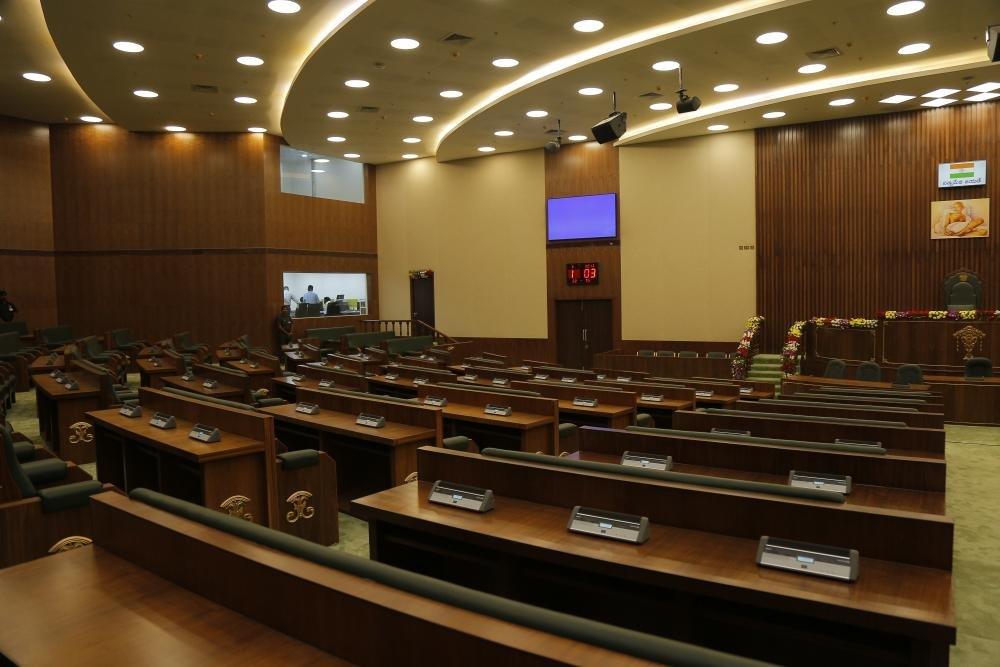
Photo: Andhra Pradesh Legislative Assembly, Kdslk, CC0

APPSC Group-I Mains · Paper III: Polity, Constitution, Governance, Law & Ethics
APPSC Group 1 Mains Running the government: administration, policies and civil services: previous questions with answers
Every APPSC Group-I Mains question on Running the government: administration, policies and civil services (Paper III) from the 2020, 2023 and 2025 papers: 18 questions in 4 topics, newest first. Tap a question for its model answer.
- The Constitution and our rights
- Centre and States: sharing power and money
- Panchayats and municipalities
- Parliament and State Legislatures
- Courts and judicial review
- Running the government: administration, policies and civil services
- Good governance and the citizen's voice
- Ethics for public servants
- Everyday laws: civil, criminal, labour, cyber and tax
Tap a question to open its model answer on its own page. Every model answer is free. Answers are by Learn with Anil (Jupudi Anil Kumar), not by APPSC; facts as of October 2026.
Running the government: administration, policies and civil services
18 questions: 6 in 2025, 6 in 2023, 6 in 2020
What public administration is and its history (Kautilya to British rule) · asked 6 times
- Q6(a)The administrative system of the Gupta dynasty was, in many ways, similar to that of the Mauryan Empire. Discuss the key similarities and differences between the two administrative structures.
2025 Paper III · 10 marks
- Q6(b)What features of British administration have influenced the Indian administrative system?
2025 Paper III · 10 marks
- Q6(a)'The concept of the welfare state had been crystallised in Kautilya's ideas long before it came to be envisioned in Western Europe' - Examine this statement.
2023 Paper III · 10 marks
- Q6(b)It is observed that much of present-day Indian bureaucracy is a result of British administration. In this connection, explain the evolution of Civil Service in India.
2023 Paper III · 10 marks
- Q6(a)Define public administration and explain its evolution in India.
2020 Paper III · 10 marks
- Q6(b)Differentiate between the administrative ideas in Kautilya's Arthashashtra and the Mughal administration.
2020 Paper III · 10 marks
Government development policies and why implementation falls short · asked 5 times
- Q7(a)Education is a vital sector for boosting the development of any nation. Highlight the recent developments in the education policy of the Indian government.
2025 Paper III · 10 marks
- Q7(b)Although policies formulated by departments are prepared by experts, the results often fall short of expectations. What are the major issues responsible for this gap between policy formulation and implementation?
2025 Paper III · 10 marks
- Q7(a)Government's intervention in development has seen a long way of impressive outcomes in India. In this connection, discuss the Atmanirbhar Bharat mission aimed at making India Self- Reliant.
2023 Paper III · 10 marks
- Q7(a)Define ‘developmentʼ as explained by Prof. Amartya Sen. Explain the characteristics of the new development thinking, and also mention the four areas where the government has to play a crucial role.
2020 Paper III · 10 marks
- Q10(b)Explain the major governmental interventions in the social sector with special reference to Health and education.
2020 Paper III · 10 marks
Civil services: role, reforms and integrity · asked 3 times
- Q7(b)Explain the scope of civil service reforms in India with a brief note on Mission Karmayogi.
2023 Paper III · 10 marks
- Q9(b)What are the reasons for decline of integrity in civil services? Also, discuss the institutional mechanism to check corruption in India.
2023 Paper III · 10 marks
- Q7(b)Describe the role of NGOs and Civil Services in Democracy.
2020 Paper III · 10 marks
Statutory, regulatory and quasi-judicial bodies (commissions, tribunals) · asked 4 times
- Q9(a)Under which Act was the National Commission for Women (NCW) established? Describe its main features and limitations.
2025 Paper III · 10 marks
- Q9(b)Which constitutional provisions empower the formation of quasi-judicial authorities in India? Explain with suitable examples.
2025 Paper III · 10 marks
- Q9(a)Explain the quasi-judicial nature of Administrative Tribunals. Examine whether writs and appeals are available against the decisions of the Administrative Tribunals.
2023 Paper III · 10 marks
- Q9(a)Describe the work of the statutory bodies with example and mention in which countries they are set up. Explain quasi-judicial bodies, providing two examples from India.
2020 Paper III · 10 marks
All Mains PYQs, year-wise and subject-wise
Every model answer on these pages is free to read. The Tool Kit adds four PDF books for Mains Papers I–IV: every previous question sorted by syllabus, with practice questions. It is in the ₹149 All-in-One Pass, with every previous paper of every exam on the site, practice quizzes, timed tests, mock test series and study books.
₹149 · valid for 12 months from the day you pay, on every exam · pay by UPI, card or net banking