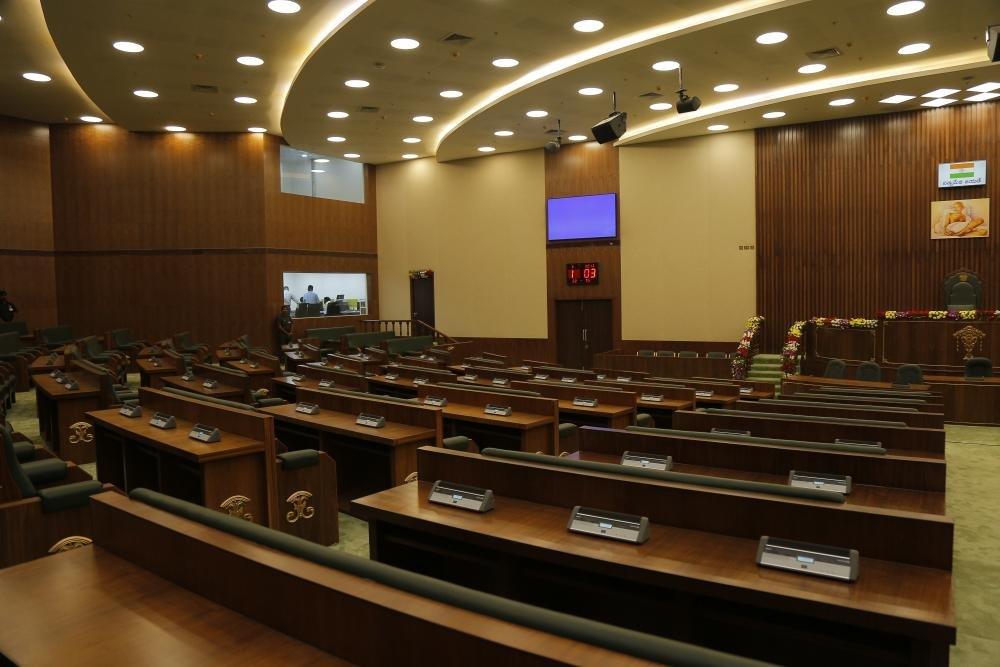
Photo: Andhra Pradesh Legislative Assembly, Kdslk, CC0

APPSC Group-I Mains 2025 · Paper III
2025 Paper III · Q9(b): model answer
Polity, Constitution, Governance, Law & Ethics · Running the government: administration, policies and civil services. Held in May 2025 (Notification 12/2023).
Which constitutional provisions empower the formation of quasi-judicial authorities in India? Explain with suitable examples.
Syllabus: Running the government: administration, policies and civil services · Statutory, regulatory and quasi-judicial bodies (commissions, tribunals)
Quasi-judicial bodiesTribunalsArticles 323A–323BNatural justice
Quasi-judicial authorities are bodies outside the regular court hierarchy that decide disputes or determine rights by applying law to facts and following natural justice, without being full courts. They offer speedy, expert and inexpensive adjudication in specialised fields such as service matters, taxation, environment and elections. The Constitution creates some of them directly and empowers Parliament and State Legislatures to create others through tribunals.
| Provision | Body | Example |
|---|---|---|
| Art 323A | Administrative tribunals for public service | Central Administrative Tribunal (1985) |
| Art 323B | Tribunals for tax, labour, land reforms, rent and other matters | Industrial and tax tribunals |
| Art 262 | Inter-State river water tribunals | Krishna and Godavari Water Disputes Tribunals |
| Art 324 with 103, 192 | Election Commission | Party symbol disputes; disqualification opinions |
| Tenth Schedule | Speaker or Chairman | Defection cases |
| Art 338, 338A, 338B | National Commissions for SCs, STs, BCs | Civil court powers in inquiries |
1. Specific constitutional provisions
- Art 323A: Parliament may set up administrative tribunals for recruitment and service conditions of public servants, as in the Central Administrative Tribunal under the Administrative Tribunals Act 1985.
- Art 323B: Parliament and State Legislatures may set up tribunals for taxation, foreign exchange, industrial and labour disputes, land reforms, elections, rent and other matters. Both articles were added by the 42nd Amendment (1976) on the Swaran Singh Committee's advice.
- Art 262: Parliament provides for adjudication of inter-State river water disputes, e.g. the Krishna Water Disputes Tribunals (Bachawat; Brijesh Kumar), vital for Andhra Pradesh.
- Art 324 with Art 103 and 192: the Election Commission decides disputes over party recognition and symbols, and its opinion binds the President or Governor on disqualification of legislators.
- Tenth Schedule: the Speaker or Chairman acts as a tribunal on defection, subject to judicial review (Kihoto Hollohan, 1992).
2. General legislative competence
Under Art 245–246, legislatures can create quasi-judicial bodies on subjects in their lists. Examples include the National Green Tribunal (2010), consumer commissions (Consumer Protection Act 2019), Information Commissions (RTI Act 2005), the Income Tax Appellate Tribunal, the Competition Commission and electricity regulatory commissions such as the AP Electricity Regulatory Commission (1999).
3. Judicial control
- Supervision: the Supreme Court (Art 136) and High Courts (Art 226, 227) review their decisions.
- L. Chandra Kumar (1997): tribunal decisions are subject to High Court review, since judicial review is a basic feature.
- Independence: the Madras Bar Association cases and the Tribunals Reforms Act 2021 addressed appointments, tenure and qualifications of members.
AP angle: Art 371D(3), inserted by the 32nd Amendment (1973), let the President set up an Administrative Tribunal for Andhra Pradesh's public-employment disputes, and in P. Sambamurthy (decided December 1986, reported 1987) the Supreme Court struck down the State Government's power to modify or annul its orders (clause (5) and its proviso).
4. Significance and concerns
They reduce court backlog and bring expertise, but vacancies, executive control over appointments and post-retirement postings raise questions of independence.
Quasi-judicial bodies are vital for speedy justice; independent selection, adequate staff and judicial oversight will keep them credible guardians of the rule of law.
The other choice in Q9
Answer either one in the exam.
- Q9(a)Under which Act was the National Commission for Women (NCW) established? Describe its main features and limitations.
10 marks · Running the government: administration, policies and civil services · Statutory, regulatory and quasi-judicial bodies (commissions, tribunals)
Every model answer on these pages is free to read. The Tool Kit adds four PDF books for Mains Papers I–IV: every previous question sorted by syllabus, with practice questions. It is in the ₹149 All-in-One Pass, with every previous paper of every exam on the site, practice quizzes, timed tests, mock test series and study books.
₹149 · valid for 12 months from the day you pay, on every exam · pay by UPI, card or net banking