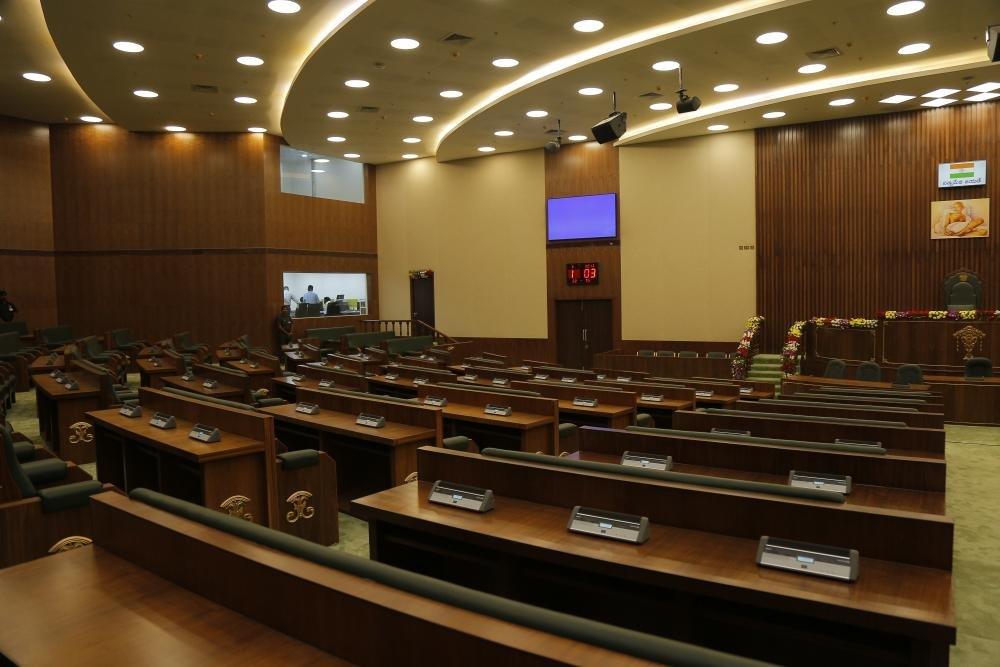
Photo: Andhra Pradesh Legislative Assembly, Kdslk, CC0

APPSC Group-I Mains 2025 · Paper III: Polity, Constitution, Governance, Law & Ethics
APPSC Group 1 Mains 2025 Paper III with model answers
Held in May 2025 (Notification 12/2023). 15 questions with an internal choice (a) or (b), 10 marks each, so 30 questions in all. Tap a question for its model answer.
Tap a question to open its model answer on its own page. Every model answer is free. Answers are by Learn with Anil (Jupudi Anil Kumar), not by APPSC; facts as of October 2026.
Paper III: Polity, Constitution, Governance, Law & Ethics
30 questions, 10 marks each
- Q1(a)What are the emergency functions of the Union Government of India? Describe how they impact the legislative powers of Parliament and State Legislatures.
10 marks · The Constitution and our rights · Emergency powers and changing (amending) the Constitution
- Q1(b)The Indian Constitution favours a federal type of government. Considering this, what duties does the Constitution place on State Governments to ensure the smooth functioning of the nation?
10 marks · The Constitution and our rights · Jobs and duties of the Union and State governments
- Q2(a)The procedure of enacting a law from a bill differs at the Union and State levels, primarily to safeguard the interests of the Union Government in state legislation. Elucidate this aspect.
10 marks · Centre and States: sharing power and money · Who makes which laws: Union, State and Concurrent Lists
- Q2(b)Although States have their separate list for law-making, this authority is not beyond the overarching legislative powers of the Parliament. Examine.
10 marks · Centre and States: sharing power and money · Who makes which laws: Union, State and Concurrent Lists
- Q3(a)The Finance Commission is considered the backbone of fiscal federalism in India. Examine its role and significance in maintaining the financial balance between the Union and the States.
10 marks · Centre and States: sharing power and money · Sharing money: Finance Commission and fiscal federalism
- Q3(b)Discuss the significance of the 73rd Constitutional Amendment Act in strengthening grassroots democracy in India.
10 marks · Panchayats and municipalities · 73rd and 74th Amendments: what panchayats and municipalities get
- Q4(a)What are the steps followed by the Indian Parliament in transforming a Bill into an Act?
10 marks · Parliament and State Legislatures · How a Bill becomes law; motions and House business
- Q4(b)In what aspects is the Legislative Council (Vidhan Parishad) different from the Rajya Sabha, considering its role at the state level?
10 marks · Parliament and State Legislatures · State Legislatures, Legislative Councils and privileges
- Q5(a)The Constitution of India grants certain rights to citizens and also provides measures to safeguard them. What are the key constitutional arrangements to ensure the protection of these rights?
10 marks · The Constitution and our rights · Fundamental Rights, Directive Principles and how rights are protected
- Q5(b)Discuss any two constitutional amendments that have significantly affected the powers or functioning of the Indian judiciary.
10 marks · Courts and judicial review · How courts are organised; amendments affecting the courts
- Q6(a)The administrative system of the Gupta dynasty was, in many ways, similar to that of the Mauryan Empire. Discuss the key similarities and differences between the two administrative structures.
10 marks · Running the government: administration, policies and civil services · What public administration is and its history (Kautilya to British rule)
- Q6(b)What features of British administration have influenced the Indian administrative system?
10 marks · Running the government: administration, policies and civil services · What public administration is and its history (Kautilya to British rule)
- Q7(a)Education is a vital sector for boosting the development of any nation. Highlight the recent developments in the education policy of the Indian government.
10 marks · Running the government: administration, policies and civil services · Government development policies and why implementation falls short
- Q7(b)Although policies formulated by departments are prepared by experts, the results often fall short of expectations. What are the major issues responsible for this gap between policy formulation and implementation?
10 marks · Running the government: administration, policies and civil services · Government development policies and why implementation falls short
- Q8(a)What do you understand by civil society in the Indian context? Discuss its key features and the limitations it faces in a democratic system.
10 marks · Good governance and the citizen's voice · Civil society and NGOs
- Q8(b)In what ways can the role of NGOs be enhanced in promoting womenʼs empowerment and welfare in India? Discuss, with a focus on the key challenges they encounter.
10 marks · Good governance and the citizen's voice · Civil society and NGOs
- Q9(a)Under which Act was the National Commission for Women (NCW) established? Describe its main features and limitations.
10 marks · Running the government: administration, policies and civil services · Statutory, regulatory and quasi-judicial bodies (commissions, tribunals)
- Q9(b)Which constitutional provisions empower the formation of quasi-judicial authorities in India? Explain with suitable examples.
10 marks · Running the government: administration, policies and civil services · Statutory, regulatory and quasi-judicial bodies (commissions, tribunals)
- Q10(a)Social audit helps to narrow gaps between vision and reality. Examine the statement and also discuss the impediments in the institutionalisation of social audit in India.
10 marks · Good governance and the citizen's voice · Social audit
- Q10(b)Define good governance. How does the Right to Information (RTI) Act promote the principles of good governance in India?
10 marks · Good governance and the citizen's voice · Right to Information (RTI) and Public Service Act
- Q11(a)Public servants often face situations where personal values conflict with public responsibilities. Examine how a strong ethical foundation can help resolve such dilemmas while maintaining accountability.
10 marks · Ethics for public servants · Ethics basics; integrity and accountability in public and private life
- Q11(b)Whistleblowers are guardians of ethical accountability in governance. Discuss the ethical and institutional importance of whistleblower protection in ensuring integrity in public service.
10 marks · Ethics for public servants · Public-service ethics: codes, leadership, corruption, Lokpal, international ethics
- Q12(a)What ethical values are essential to ensure peaceful coexistence in a diverse society? Illustrate your answer with suitable examples.
10 marks · Ethics for public servants · Human values: family, education, gender equality, great leaders
- Q12(b)How does early value education in the family influence ethical decision-making in adulthood?
10 marks · Ethics for public servants · Human values: family, education, gender equality, great leaders
- Q13(a)Define attitude. How does attitude affect the behaviour of public servants?
10 marks · Ethics for public servants · Attitude, persuasion and emotional intelligence
- Q13(b)Explain the difference between cognitive, affective and behavioural components of attitude with suitable examples in the public service context.
10 marks · Ethics for public servants · Attitude, persuasion and emotional intelligence
- Q14(a)In what ways can the implementation of a code of ethics in public administration help in resolving conflicts of interest and promoting ethical decision-making?
10 marks · Ethics for public servants · Public-service ethics: codes, leadership, corruption, Lokpal, international ethics
- Q14(b)Discuss the significance of integrity, transparency and accountability in leadership. How can public leaders demonstrate these values in their decisionmaking process?
10 marks · Ethics for public servants · Public-service ethics: codes, leadership, corruption, Lokpal, international ethics
- Q15(a)What do you understand by cyberstalking? What are the various other cyber offences recognised under Information Technology Act, 2000?
10 marks · Everyday laws: civil, criminal, labour, cyber and tax · Cyber laws and cyber crime
- Q15(b)What is GST? Discuss the regulatory framework of GST in India, including Constitutional provisions applicable to GST.
10 marks · Everyday laws: civil, criminal, labour, cyber and tax · Tax laws: income tax, corporate tax, GST
All Mains PYQs, year-wise and subject-wise
Every model answer on these pages is free to read. The Tool Kit adds four PDF books for Mains Papers I–IV: every previous question sorted by syllabus, with practice questions. It is in the ₹149 All-in-One Pass, with every previous paper of every exam on the site, practice quizzes, timed tests, mock test series and study books.
₹149 · valid for 12 months from the day you pay, on every exam · pay by UPI, card or net banking