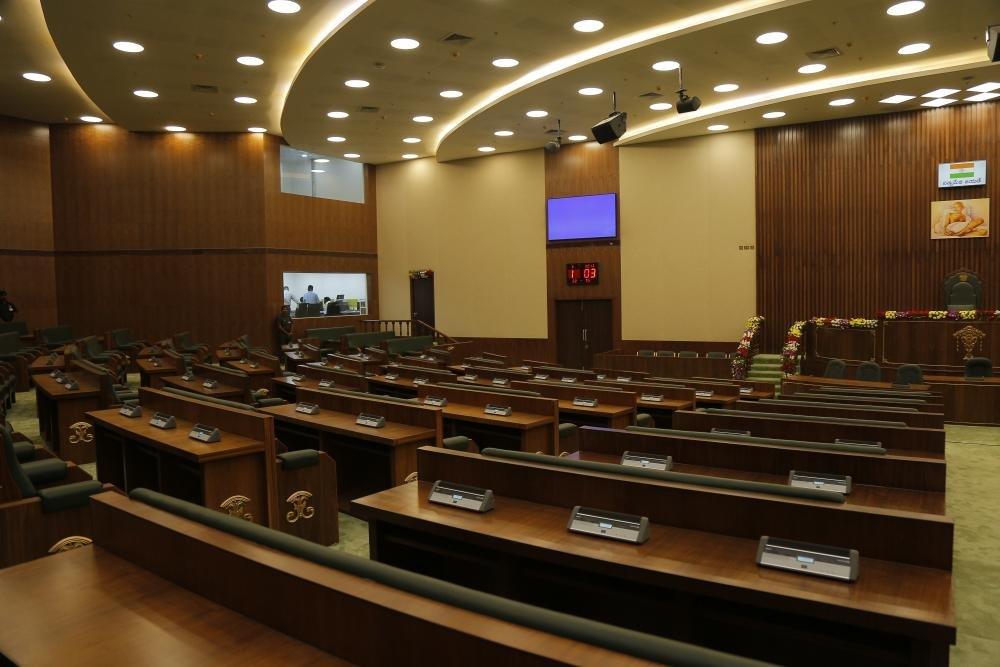
Photo: Andhra Pradesh Legislative Assembly, Kdslk, CC0

APPSC Group-I Mains 2025 · Paper III
2025 Paper III · Q4(b): model answer
Polity, Constitution, Governance, Law & Ethics · Parliament and State Legislatures. Held in May 2025 (Notification 12/2023).
In what aspects is the Legislative Council (Vidhan Parishad) different from the Rajya Sabha, considering its role at the state level?
Syllabus: Parliament and State Legislatures · State Legislatures, Legislative Councils and privileges
Legislative CouncilArticle 169Rajya SabhaBicameralism
Under Article 169, Parliament may create or abolish a State's Legislative Council if the Assembly passes a resolution by a special majority. Only six States have one: Andhra Pradesh, Telangana, Bihar, Karnataka, Maharashtra and Uttar Pradesh. Both the Council and the Rajya Sabha are upper Houses and continuing chambers, but the Rajya Sabha is a federal chamber with near-equal powers, while the Council is a revising chamber with only delaying powers.
| Basis | Rajya Sabha | Legislative Council |
|---|---|---|
| Existence | Essential part of Parliament (Art 79–80) | Optional; created or abolished by Parliament (Art 169) |
| Strength | Maximum 250: 238 elected, 12 nominated | One-third of the Assembly at most, minimum 40 (Art 171) |
| Election | By elected MLAs of States (and some UTs) | Mixed: local bodies, MLAs, graduates, teachers, nominees |
| Ordinary Bills | Equal power; joint sitting | Can delay 3 + 1 months; no joint sitting |
| Money Bills | Recommendations within 14 days | Recommendations within 14 days |
| Presiding officer | Vice-President, ex officio | Chairman elected by members (Art 182) |
1. Existence and composition
- Status: the Rajya Sabha is a permanent and essential House of Parliament. A Council depends on the Assembly's will, and the law creating or abolishing it is not treated as a constitutional amendment under Art 368. In both, members serve six years and one-third retire every two years.
- Representation: the Rajya Sabha represents the States, elected by the elected members of State Assemblies by proportional representation (Art 80(4)). A Council has functional representation (Art 171): one-third elected by local bodies, one-third by MLAs, one-twelfth each by graduates and teachers, and one-sixth nominated by the Governor from literature, science, art, the cooperative movement and social service.
2. Legislative and financial powers
- Ordinary Bills: the Rajya Sabha can reject a Bill, and a deadlock goes to a joint sitting (Art 108). A Council can only delay a Bill passed by the Assembly, for three months and then one month (Art 197); a Bill that originates in the Council and is rejected by the Assembly simply ends.
- Money Bills: both can only make recommendations within 14 days (Art 109, 198).
- Constitutional amendments: the Rajya Sabha must pass every amendment Bill by a special majority (Art 368(2)). The Council has no such role; it comes in only as part of the State Legislature when a federal amendment needs ratification by the Legislatures of half the States (proviso to Art 368(2)).
3. Federal, executive and electoral role
- Federal powers: only the Rajya Sabha can let Parliament legislate on a State subject (Art 249) or create new All India Services (Art 312).
- Executive control: in both cases ministers are collectively responsible only to the lower House (Art 75(3), 164(2)), but members of both upper Houses may ask questions and become ministers.
- Elections: elected Rajya Sabha members vote in the President's election and all members in the Vice-President's; Council members vote in neither, nor in Rajya Sabha elections.
- 1958 Council created for Andhra Pradesh
- 1985 Abolished by Parliament on the Assembly's resolution
- 2007 Revived
- 2020 Assembly resolves to abolish it again
- 2021 Resolution withdrawn; the 58-member Council continues
AP angle: In 2020, when the Council referred two Bills on decentralisation and the CRDA to a select committee, the Assembly re-passed them and they became law under Art 197; they were repealed in 2021. The episode showed both the Council's power to delay and its inability to block.
The Rajya Sabha is thus a co-equal federal chamber, while the Council is a chamber of second thought, useful for expert review but dependent on the Assembly for its very existence.
The other choice in Q4
Answer either one in the exam.
- Q4(a)What are the steps followed by the Indian Parliament in transforming a Bill into an Act?
10 marks · Parliament and State Legislatures · How a Bill becomes law; motions and House business
Every model answer on these pages is free to read. The Tool Kit adds four PDF books for Mains Papers I–IV: every previous question sorted by syllabus, with practice questions. It is in the ₹149 All-in-One Pass, with every previous paper of every exam on the site, practice quizzes, timed tests, mock test series and study books.
₹149 · valid for 12 months from the day you pay, on every exam · pay by UPI, card or net banking