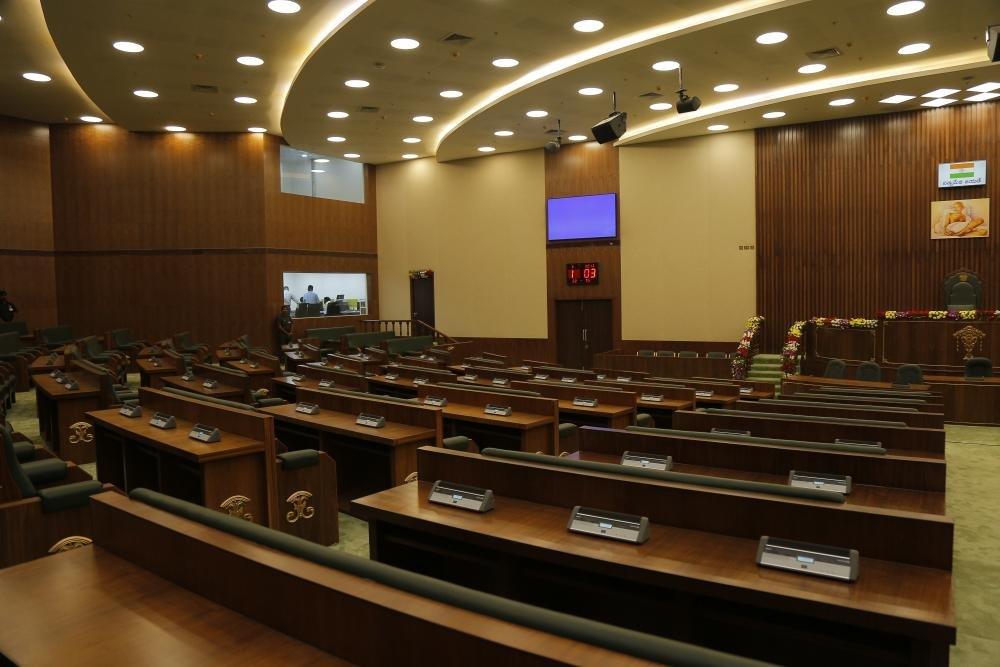
Photo: Andhra Pradesh Legislative Assembly, Kdslk, CC0

APPSC Group-I Mains 2025 · Paper III
2025 Paper III · Q1(b): model answer
Polity, Constitution, Governance, Law & Ethics · The Constitution and our rights. Held in May 2025 (Notification 12/2023).
The Indian Constitution favours a federal type of government. Considering this, what duties does the Constitution place on State Governments to ensure the smooth functioning of the nation?
Syllabus: The Constitution and our rights · Jobs and duties of the Union and State governments
Cooperative federalismArticles 256–257Union directionsArticle 365
The Constitution calls India a "Union of States" (Art 1). The Seventh Schedule gives States wide autonomy, yet the framers also placed definite constitutional duties on State Governments, so that 28 States act as parts of one nation rather than as rival units. Granville Austin called this blend of autonomy and obligation cooperative federalism; these duties are its legal backbone.
1. Administrative duties towards the Union
- Compliance with Union laws (Art 256): a State must use its executive power to ensure that laws made by Parliament are obeyed; the Union may give directions for this. States' police and revenue staff enforce central laws such as the Bharatiya Nyaya Sanhita and the National Food Security Act.
- Not impeding the Union (Art 257(1)): State executive power must not obstruct the Union's executive power.
- Communications and railways (Art 257(2)–(3)): when directed, States must maintain means of communication of national or military importance and protect railways in their territory; the Union pays any extra cost (Art 257(4)).
- Election duty (Art 324(6)): the Governor must make staff available to the Election Commission, which is why State officials conduct Lok Sabha polls.
| Article | Duty | Purpose |
|---|---|---|
| 256 | Ensure compliance with Parliament's laws | One rule of law |
| 257 | Not impede the Union; protect railways and national communications | Security and unity |
| 261 | Full faith and credit to public acts of Union and States | One legal space |
| 324(6) | Lend staff to the Election Commission | Free and fair elections |
| 350A | Primary education in the mother tongue for linguistic minorities | Minority protection |
| 243I, 243K | State Finance Commission and State Election Commission | Grassroots democracy |
2. Duties towards other States and the nation
- Full faith and credit (Art 261): public acts, records and judicial proceedings of the Union and every State must be recognised throughout India.
- Inter-State cooperation: States implement river-water tribunal awards (Art 262) and work through the Inter-State Council (Art 263, set up in 1990) and the Zonal Councils.
- Fiscal discipline (Art 293): a State indebted to the Union needs its consent to borrow; States have Fiscal Responsibility laws, such as the AP FRBM Act 2005.
- Shared decisions (Art 279A): States sit in the GST Council to keep one national market.
3. Social and democratic duties
- Directive Principles (Art 37): "fundamental in the governance" of the country, for example panchayats (Art 40), public health (Art 47) and environment (Art 48A).
- Weaker sections: promote the interests of SCs and STs (Art 46) and follow Union directions on schemes for STs (Art 339(2)).
- Local democracy (Parts IX and IXA): hold panchayat and municipal elections through a State Election Commission and set up a State Finance Commission every five years.
In return, the Union must protect every State against external aggression and internal disturbance (Art 355).
AP angle: Andhra Pradesh executes the Polavaram project, a national project under Section 90 of the AP Reorganisation Act 2014, on the Union's behalf; its State Disaster Management Authority works with the NDRF during cyclones, and it sits in the Southern Zonal Council.
The Sarkaria (1988) and Punchhi (2010) Commissions stressed consultation over coercion: when States perform these duties willingly and the Union respects their autonomy, national unity and State autonomy reinforce each other.
The other choice in Q1
Answer either one in the exam.
- Q1(a)What are the emergency functions of the Union Government of India? Describe how they impact the legislative powers of Parliament and State Legislatures.
10 marks · The Constitution and our rights · Emergency powers and changing (amending) the Constitution
Every model answer on these pages is free to read. The Tool Kit adds four PDF books for Mains Papers I–IV: every previous question sorted by syllabus, with practice questions. It is in the ₹149 All-in-One Pass, with every previous paper of every exam on the site, practice quizzes, timed tests, mock test series and study books.
₹149 · valid for 12 months from the day you pay, on every exam · pay by UPI, card or net banking