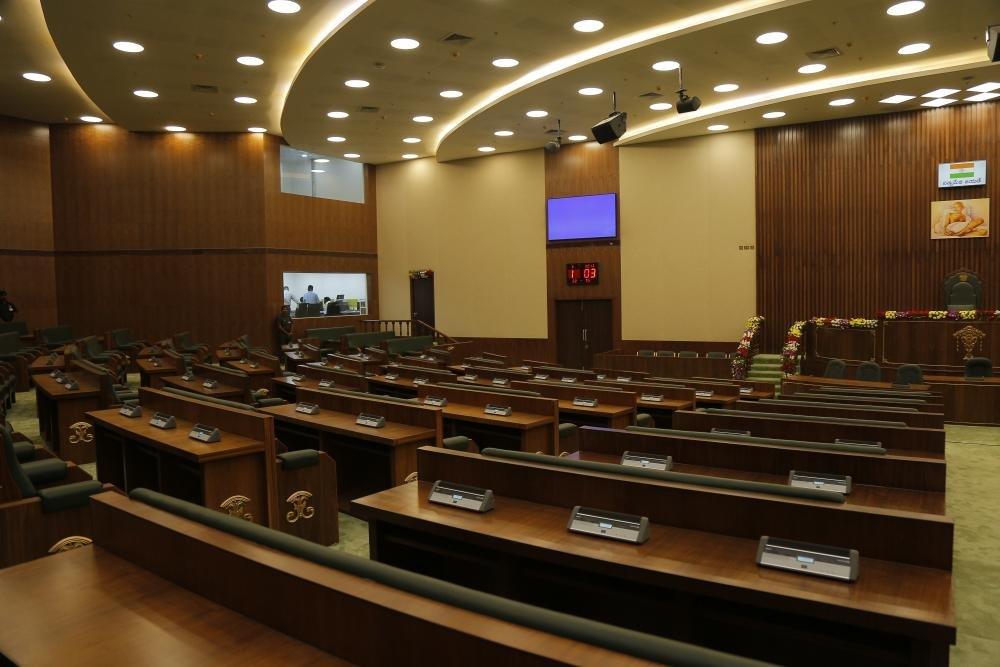
Photo: Andhra Pradesh Legislative Assembly, Kdslk, CC0

APPSC Group-I Mains 2025 · Paper III
2025 Paper III · Q2(a): model answer
Polity, Constitution, Governance, Law & Ethics · Centre and States: sharing power and money. Held in May 2025 (Notification 12/2023).
The procedure of enacting a law from a bill differs at the Union and State levels, primarily to safeguard the interests of the Union Government in state legislation. Elucidate this aspect.
Syllabus: Centre and States: sharing power and money · Who makes which laws: Union, State and Concurrent Lists
State legislative procedureGovernor's reservationArticles 200–201Union primacy
A Union Bill becomes law once both Houses pass it and the President gives assent (Art 111). A State Bill (Art 196–201) passes through an extra Union filter: the Governor, appointed by the President (Art 155) and holding office during his pleasure (Art 156), who may reserve it for the President acting on the Union Cabinet's advice. This asymmetry reflects India's "holding together" federation, where national unity and uniform law take priority.
1. How the two procedures differ
| Stage | Union Bill | State Bill |
|---|---|---|
| Upper House | Rajya Sabha nearly equal; joint sitting (Art 108) | Council can only delay, 3 + 1 months (Art 197) |
| Assent | President alone (Art 111) | Governor, who may reserve for the President (Art 200) |
| Re-passed Bill | President must assent | President not bound (Art 201) |
| Outside check | No State role, except ratifying federal amendments (Art 368(2)) | Union reviews through the Governor and the President |
2. Safeguards for Union interests
- Discretionary reservation (Art 200): the Governor may reserve any Bill; reservation is compulsory if it would endanger the position of the High Court.
- Absolute veto (Art 201): the President may withhold assent; a returned non-Money Bill must be reconsidered within six months, yet assent is still not obligatory, and no time limit is laid down.
- Prior sanction or assent: Bills restricting inter-State trade need the President's previous sanction (Art 304(b)); a State law repugnant to a central law on a Concurrent subject prevails only with presidential assent (Art 254(2)); laws under Art 31A and 31C, and State taxes on water or electricity of Union authorities (Art 288), are protected only after reservation.
- Financial Emergency (Art 360): State Money Bills may have to be reserved for the President.
3. Judicial balancing
- Punjab Governor case (2023): the Supreme Court held that a Governor cannot sit on Bills indefinitely; withholding means returning the Bill to the House.
- Tamil Nadu Governor case (8 April 2025): a two-judge Bench fixed timelines for the Governor and the President and, using Art 142, deemed ten re-passed Bills to have received assent; this led to a Presidential Reference.
- Presidential Reference opinion (Art 143, November 2025): a five-judge Bench held that courts cannot fix timelines or grant "deemed assent", but prolonged, unexplained inaction is open to limited judicial review.
AP angle: The AP Disha Bill 2019, which amended central criminal laws on a Concurrent subject, was sent for the President's assent, showing how Art 254(2) brings State laws under Union review.
4. Assessment
- Justification: uniform laws on Concurrent subjects, protection of the High Court, a single national market and a check on unconstitutional Bills.
- Criticism: the Governor may act as an agent of the Union, and long delays over Bills have strained Centre–State relations.
These safeguards protect national uniformity, but, as the Sarkaria and Punchhi Commissions advised, reservation should be rare and decisions timely, so that cooperative federalism is not reduced to Union control.
The other choice in Q2
Answer either one in the exam.
- Q2(b)Although States have their separate list for law-making, this authority is not beyond the overarching legislative powers of the Parliament. Examine.
10 marks · Centre and States: sharing power and money · Who makes which laws: Union, State and Concurrent Lists
Every model answer on these pages is free to read. The Tool Kit adds four PDF books for Mains Papers I–IV: every previous question sorted by syllabus, with practice questions. It is in the ₹149 All-in-One Pass, with every previous paper of every exam on the site, practice quizzes, timed tests, mock test series and study books.
₹149 · valid for 12 months from the day you pay, on every exam · pay by UPI, card or net banking