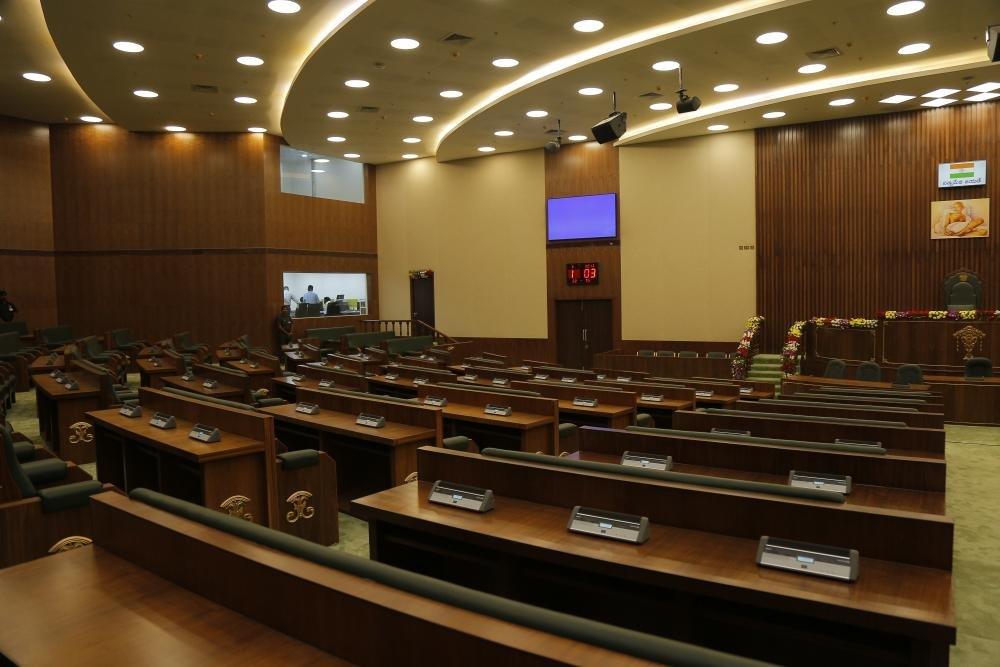
Photo: Andhra Pradesh Legislative Assembly, Kdslk, CC0

APPSC Group-I Mains 2025 · Paper III
2025 Paper III · Q2(b): model answer
Polity, Constitution, Governance, Law & Ethics · Centre and States: sharing power and money. Held in May 2025 (Notification 12/2023).
Although States have their separate list for law-making, this authority is not beyond the overarching legislative powers of the Parliament. Examine.
Syllabus: Centre and States: sharing power and money · Who makes which laws: Union, State and Concurrent Lists
Seventh ScheduleParliamentary supremacyArticles 249–253State autonomy
Article 246 and the Seventh Schedule divide legislative power among the Union, State and Concurrent Lists (originally 97, 66 and 47 subjects). States have exclusive power over the State List in normal times, but the scheme is tilted towards the Centre: Parliament can enter the State field in several situations, and its law prevails in a conflict. This reflects India's centralised federation built for unity and integrity.
1. Parliament's power over State subjects
- National interest (Art 249): if the Rajya Sabha resolves by two-thirds of members present and voting, Parliament may legislate on a State subject for one year, renewable; the law lapses six months after the resolution ends.
- Consent of States (Art 252): when two or more States request it, Parliament may legislate for them, and other States may adopt the law; only Parliament can then amend it. Examples: Wild Life (Protection) Act 1972 and Water (Prevention and Control of Pollution) Act 1974.
- International agreements (Art 253): Parliament can implement treaties even on State subjects, as in the Environment (Protection) Act 1986, which followed the Stockholm Conference (1972).
- Emergencies: during a National Emergency (Art 250) and President's Rule (Art 356–357), Parliament can legislate on any State subject.
| Article | Situation | Condition | Example |
|---|---|---|---|
| 249 | National interest | Rajya Sabha resolution; one year, renewable | Any State subject named in the resolution |
| 250 | National Emergency | Laws lapse six months after the emergency | Any State subject |
| 252 | Request of two or more States | Applies to consenting and adopting States | Wild Life (Protection) Act 1972 |
| 253 | Treaties and international decisions | No time limit | Environment (Protection) Act 1986 |
| 356–357 | President's Rule | Laws continue until the State changes them | State budget passed by Parliament |
2. Supremacy in conflicts and structure
- Federal supremacy (Art 246(1), 254(1)): the Union List prevails over the State List, and a central law prevails over a State law on a Concurrent subject; even when a State law gets assent under Art 254(2), Parliament can later override it.
- Shifting the lists: the 42nd Amendment (1976) moved education, forests, weights and measures, protection of wild animals and birds, and administration of justice from the State List to the Concurrent List.
- Reservation of State Bills (Art 200–201): the Union can veto State laws through the President.
- Reorganisation (Art 3): Parliament can alter State boundaries; the views of the State Legislature are not binding (Babulal Parate, 1960).
3. Limits on this overarching power
- Doctrines: courts apply pith and substance and strike down colourable legislation, protecting the State field.
- Federalism is basic structure (S.R. Bommai, 1994): Parliament cannot destroy the States' sphere.
- Ratification: in Union of India v Rajendra N. Shah (2021), the 97th Amendment's provisions on State cooperative societies were struck down for lack of ratification by half the States.
- Taxing powers: in Mineral Area Development Authority (2024), a nine-judge Bench held that States can tax mineral rights.
AP angle: The AP Reorganisation Act 2014 was enacted under Art 3 although the AP Assembly had rejected the draft Bill, showing that even a State's territory lies within Parliament's power.
State autonomy is thus real but subordinate to the national interest. Sparing use of Art 249 and 252, and consultation through a stronger Inter-State Council (Art 263), as the Punchhi Commission urged, can balance unity with diversity.
The other choice in Q2
Answer either one in the exam.
- Q2(a)The procedure of enacting a law from a bill differs at the Union and State levels, primarily to safeguard the interests of the Union Government in state legislation. Elucidate this aspect.
10 marks · Centre and States: sharing power and money · Who makes which laws: Union, State and Concurrent Lists
Every model answer on these pages is free to read. The Tool Kit adds four PDF books for Mains Papers I–IV: every previous question sorted by syllabus, with practice questions. It is in the ₹149 All-in-One Pass, with every previous paper of every exam on the site, practice quizzes, timed tests, mock test series and study books.
₹149 · valid for 12 months from the day you pay, on every exam · pay by UPI, card or net banking