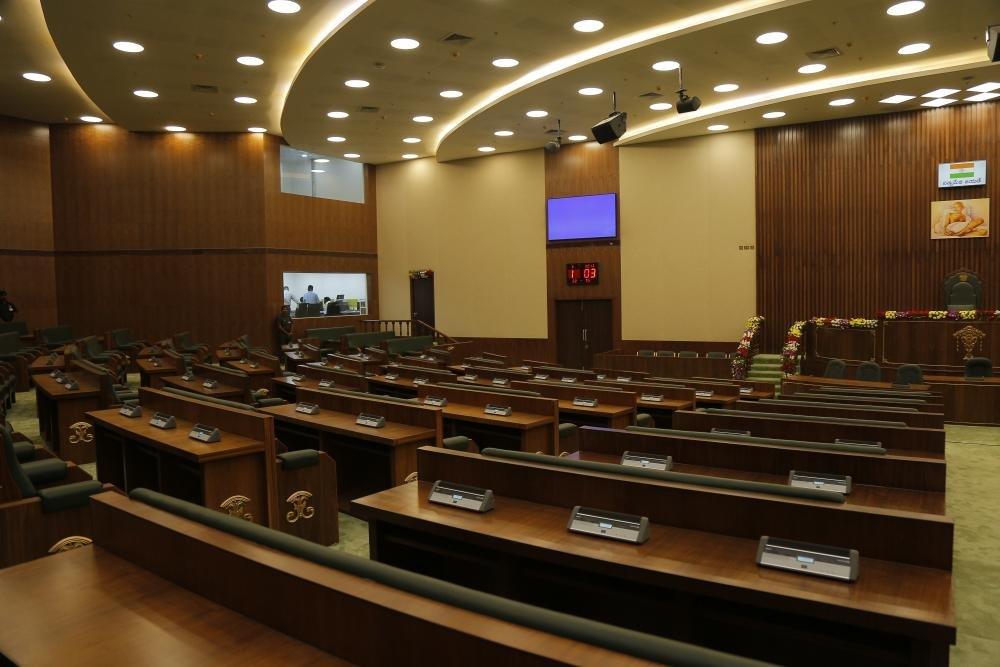
Photo: Andhra Pradesh Legislative Assembly, Kdslk, CC0

APPSC Group-I Mains 2025 · Paper III
2025 Paper III · Q7(b): model answer
Polity, Constitution, Governance, Law & Ethics · Running the government: administration, policies and civil services. Held in May 2025 (Notification 12/2023).
Although policies formulated by departments are prepared by experts, the results often fall short of expectations. What are the major issues responsible for this gap between policy formulation and implementation?
Syllabus: Running the government: administration, policies and civil services · Government development policies and why implementation falls short
Implementation gapStreet-level bureaucracyLast-mile deliveryOutcome monitoring
The policy–implementation gap is the distance between a policy's stated goals and its actual outcomes. In their classic study "Implementation" (1973), Pressman and Wildavsky showed how a well-funded programme failed as it passed through many agencies and decision points. In India, the gap was captured in the oft-quoted 1985 remark of Prime Minister Rajiv Gandhi that only about 15 paise of every rupee reached the intended beneficiary.
1. Design-stage issues
- Top-down design: policies made centrally without field consultation ignore local diversity; uniform norms and unit costs do not suit hilly, tribal or urban areas alike.
- Rigid schemes: many Centrally Sponsored Schemes overlap and leave States little flexibility, which is why they were rationalised into core and optional schemes in 2016.
- No piloting: schemes are scaled up nationwide without testing, so design flaws surface late.
2. Administrative and capacity issues
- Weak field capacity: vacancies, poorly trained frontline staff and frequent transfers break continuity. Lipsky's idea of street-level bureaucrats shows that frontline staff, through their discretion, often decide what a policy becomes.
- Silos: departments work in isolation, so convergence of schemes on the same household is rare.
- Fund flow problems: delayed releases and unspent balances, now partly addressed through SNA-SPARSH.
- Leakages and corruption: middlemen, ghost beneficiaries and inclusion-exclusion errors, as in the PDS before Aadhaar seeding.
3. Monitoring and participation issues
- Output, not outcome: counting toilets built or money spent rather than toilets used or learning achieved.
- Low citizen participation: beneficiaries are unaware of entitlements, and grievance redress is weak.
- Political and legal hurdles: short-term priorities, litigation and land acquisition delays.
- Information gaps: policy-makers lack timely field data, so problems surface only after damage is done.
| Issue | Example | Remedy |
|---|---|---|
| Top-down design | Uniform norms across terrains | Consultation, pilots, State flexibility |
| Weak capacity | Vacancies, frequent transfers | Mission Karmayogi, stable tenures |
| Leakages | Ghost beneficiaries | Direct Benefit Transfer, social audit |
| Output focus | Toilets built, not used | Outcome budgets, independent evaluation |
| Fund delays | Unspent balances | Just-in-time release (SNA-SPARSH) |
4. Bridging the gap
- Evidence-based policy: NITI Aayog's Development Monitoring and Evaluation Office (DMEO) evaluates schemes.
- Outcome tracking: the Aspirational Districts Programme (2018) ranks districts on outcome indicators, and PRAGATI reviews stalled projects.
- Accountability tools: Direct Benefit Transfer, social audits, citizen charters and capacity building under Mission Karmayogi.
AP angle: The long delays and cost escalation of the Polavaram project show how rehabilitation, funding and coordination problems widen the gap. Village and ward secretariats (2019), Real Time Governance dashboards and WhatsApp governance (Mana Mitra, 2025) aim to close last-mile gaps.
Expert design is necessary but not sufficient: participatory planning, capable field institutions and outcome monitoring turn plans into results at the citizen's doorstep.
The other choice in Q7
Answer either one in the exam.
- Q7(a)Education is a vital sector for boosting the development of any nation. Highlight the recent developments in the education policy of the Indian government.
10 marks · Running the government: administration, policies and civil services · Government development policies and why implementation falls short
Every model answer on these pages is free to read. The Tool Kit adds four PDF books for Mains Papers I–IV: every previous question sorted by syllabus, with practice questions. It is in the ₹149 All-in-One Pass, with every previous paper of every exam on the site, practice quizzes, timed tests, mock test series and study books.
₹149 · valid for 12 months from the day you pay, on every exam · pay by UPI, card or net banking