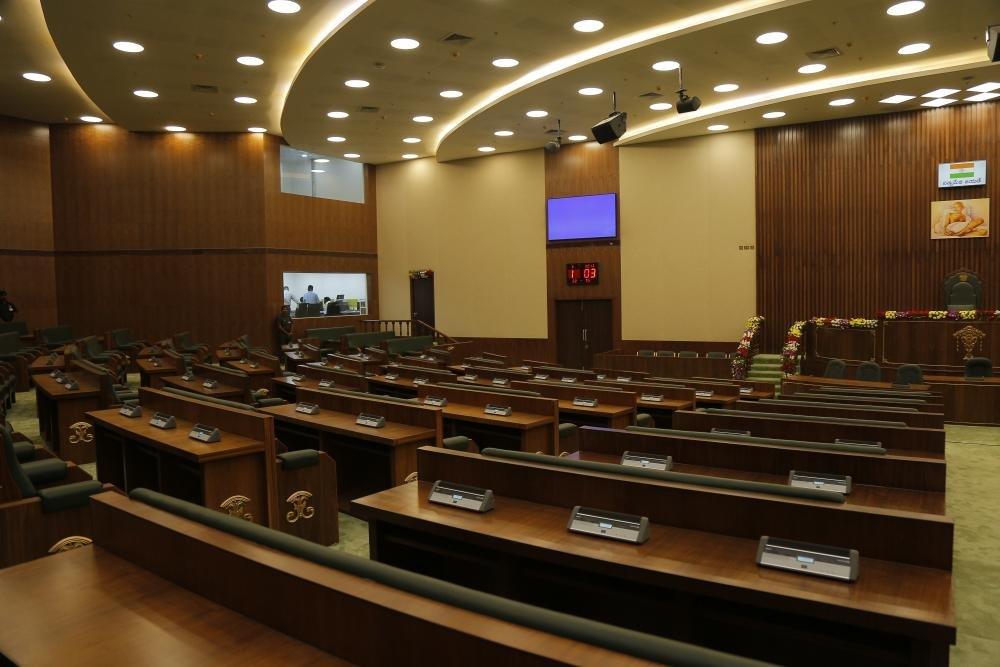
Photo: Andhra Pradesh Legislative Assembly, Kdslk, CC0

APPSC Group-I Mains 2025 · Paper III
2025 Paper III · Q5(b): model answer
Polity, Constitution, Governance, Law & Ethics · Courts and judicial review. Held in May 2025 (Notification 12/2023).
Discuss any two constitutional amendments that have significantly affected the powers or functioning of the Indian judiciary.
Syllabus: Courts and judicial review · How courts are organised; amendments affecting the courts
Judicial independence42nd Amendment99th AmendmentBasic structure
The judiciary's powers rest on judicial review and on Articles 32, 136 and 226. Parliament has often used its amending power under Article 368 to reshape these powers, and the Supreme Court has replied with the basic structure doctrine (Kesavananda Bharati, 1973). Two amendments stand out: the 42nd (1976), which curtailed judicial review, and the 99th (2014), which sought to change how judges are appointed.
- 1973 Kesavananda Bharati: basic structure doctrine
- 1976 42nd Amendment curbs judicial review
- 1977–78 43rd and 44th Amendments undo most curbs
- 1980 Minerva Mills strikes down Art 368(4) and (5)
- 1993 Second Judges case creates the collegium
- 2014 99th Amendment sets up the NJAC
- 2015 Fourth Judges case strikes down the NJAC
1. 42nd Amendment Act, 1976: curtailing judicial review
- Limits on writ and review powers: inserted Art 32A (the Supreme Court could not examine State laws in Art 32 cases), Art 131A (exclusive Supreme Court jurisdiction over the validity of central laws), Art 144A (at least seven judges and a two-thirds majority to invalidate a law) and Art 226A, and narrowed the High Courts' writ jurisdiction.
- Amendments beyond review: added Art 368(4) and (5), declaring that no amendment could be questioned in any court and that Parliament's amending power was unlimited.
- Tribunals: inserted Art 323A and 323B, enabling tribunals to take over service, tax and other disputes from High Courts.
- Impact: the judiciary's role as guardian of rights was weakened during the Emergency. The 43rd (1977) and 44th (1978) Amendments undid most changes; Minerva Mills (1980) struck down Art 368(4) and (5), holding limited amending power to be a basic feature, and L. Chandra Kumar (1997) brought tribunal decisions under High Court review.
- Lasting effect: tribunals survive, and Art 39A (free legal aid), added by the same amendment, widened access to justice.
2. 99th Amendment Act, 2014: National Judicial Appointments Commission
- Context: the collegium system, created by the Second Judges case (1993) and refined in the Third Judges case (1998), was criticised as opaque.
- What changed: Art 124A–124C set up a six-member NJAC: the Chief Justice of India, the two senior-most judges, the Union Law Minister and two eminent persons; any two members could block a recommendation.
- Impact: in SCAORA v Union of India (2015), the Fourth Judges case, the Supreme Court struck it down 4:1 as violating judicial independence, a basic feature, and the collegium was restored. The Court asked for a revised Memorandum of Procedure to improve transparency.
3. Combined significance
- Basic structure as a shield: both attempts failed because judicial review and judicial independence are basic features beyond Parliament's amending power.
- Institutional dialogue: Parliament amends and the courts review, a balance that keeps both accountable.
| Basis | 42nd Amendment (1976) | 99th Amendment (2014) |
|---|---|---|
| Aim | Curb judicial review | Change the appointment of judges |
| Key provisions | Art 32A, 131A, 144A, 226A; Art 368(4)–(5); Art 323A–323B | Art 124A–124C: six-member NJAC |
| Judicial response | Minerva Mills (1980); L. Chandra Kumar (1997) | SCAORA (2015), 4:1 |
| Lasting effect | Tribunals; Art 39A legal aid | Collegium continues |
AP angle: Art 371D, added for Andhra Pradesh by the 32nd Amendment (1973), allowed the State Government to modify or annul orders of the AP Administrative Tribunal; in P. Sambamurthy (decided December 1986, reported 1987) the Supreme Court struck down clause (5) and its proviso for denying effective judicial review.
Both episodes show that the basic structure doctrine protects judicial independence. Transparent appointments and timely filling of vacancies remain the way to keep the judiciary both independent and accountable.
The other choice in Q5
Answer either one in the exam.
- Q5(a)The Constitution of India grants certain rights to citizens and also provides measures to safeguard them. What are the key constitutional arrangements to ensure the protection of these rights?
10 marks · The Constitution and our rights · Fundamental Rights, Directive Principles and how rights are protected
Every model answer on these pages is free to read. The Tool Kit adds four PDF books for Mains Papers I–IV: every previous question sorted by syllabus, with practice questions. It is in the ₹149 All-in-One Pass, with every previous paper of every exam on the site, practice quizzes, timed tests, mock test series and study books.
₹149 · valid for 12 months from the day you pay, on every exam · pay by UPI, card or net banking