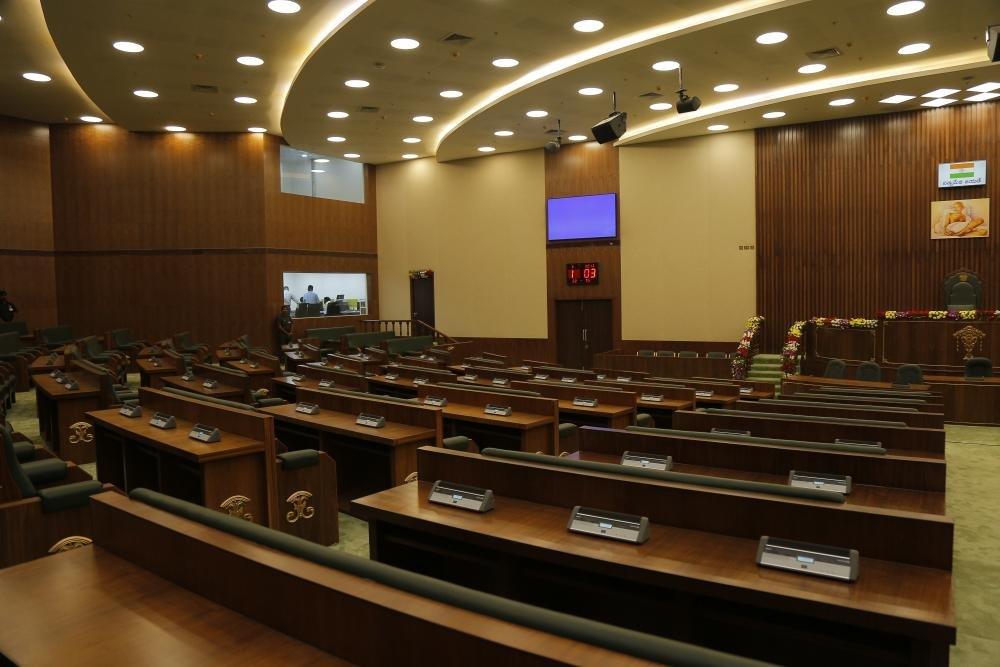
Photo: Andhra Pradesh Legislative Assembly, Kdslk, CC0

APPSC Group-I Mains 2023 · Paper III: Polity, Constitution, Governance, Law & Ethics
APPSC Group 1 Mains 2023 Paper III with model answers
Held in June 2023 (Notification 28/2022). 15 questions with an internal choice (a) or (b), 10 marks each, so 30 questions in all. Tap a question for its model answer.
Tap a question to open its model answer on its own page. Every model answer is free. Answers are by Learn with Anil (Jupudi Anil Kumar), not by APPSC; facts as of October 2026.
Paper III: Polity, Constitution, Governance, Law & Ethics
30 questions, 10 marks each
- Q1(a)Examine the scope of 'reasonable restrictions' and the 'test of reasonableness' in connection with Article 19 of the Indian Constitution.
10 marks · The Constitution and our rights · Fundamental Rights, Directive Principles and how rights are protected
- Q1(b)Explain the genesis of the Inter-State Council and discuss its relevance in the context of Centre-State and Inter-State coordination and cooperation in India.
10 marks · Centre and States: sharing power and money · Federalism: a strong Centre, Centre–State friction and cooperation
- Q2(a)The office of the Governor in certain situations carries with it the exercise of discretionary functions and special responsibilities. Discuss this statement in view of the constitutional provisions.
10 marks · Centre and States: sharing power and money · The Governor's role and powers
- Q2(b)The National Education Policy (2020) has been criticized as denuding the autonomy of states. In this connection, examine the rationale behind the transfer of matters from the State list to the Concurrent list.
10 marks · Centre and States: sharing power and money · Who makes which laws: Union, State and Concurrent Lists
- Q3(a)Discuss the scope and challenges involved in the political empowerment of women through the Panchayat Raj. Briefly suggest on how to enhance women empowerment in rural and urban local governance.
10 marks · Panchayats and municipalities · Women and weaker sections in local bodies
- Q3(b)'The Finance Commission, though not being a permanent body, has still maintained its credibility by promoting fiscal democracy in India,' - Comment.
10 marks · Centre and States: sharing power and money · Sharing money: Finance Commission and fiscal federalism
- Q4(a)Briefly discuss the different kinds of motions used to discuss matters in the Parliament. Comment on the difference between motions and resolutions.
10 marks · Parliament and State Legislatures · How a Bill becomes law; motions and House business
- Q4(b)Describe the matters in which the Legislative Council stands equal with the Legislative Assembly along with the matters in which it stands unequal with the Legislative Assembly.
10 marks · Parliament and State Legislatures · State Legislatures, Legislative Councils and privileges
- Q5(a)Discuss the scope of Judicial review in reviewing administrative action, legislative enactments and judicial decisions.
10 marks · Courts and judicial review · Judicial review: courts checking laws and orders
- Q5(b)What is meant by Public Interest Litigation (PIL)? Describe the nature of court orders that are passed by courts in PIL cases.
10 marks · Courts and judicial review · Public Interest Litigation (PIL) and judicial activism
- Q6(a)'The concept of the welfare state had been crystallised in Kautilya's ideas long before it came to be envisioned in Western Europe' - Examine this statement.
10 marks · Running the government: administration, policies and civil services · What public administration is and its history (Kautilya to British rule)
- Q6(b)It is observed that much of present-day Indian bureaucracy is a result of British administration. In this connection, explain the evolution of Civil Service in India.
10 marks · Running the government: administration, policies and civil services · What public administration is and its history (Kautilya to British rule)
- Q7(a)Government's intervention in development has seen a long way of impressive outcomes in India. In this connection, discuss the Atmanirbhar Bharat mission aimed at making India Self- Reliant.
10 marks · Running the government: administration, policies and civil services · Government development policies and why implementation falls short
- Q7(b)Explain the scope of civil service reforms in India with a brief note on Mission Karmayogi.
10 marks · Running the government: administration, policies and civil services · Civil services: role, reforms and integrity
- Q8(a)The making of the Right to Information Act, 2005 in India has been largely attributed to the success of civil society movement. Comment.
10 marks · Good governance and the citizen's voice · Right to Information (RTI) and Public Service Act
- Q8(b)“NGOs play a critical role in promoting human rights, defending the marginalized, and creating a more just and equitable society.ˮ Comment on the role of NGO's in India.
10 marks · Good governance and the citizen's voice · Civil society and NGOs
- Q9(a)Explain the quasi-judicial nature of Administrative Tribunals. Examine whether writs and appeals are available against the decisions of the Administrative Tribunals.
10 marks · Running the government: administration, policies and civil services · Statutory, regulatory and quasi-judicial bodies (commissions, tribunals)
- Q9(b)What are the reasons for decline of integrity in civil services? Also, discuss the institutional mechanism to check corruption in India.
10 marks · Running the government: administration, policies and civil services · Civil services: role, reforms and integrity
- Q10(a)Discuss the Indian experience of Citizen Charter movement and suggest solutions to improve its impact in India.
10 marks · Good governance and the citizen's voice · Good governance, e-governance and Citizen's Charter
- Q10(b)What are the different dimensions of governance? Briefly explain the administrative dimension of governance and its key components.
10 marks · Good governance and the citizen's voice · Good governance, e-governance and Citizen's Charter
- Q11(a)Ethics in public service is an essential component of parliamentary democracy. In this connection, discuss the pathway towards a 'Naitik Bharat'.
10 marks · Ethics for public servants · Ethics basics; integrity and accountability in public and private life
- Q11(b)Define Accountability. Discuss the factors that have led to weakening of accountability in civil services. Suggest ways to improve the mechanisms for accountability in civil services.
10 marks · Ethics for public servants · Ethics basics; integrity and accountability in public and private life
- Q12(a)Discuss the significance of values in the development of personality and socio-cultural systems. Add a brief note on the hierarchy of values in India.
10 marks · Ethics for public servants · Human values: family, education, gender equality, great leaders
- Q12(b)Vinoba Bhave's reform ideology had helped to nurture an ethical atmosphere in Indian public life. In this connection, evaluate the relevance of Vinoba Bhave's ideology in modern times.
10 marks · Ethics for public servants · Human values: family, education, gender equality, great leaders
- Q13(a)Do attitudes influence behaviour? Discuss the polarization of political attitudes in India.
10 marks · Ethics for public servants · Attitude, persuasion and emotional intelligence
- Q13(b)Define Persuasion and its constructs? Can the power of persuasion be used by civil servants in order to realize the ends and objectives of a 'New India'? Substantiate.
10 marks · Ethics for public servants · Attitude, persuasion and emotional intelligence
- Q14(a)Does popular democracy breed distrust in the public towards their representatives? Discuss the scope of ethical leadership in democracy and politics.
10 marks · Ethics for public servants · Public-service ethics: codes, leadership, corruption, Lokpal, international ethics
- Q14(b)What is meant by 'International Ethics'? Explain the significance of [illegible] international dispute resolutions and environmental cooperation among nations.
10 marks · Ethics for public servants · Public-service ethics: codes, leadership, corruption, Lokpal, international ethics
- Q15(a)[illegible] 'Substantive Law and Procedural Law' Discuss the interrelationship and differences between Substantive Law and Procedural Law.
10 marks · Everyday laws: civil, criminal, labour, cyber and tax · Civil and criminal law and courts (new criminal laws, Nirbhaya Act)
- Q15(b)Are Direct Taxes transferable or non-transferable? Explain the recent Direct Tax Reforms undertaken in India.
10 marks · Everyday laws: civil, criminal, labour, cyber and tax · Tax laws: income tax, corporate tax, GST
All Mains PYQs, year-wise and subject-wise
Every model answer on these pages is free to read. The Tool Kit adds four PDF books for Mains Papers I–IV: every previous question sorted by syllabus, with practice questions. It is in the ₹149 All-in-One Pass, with every previous paper of every exam on the site, practice quizzes, timed tests, mock test series and study books.
₹149 · valid for 12 months from the day you pay, on every exam · pay by UPI, card or net banking