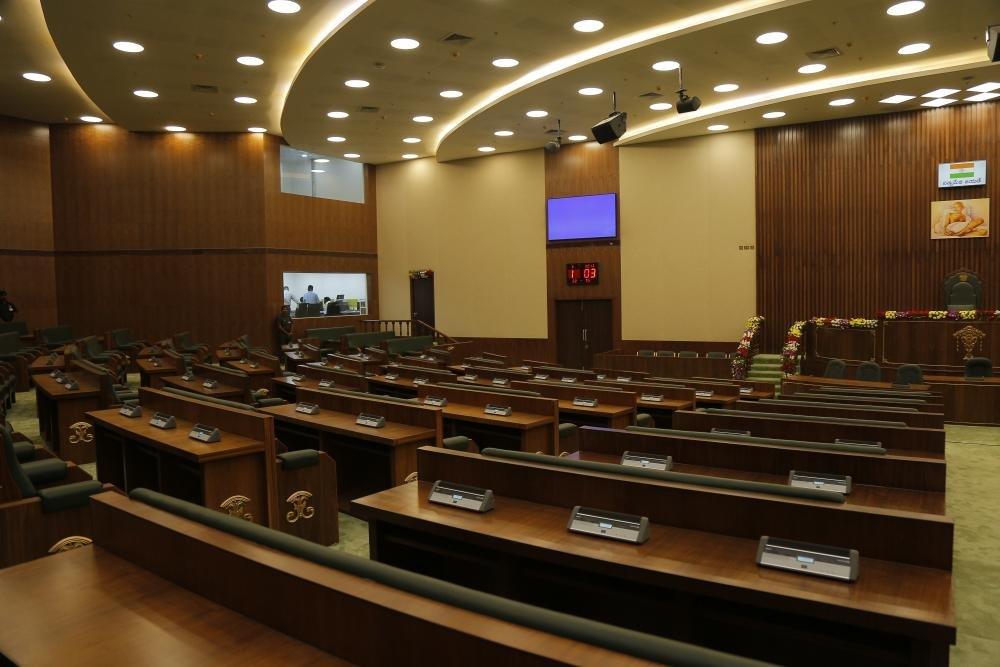
Photo: Andhra Pradesh Legislative Assembly, Kdslk, CC0

APPSC Group-I Mains 2023 · Paper III
2023 Paper III · Q4(b): model answer
Polity, Constitution, Governance, Law & Ethics · Parliament and State Legislatures. Held in June 2023 (Notification 28/2022).
Describe the matters in which the Legislative Council stands equal with the Legislative Assembly along with the matters in which it stands unequal with the Legislative Assembly.
Syllabus: Parliament and State Legislatures · State Legislatures, Legislative Councils and privileges
Legislative CouncilArticles 168-171BicameralismArticle 169
Under Articles 168-169, a State may have a Legislative Council as a second chamber. Six States have one: Andhra Pradesh, Telangana, Karnataka, Maharashtra, Bihar and Uttar Pradesh. Its strength cannot exceed one-third of the Assembly's or fall below 40 (Article 171), and its members are partly elected by local bodies, graduates, teachers and MLAs and partly nominated by the Governor. The Council is a revising chamber that stands equal to the Assembly in some matters and clearly unequal in others.
1. Matters in which the Council is equal
- Ordinary Bills may be introduced in either House.
- Ordinances issued by the Governor (Article 213) must be laid before both Houses.
- Ministers, including the Chief Minister, may be drawn from either House.
- Reports of the State Finance Commission, the State Public Service Commission and the CAG are considered by both Houses.
- Enlarging the jurisdiction of the State Public Service Commission needs approval of both Houses.
2. Matters in which the Council is unequal
- Money Bills and Budget: a Money Bill is introduced only in the Assembly; the Council can only make recommendations within 14 days (Article 198), and the Speaker decides whether a Bill is a Money Bill (Article 199). The Council discusses the Budget but cannot vote on demands for grants.
- Ordinary Bills: the Council can delay a Bill passed by the Assembly for at most three months the first time and one month the second (Article 197); there is no joint sitting, so the Assembly prevails. A Bill originating in the Council and rejected by the Assembly simply ends.
- Ministerial responsibility: the Council of Ministers is responsible only to the Assembly (Article 164(2)).
- Elections: only elected MLAs vote in the elections of the President and of Rajya Sabha members.
- Survival: Parliament creates or abolishes a Council by law on an Assembly resolution passed by a special majority (Article 169).
| Matter | Legislative Council | Legislative Assembly |
|---|---|---|
| Ordinary Bill | Can delay up to 3 + 1 months | Final say |
| Money Bill | Recommends within 14 days | Exclusive power |
| Demands for grants | Discussion only | Votes on them |
| No-confidence motion | Not possible | Ministry responsible to it |
| Existence | Optional; created or abolished on Assembly resolution (Art. 169) | Required in every State (Art. 168) |
- 1958 Council created
- 1985 Abolished
- 2007 Revived
- January 2020 Assembly resolution seeking abolition
- November 2021 Resolution withdrawn; Council continues
3. Assessment
- Merits: graduates, teachers and nominated experts bring knowledge to debates, and the Council gives a second look at hasty legislation.
- Criticism: it can only delay, adds to cost, and is sometimes used to accommodate those who lose elections.
AP angle: AP's Council has 58 members. The timeline shows its dependence on the Assembly: it has been created, abolished, revived and nearly abolished again by Assembly resolutions under Article 169.
As a revising chamber, the Council adds expertise and second thought to State law-making; a national policy on Councils would end their ad hoc creation and abolition.
The other choice in Q4
Answer either one in the exam.
- Q4(a)Briefly discuss the different kinds of motions used to discuss matters in the Parliament. Comment on the difference between motions and resolutions.
10 marks · Parliament and State Legislatures · How a Bill becomes law; motions and House business
Every model answer on these pages is free to read. The Tool Kit adds four PDF books for Mains Papers I–IV: every previous question sorted by syllabus, with practice questions. It is in the ₹149 All-in-One Pass, with every previous paper of every exam on the site, practice quizzes, timed tests, mock test series and study books.
₹149 · valid for 12 months from the day you pay, on every exam · pay by UPI, card or net banking