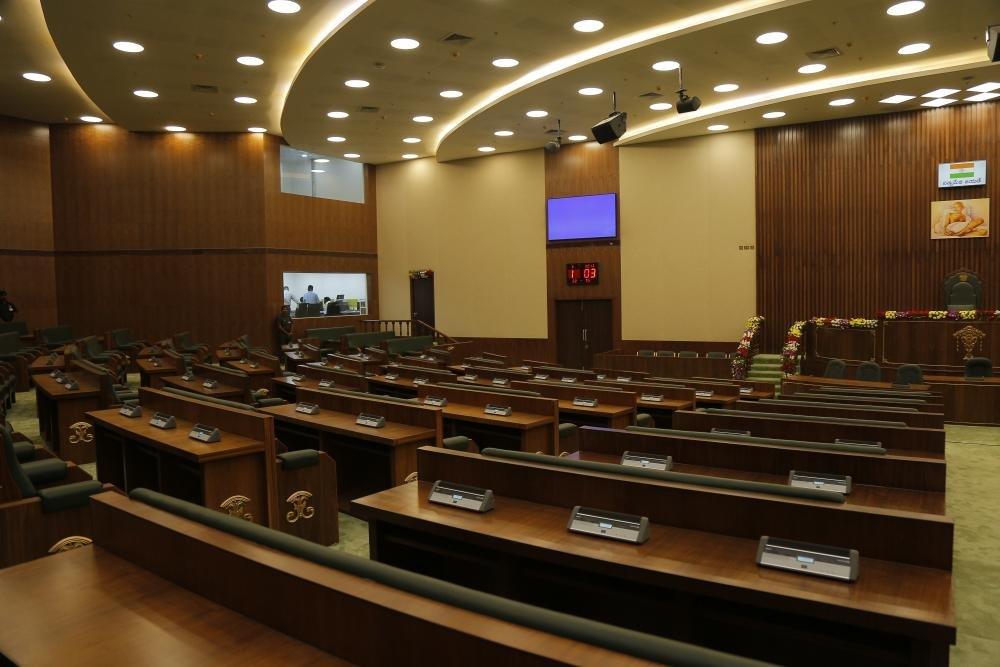
Photo: Andhra Pradesh Legislative Assembly, Kdslk, CC0

APPSC Group-I Mains 2023 · Paper III
2023 Paper III · Q4(a): model answer
Polity, Constitution, Governance, Law & Ethics · Parliament and State Legislatures. Held in June 2023 (Notification 28/2022).
Briefly discuss the different kinds of motions used to discuss matters in the Parliament. Comment on the difference between motions and resolutions.
Syllabus: Parliament and State Legislatures · How a Bill becomes law; motions and House business
MotionsResolutionsParliamentary procedureExecutive accountability
A motion is a formal proposal made by a member for eliciting a decision of the House. No discussion on a matter of general public importance can take place in Parliament except on a motion moved with the consent of the presiding officer. Motions are thus the main procedural tools through which the House debates issues, expresses its will and holds the government to accountability.
1. Kinds of motions
- Substantive motion: a self-contained, independent proposal, such as the motion for impeachment of the President or removal of a judge.
- Substitute and subsidiary motions: a substitute motion replaces an original motion on a policy or situation; subsidiary motions (ancillary, superseding, amendments) depend on or relate to another motion.
- Closure motion: cuts short a debate; it may be simple, compartment, kangaroo or guillotine.
- Calling attention motion: an Indian innovation (1954) to draw a minister's attention to an urgent matter and seek an authoritative statement.
- Other motions: cut motions (policy, economy and token cuts) to reduce demands for grants, and No-Day-Yet-Named motions, admitted by the presiding officer but without a date fixed for discussion.
| Motion | Purpose | Key feature |
|---|---|---|
| Adjournment motion | Discuss a definite matter of urgent public importance | Lok Sabha only; 50 members; implies censure |
| No-confidence motion | Test whether the ministry has the House's confidence | Lok Sabha only; 50 members; ministry must resign if passed |
| Censure motion | Disapprove specific policies or actions | Must state reasons; may target a minister |
| Motion of Thanks | Thank the President for the Address (Art. 87) | Its defeat means the government's defeat |
| Privilege motion | Act against breach of privilege | Usually against a minister for misleading the House |
2. Motions and resolutions: the difference
- Relationship: a resolution is a particular kind of substantive motion; every resolution is a motion, but not every motion is a resolution.
- Voting: every resolution must be put to vote, whereas many motions, such as calling attention or short-duration discussions, end without a vote.
- Purpose: a resolution records the opinion or decision of the House on a matter of general public interest; a motion may be only a procedural step.
- Types of resolutions: private members' resolutions, government resolutions and statutory resolutions, such as those approving a Proclamation of Emergency or President's Rule.
3. Significance and concerns
- Accountability: motions keep the executive answerable on a daily basis, the essence of parliamentary government.
- Voice of the Opposition: adjournment, censure and no-confidence motions give minorities in the House a structured way to raise issues and force a debate.
- Decline in use: frequent disruptions and fewer sittings mean that many admitted motions are never discussed.
AP angle: in July 2018 a no-confidence motion moved in the Lok Sabha by a member from Andhra Pradesh, over special category status for the State, was debated and defeated. In January 2020 the Andhra Pradesh Assembly passed a resolution under Article 169 seeking abolition of the Legislative Council, and withdrew it by another resolution in November 2021, showing how a resolution records a House's formal decision.
Motions and resolutions are the instruments of deliberation in a parliamentary democracy; more sittings and fewer disruptions would let legislatures use them to the full.
The other choice in Q4
Answer either one in the exam.
- Q4(b)Describe the matters in which the Legislative Council stands equal with the Legislative Assembly along with the matters in which it stands unequal with the Legislative Assembly.
10 marks · Parliament and State Legislatures · State Legislatures, Legislative Councils and privileges
Every model answer on these pages is free to read. The Tool Kit adds four PDF books for Mains Papers I–IV: every previous question sorted by syllabus, with practice questions. It is in the ₹149 All-in-One Pass, with every previous paper of every exam on the site, practice quizzes, timed tests, mock test series and study books.
₹149 · valid for 12 months from the day you pay, on every exam · pay by UPI, card or net banking