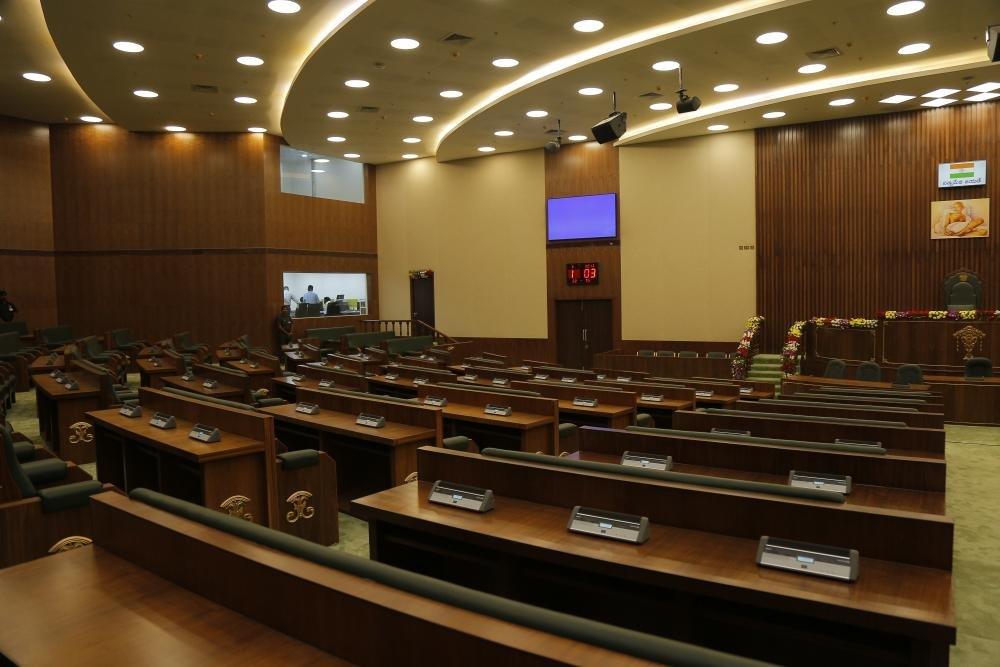
Photo: Andhra Pradesh Legislative Assembly, Kdslk, CC0

APPSC Group-I Mains 2023 · Paper III
2023 Paper III · Q3(b): model answer
Polity, Constitution, Governance, Law & Ethics · Centre and States: sharing power and money. Held in June 2023 (Notification 28/2022).
'The Finance Commission, though not being a permanent body, has still maintained its credibility by promoting fiscal democracy in India,' - Comment.
Syllabus: Centre and States: sharing power and money · Sharing money: Finance Commission and fiscal federalism
Article 280Finance CommissionFiscal democracyDevolution
The Finance Commission (FC) is a quasi-judicial body constituted by the President every five years under Article 280 to recommend the sharing of Union taxes and grants-in-aid. It is not a permanent body: it dissolves after submitting its report. Yet its rule-based, consultative method has made it the most trusted pillar of fiscal federalism. The 16th FC (Chairman Arvind Panagariya, constituted 31 December 2023) covers 2026-27 to 2030-31; its report was tabled with the Union Budget 2026-27.
1. Why its credibility endures
- Independent experts: a Chairperson and four members, with qualifications laid down by the Finance Commission (Miscellaneous Provisions) Act, 1951, consult the Union, every State and local bodies.
- Transparency: formulae, weights and reasons are published, and the report is laid before Parliament with an explanatory memorandum (Article 281).
- Convention of acceptance: although advisory, its tax-devolution recommendations are accepted by the Union.
- Institutional memory: each Commission builds on the data and methods of its predecessors, which keeps transfers predictable.
2. Promoting fiscal democracy
Fiscal democracy here means that citizens of every State, whatever its revenue capacity, get comparable public services, and that transfers are decided through an open, consultative and rule-bound process rather than discretion.
- Vertical balance: the States' share of the divisible pool rose to 42% (14th FC) and is 41% under the 15th and 16th FCs.
- Equity: the income-distance criterion (42.5% weight under the 16th FC) gives more to poorer States.
- Incentives: demographic performance, forest and ecology, and the 16th FC's new "contribution to GDP" criterion (10%) reward good performance.
- Third tier: grants to panchayats and municipalities and disaster response funds carry resources to the grassroots.
| FC | Chairman | Period | States' share | AP's share |
|---|---|---|---|---|
| 14th | Y.V. Reddy | 2015-20 | 42% | 4.305% |
| 15th | N.K. Singh | 2020-26 | 41% | 4.047% (2021-26) |
| 16th | Arvind Panagariya | 2026-31 | 41% | about 4.2% |
3. Limitations
- Terms of reference are set by the Union and can tilt the outcome.
- Cesses and surcharges stay outside the divisible pool, so the States' effective share is lower than 41%.
- No permanent secretariat monitors implementation between Commissions.
- Bypass routes: Centrally Sponsored Schemes and discretionary grants (Article 282) move large sums outside the FC framework.
AP angle: Andhra Pradesh's share rises from about 4.05% (15th FC) to about 4.2% (16th FC). After bifurcation AP relied on revenue-deficit grants under the 14th and 15th FCs; the 16th FC has discontinued such grants, making own-revenue growth vital.
A permanent secretariat, a smaller share of cesses and closer consultation with States on the terms of reference would further strengthen this credible, temporary institution of fiscal federalism.
The other choice in Q3
Answer either one in the exam.
- Q3(a)Discuss the scope and challenges involved in the political empowerment of women through the Panchayat Raj. Briefly suggest on how to enhance women empowerment in rural and urban local governance.
10 marks · Panchayats and municipalities · Women and weaker sections in local bodies
Every model answer on these pages is free to read. The Tool Kit adds four PDF books for Mains Papers I–IV: every previous question sorted by syllabus, with practice questions. It is in the ₹149 All-in-One Pass, with every previous paper of every exam on the site, practice quizzes, timed tests, mock test series and study books.
₹149 · valid for 12 months from the day you pay, on every exam · pay by UPI, card or net banking