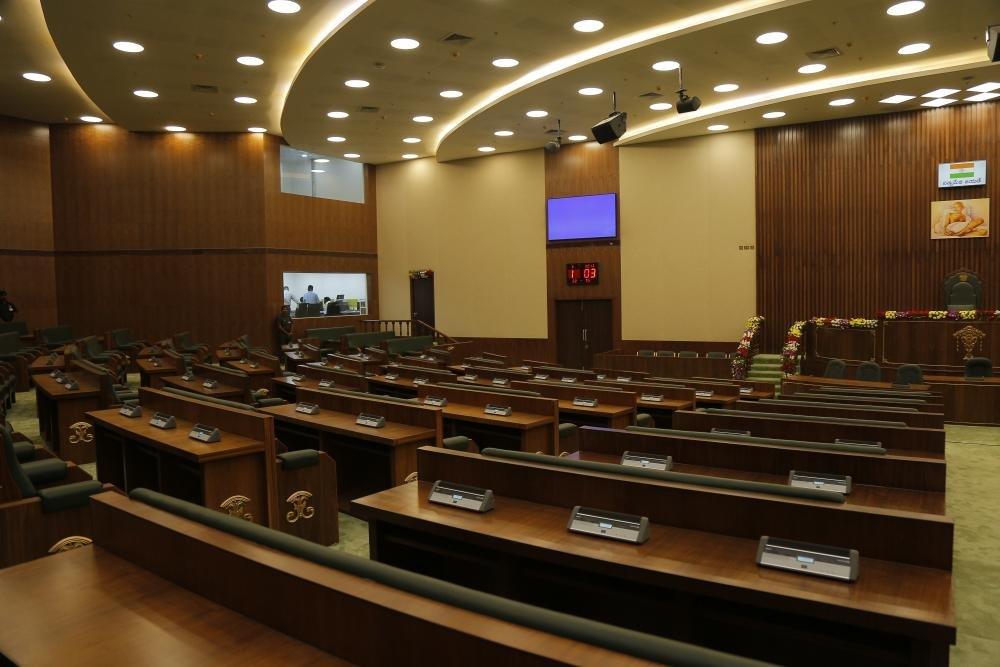
Photo: Andhra Pradesh Legislative Assembly, Kdslk, CC0

APPSC Group-I Mains 2023 · Paper III
2023 Paper III · Q3(a): model answer
Polity, Constitution, Governance, Law & Ethics · Panchayats and municipalities. Held in June 2023 (Notification 28/2022).
Discuss the scope and challenges involved in the political empowerment of women through the Panchayat Raj. Briefly suggest on how to enhance women empowerment in rural and urban local governance.
Syllabus: Panchayats and municipalities · Women and weaker sections in local bodies
73rd and 74th AmendmentsWomen's reservationProxy leadershipPolitical empowerment
The 73rd Amendment (1992) reserved at least one-third of seats and chairperson posts in Panchayats for women (Article 243D); the 74th Amendment reserved one-third of seats in municipalities (Article 243T), leaving chairpersons' reservation to State law. Twenty-one States, including Andhra Pradesh, and two UTs reserve 50%, and about 15 lakh women, around 46% of the 32 lakh elected panchayat representatives, hold office (Ministry of Panchayati Raj). This makes local bodies a major arena of women's political empowerment.
1. Scope
- Grassroots leadership: women preside over panchayats and Gram Sabhas, bringing their concerns into local planning.
- Gender-sensitive priorities: Chattopadhyay and Duflo (2004) found that women pradhans invested more in drinking water, a key need of women.
- Better oversight of services: elected women monitor anganwadis, schools, sanitation, health and nutrition more closely.
- Social inclusion: reservation within SC and ST seats has brought Dalit and Adivasi women into public office, challenging both caste and gender hierarchies.
- A pipeline to higher office: local experience complements the 106th Amendment (2023), which reserves one-third of Lok Sabha and Assembly seats for women.
2. Challenges
- Proxy leadership: male relatives ("sarpanch-pati") often run affairs while the elected woman only signs.
- Social barriers: patriarchy, caste hierarchy and low literacy limit women's voice in meetings and Gram Sabhas.
- Rotation of reserved seats every term breaks continuity and discourages long-term work.
- Weak devolution of funds, functions and functionaries leaves even capable leaders with little real power.
- Domestic burden, harassment and violence deter women from contesting again.
3. Enhancing empowerment in rural and urban local bodies
- End proxy leadership: a Ministry of Panchayati Raj advisory committee (report, 2025) recommended exemplary penalties, women's ombudspersons and a federation of women leaders for peer support.
- Capacity building: training under the Rashtriya Gram Swaraj Abhiyan, including digital literacy and financial management.
- Continuity and voice: rotation after two terms, Mahila Sabhas before Gram Sabhas, and women's ward committees in cities.
- Real devolution: gender budgeting, safety measures and child-care support.
- Collective strength: linking elected women with self-help group federations gives them networks, information and confidence.
| Aspect | Rural (Panchayats) | Urban (municipalities) |
|---|---|---|
| Constitutional base | Article 243D (seats and chairpersons) | Article 243T (seats; chairpersons as per State law) |
| Forum for women's voice | Mahila Sabhas before Gram Sabhas | Women's ward committees and area sabhas |
| Support network | Self-help group federations (SERP in AP) | Urban self-help groups (MEPMA in AP) |
| Priority reform | Penalties for proxy leadership; training | Gender budgeting; safe public spaces |
AP angle: Andhra Pradesh's self-help group movement (DWCRA from 1982, SERP in rural and MEPMA in urban areas) has produced confident women leaders who contest local elections and manage public resources.
Moving from representation to real power needs capacity, devolution and social change, so that women lead local governance in their own right.
The other choice in Q3
Answer either one in the exam.
- Q3(b)'The Finance Commission, though not being a permanent body, has still maintained its credibility by promoting fiscal democracy in India,' - Comment.
10 marks · Centre and States: sharing power and money · Sharing money: Finance Commission and fiscal federalism
Every model answer on these pages is free to read. The Tool Kit adds four PDF books for Mains Papers I–IV: every previous question sorted by syllabus, with practice questions. It is in the ₹149 All-in-One Pass, with every previous paper of every exam on the site, practice quizzes, timed tests, mock test series and study books.
₹149 · valid for 12 months from the day you pay, on every exam · pay by UPI, card or net banking