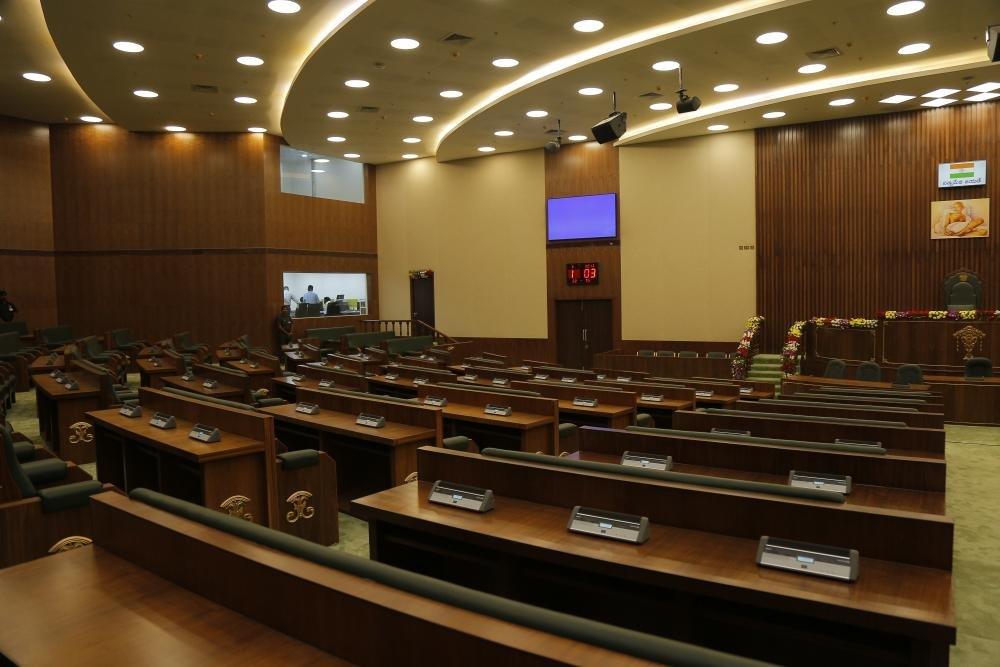
Photo: Andhra Pradesh Legislative Assembly, Kdslk, CC0

APPSC Group-I Mains 2023 · Paper III
2023 Paper III · Q2(b): model answer
Polity, Constitution, Governance, Law & Ethics · Centre and States: sharing power and money. Held in June 2023 (Notification 28/2022).
The National Education Policy (2020) has been criticized as denuding the autonomy of states. In this connection, examine the rationale behind the transfer of matters from the State list to the Concurrent list.
Syllabus: Centre and States: sharing power and money · Who makes which laws: Union, State and Concurrent Lists
NEP 202042nd AmendmentConcurrent ListCooperative federalism
The National Education Policy (NEP) 2020, based on the Kasturirangan Committee draft, replaced the 1986 policy. Some States see it as centralising: a uniform 5+3+3+4 school structure, the three-language formula, common entrance tests, a proposed single higher-education regulator and Samagra Shiksha funds linked to PM SHRI agreements. The debate goes back to the 42nd Amendment (1976), which, on the Swaran Singh Committee's advice, moved education and four other subjects from the State List to the Concurrent List.
1. What was transferred
| Subject | Earlier (List II) | Now (List III) |
|---|---|---|
| Education, including universities | Entry 11 | Merged into Entry 25 |
| Administration of justice; courts other than the Supreme Court and High Courts | Part of Entry 3 | Entry 11A |
| Forests | Entry 19 | Entry 17A |
| Protection of wild animals and birds | Entry 20 | Entry 17B |
| Weights and measures (except establishment of standards) | Entry 29 | Entry 33A |
2. Rationale behind the transfer
- National standards: a concurrent role in education complements the Union's power to coordinate and determine standards in higher education and research (Entry 66, List I).
- National integration and mobility: the Kothari Commission (1964-66) favoured a national system of education with a common structure, and common norms ease recognition of degrees and movement of students and teachers across States.
- Funding and planning: the Union could legislate and fund on a national scale, as in the RTE Act, 2009 (under Article 21A) and Centrally Sponsored Schemes such as Samagra Shiksha.
- Ecology: forests and wildlife cross State boundaries; the Forest (Conservation) Act, 1980, renamed the Van (Sanrakshan Evam Samvardhan) Adhiniyam in 2023, followed.
- Context: the transfer was made during the Emergency without wide consultation with the States, which is one reason the autonomy debate persists.
3. Does the NEP denude State autonomy?
- Concerns: under Article 254 a Union law prevails over a repugnant State law, and conditional grants pressure States to adopt central models.
- Diversity: uniform entrance tests and the language formula may not suit every State's needs, and a single higher-education regulator could reduce the role of State universities and State councils of higher education.
- Counterpoint: the NEP is a policy, not a law; it leaves States room to adapt language, curriculum and pace, and States still run and fund most government schools and universities.
- Federal safeguard: the Sarkaria and Punchhi Commissions advised the Union to consult States before legislating on Concurrent subjects.
AP angle: Andhra Pradesh has adopted NEP-aligned steps such as foundational-stage school restructuring and PM SHRI schools, showing room for State-specific implementation within a national framework.
Cooperative federalism, with the Union setting minimum standards, flexible rather than conditional funding, and the States free to innovate after genuine consultation, can reconcile national quality with State autonomy in education.
The other choice in Q2
Answer either one in the exam.
Every model answer on these pages is free to read. The Tool Kit adds four PDF books for Mains Papers I–IV: every previous question sorted by syllabus, with practice questions. It is in the ₹149 All-in-One Pass, with every previous paper of every exam on the site, practice quizzes, timed tests, mock test series and study books.
₹149 · valid for 12 months from the day you pay, on every exam · pay by UPI, card or net banking