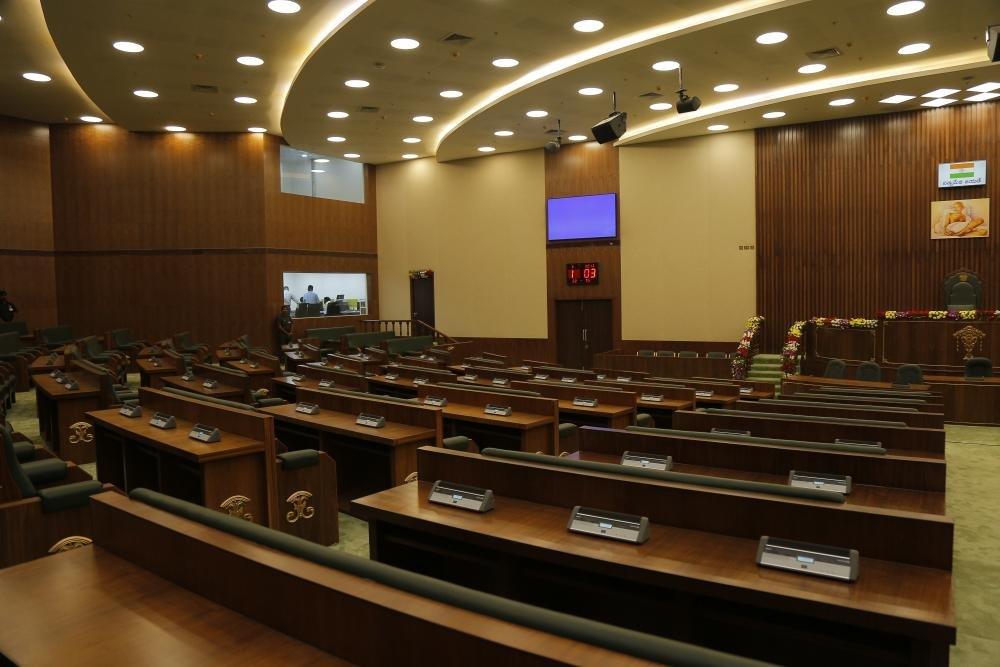
Photo: Andhra Pradesh Legislative Assembly, Kdslk, CC0

APPSC Group-I Mains 2023 · Paper III
2023 Paper III · Q11(b): model answer
Polity, Constitution, Governance, Law & Ethics · Ethics for public servants. Held in June 2023 (Notification 28/2022).
Define Accountability. Discuss the factors that have led to weakening of accountability in civil services. Suggest ways to improve the mechanisms for accountability in civil services.
Syllabus: Ethics for public servants · Ethics basics; integrity and accountability in public and private life
AccountabilityAnswerabilityEnforceabilityCivil service reforms
Accountability is the obligation of a public official to answer for decisions and results to a higher authority, the legislature, the courts and citizens, and to face consequences for failure. It has two elements: answerability (explaining and justifying actions) and enforceability (rewards and sanctions). In a democracy, civil servants are accountable to ministers, and through them to Parliament, as well as directly to the law and to citizens.
1. Meaning and forms
- Answerability: the duty to explain and justify decisions, through reports, audits, questions in the legislature and RTI replies.
- Enforceability: the possibility of rewards and sanctions, from promotions to disciplinary action and prosecution.
- Multiple directions: accountability runs upward to superiors, outward to citizens and inward to professional ethics (see diagram).
2. Factors that have weakened accountability
- Legal protection: Article 311 guards against arbitrary dismissal, and prior sanction for prosecution (Section 218 BNSS, formerly Section 197 CrPC; Section 17A of the Prevention of Corruption Act) is often delayed.
- Anonymity: under ministerial responsibility civil servants are not publicly answerable, and collective file-based decisions diffuse responsibility.
- Process over outcomes: a colonial, rule-bound culture values procedure over results, and vague targets and inflated, subjective appraisals mean that performance rarely affects careers.
- Political interference: frequent transfers weaken ownership of results and encourage loyalty to patrons rather than to the public.
- Weak enforcement: slow disciplinary proceedings, information asymmetry, weak citizen participation and poor protection for whistle-blowers mean that failures rarely carry consequences.
3. Ways to improve accountability mechanisms
- Performance: outcome budgets and measurable key performance indicators for each office; revive performance agreements like the Results-Framework Documents (2009), which linked ministries' targets to annual evaluation.
- Appraisal: 360-degree appraisal, premature retirement of non-performers under FR 56(j) and performance-linked promotions (Second ARC).
- Citizens: proactive disclosure under Section 4 of the RTI Act, social audits, Citizen's Charters with compensation and Right to Services laws.
- Oversight: Lokpal, CVC, CAG performance audits and parliamentary committees such as the Public Accounts Committee.
- Technology and fairness: e-Office, real-time dashboards and online grievance tracking (CPGRAMS); clear delegation and time-bound sanction decisions protect honest officers, so that accountability does not breed fear of decision-making.
| Factor | Remedy |
|---|---|
| Delayed sanction for prosecution | Time-bound sanction decisions |
| Anonymity and diffused responsibility | Clear delegation; file tracking on e-Office |
| Subjective appraisal | Measurable targets; 360-degree appraisal |
| Frequent transfers | Minimum tenure; Civil Services Boards |
| Weak citizen voice | Social audit; Right to Services laws |
AP angle: Andhra Pradesh's Society for Social Audit, Accountability and Transparency (2009), one of India's first independent social audit units, takes rural employment scheme records to Gram Sabhas, making officials answerable to the people they serve.
Accountability should be for outcomes, not merely for following procedure. Balancing answerability with protection of bona fide decisions and citizen oversight can create a civil service that is both fearless and responsive to the people it serves.
The other choice in Q11
Answer either one in the exam.
- Q11(a)Ethics in public service is an essential component of parliamentary democracy. In this connection, discuss the pathway towards a 'Naitik Bharat'.
10 marks · Ethics for public servants · Ethics basics; integrity and accountability in public and private life
Every model answer on these pages is free to read. The Tool Kit adds four PDF books for Mains Papers I–IV: every previous question sorted by syllabus, with practice questions. It is in the ₹149 All-in-One Pass, with every previous paper of every exam on the site, practice quizzes, timed tests, mock test series and study books.
₹149 · valid for 12 months from the day you pay, on every exam · pay by UPI, card or net banking