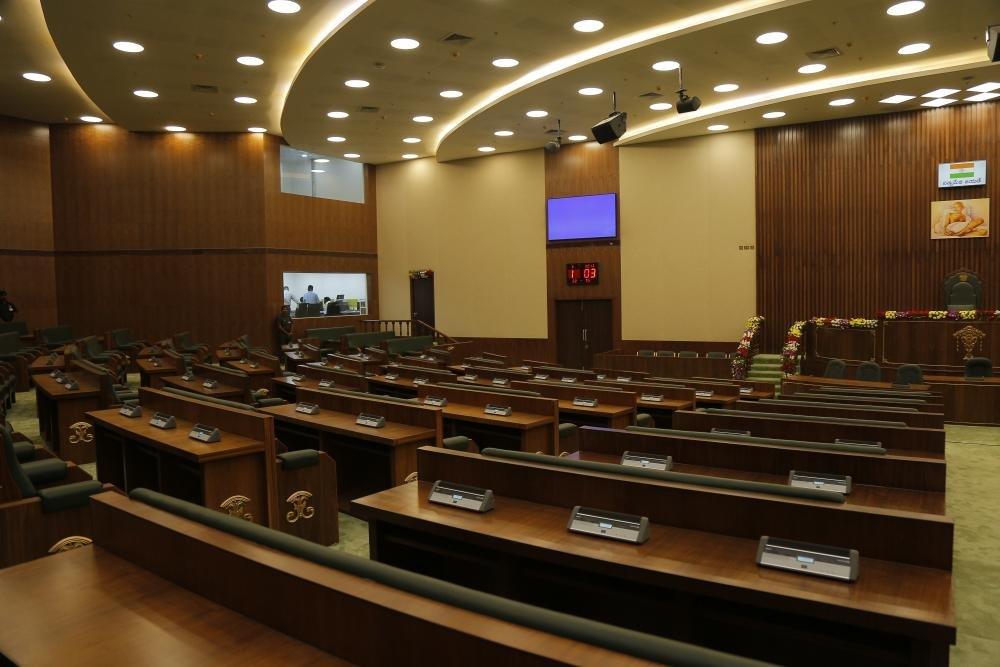
Photo: Andhra Pradesh Legislative Assembly, Kdslk, CC0

APPSC Group-I Mains 2023 · Paper III
2023 Paper III · Q9(a): model answer
Polity, Constitution, Governance, Law & Ethics · Running the government: administration, policies and civil services. Held in June 2023 (Notification 28/2022).
Explain the quasi-judicial nature of Administrative Tribunals. Examine whether writs and appeals are available against the decisions of the Administrative Tribunals.
Syllabus: Running the government: administration, policies and civil services · Statutory, regulatory and quasi-judicial bodies (commissions, tribunals)
Article 323AAdministrative tribunalsL. Chandra KumarJudicial review
Article 323A, added by the 42nd Amendment (1976), lets Parliament set up tribunals for disputes on recruitment and service conditions of public servants. The Administrative Tribunals Act, 1985 created the Central Administrative Tribunal (CAT) and allowed States to set up State Administrative Tribunals. The aim was to relieve High Courts of service cases and offer speedy, specialised justice. These bodies are quasi-judicial: they decide like courts but stand outside the regular judicial hierarchy.
1. Quasi-judicial nature
- Adjudication: they decide service disputes between government and employees on evidence and law, and their orders bind the parties like decrees of a court.
- Flexible procedure: they are not bound by the Code of Civil Procedure; they follow the principles of natural justice and regulate their own procedure.
- Court-like powers: they have the powers of a civil court for summoning witnesses, requiring documents and reviewing decisions, and can punish for contempt.
- Mixed benches: judicial and administrative members sit together, combining legal skill with administrative experience.
2. Are writs and appeals available?
- Original scheme: Article 323A(2)(d) and Section 28 of the Act excluded the jurisdiction of all courts except the Supreme Court under Article 136; S.P. Sampath Kumar (1987) accepted this, treating tribunals as substitutes for High Courts.
- L. Chandra Kumar (1997): a seven-judge bench struck down that exclusion, holding judicial review under Articles 226, 227 and 32 part of the basic structure.
- Present route: a tribunal's order is challenged first before a Division Bench of the High Court in whose jurisdiction the tribunal lies, and then before the Supreme Court under Article 136; no direct appeal to the Supreme Court lies.
- Limit: tribunals may examine the validity of laws, but cannot decide the validity of their own parent Act.
3. Recent developments
- Tribunals Reforms Act, 2021: abolished several appellate tribunals and set uniform terms of service.
- Madras Bar Association (19 November 2025): the Supreme Court struck down key appointment and tenure provisions of the 2021 Act as violating judicial independence and directed a National Tribunals Commission within four months.
- 1976 Article 323A (42nd Amendment)
- 1985 Administrative Tribunals Act; CAT set up
- 1987 S.P. Sampath Kumar upholds exclusion of High Courts
- 1997 L. Chandra Kumar restores High Court review
- 2021 Tribunals Reforms Act
- 2025 Madras Bar Association: National Tribunals Commission directed
AP angle: Article 371D (32nd Amendment, 1973) enabled the Andhra Pradesh Administrative Tribunal (set up 1975), a forerunner of Article 323A; P. Sambamurthy (1987) struck down the proviso letting the State government modify its orders. In 2019 the State government moved a proposal to close the tribunal.
Independent tribunals under High Court oversight can deliver both speed and the rule of law; a National Tribunals Commission would strengthen their independence.
The other choice in Q9
Answer either one in the exam.
- Q9(b)What are the reasons for decline of integrity in civil services? Also, discuss the institutional mechanism to check corruption in India.
10 marks · Running the government: administration, policies and civil services · Civil services: role, reforms and integrity
Every model answer on these pages is free to read. The Tool Kit adds four PDF books for Mains Papers I–IV: every previous question sorted by syllabus, with practice questions. It is in the ₹149 All-in-One Pass, with every previous paper of every exam on the site, practice quizzes, timed tests, mock test series and study books.
₹149 · valid for 12 months from the day you pay, on every exam · pay by UPI, card or net banking