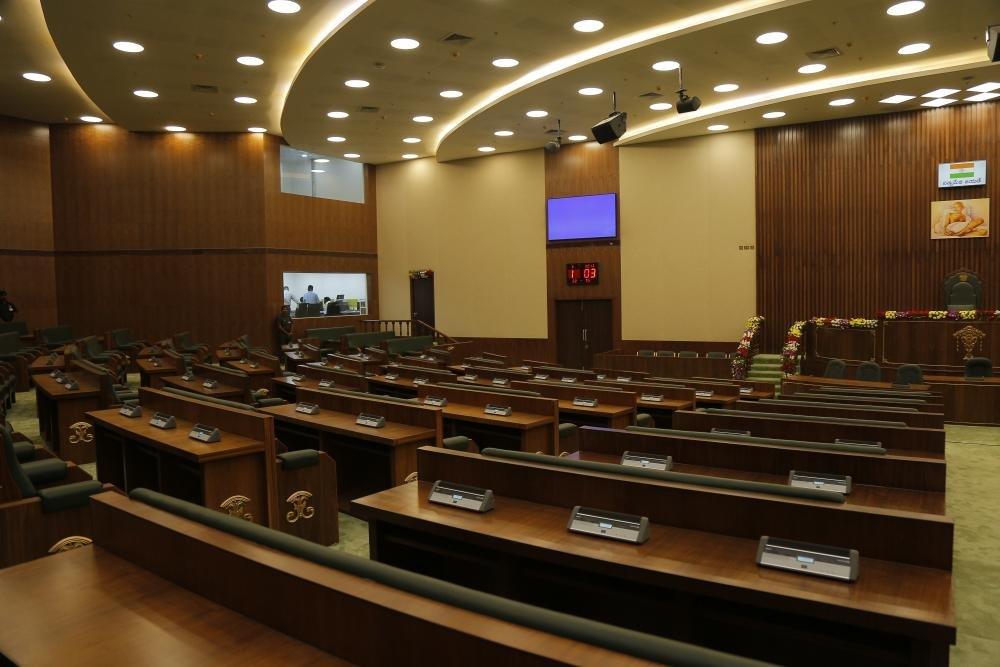
Photo: Andhra Pradesh Legislative Assembly, Kdslk, CC0

APPSC Group-I Mains 2023 · Paper III
2023 Paper III · Q13(a): model answer
Polity, Constitution, Governance, Law & Ethics · Ethics for public servants. Held in June 2023 (Notification 28/2022).
Do attitudes influence behaviour? Discuss the polarization of political attitudes in India.
Syllabus: Ethics for public servants · Attitude, persuasion and emotional intelligence
AttitudeTheory of Planned BehaviourCognitive dissonancePolitical polarisation
An attitude is a learned tendency to evaluate a person, object or idea favourably or unfavourably. It has three components (ABC model): affective (feelings), behavioural (tendency to act) and cognitive (beliefs). Attitudes influence behaviour, but the link is neither automatic nor one-way. In politics, strongly held attitudes can harden into polarisation, which is increasingly visible in India.
1. Do attitudes influence behaviour?
- Yes, often: in Ajzen's Theory of Planned Behaviour, attitudes, social norms and perceived control shape intentions that drive behaviour; strong, specific attitudes formed by personal experience predict behaviour best.
- Not always: in LaPiere's study (1934), hotels that had served a Chinese couple later said in letters that they would refuse Chinese guests. Situational pressure, social norms and competing attitudes weaken the link.
- Strength and specificity matter: a specific attitude (towards voting in this election) predicts behaviour better than a general one (towards politics), and attitudes that come to mind easily guide action more.
- Two-way link: behaviour also shapes attitudes through cognitive dissonance (Festinger, 1957); laws against untouchability changed attitudes over time.
| Component | Meaning | Example |
|---|---|---|
| Attitude towards the behaviour | One's own evaluation of the act | "Voting is worthwhile" |
| Subjective norms | Perceived social pressure | "My family expects me to vote" |
| Perceived behavioural control | Belief that one can do it | "The polling booth is close by" |
| Intention, then behaviour | The three together shape intention, which drives action | Goes to vote on polling day |
2. Polarisation of political attitudes in India
- Meaning: growing distance and hostility between political camps, both ideological and affective (dislike of opponents' supporters).
- Social drivers: identity politics of religion, caste, language and region turns political choice into a question of group loyalty.
- Media drivers: social-media echo chambers, misinformation, algorithmic amplification, personality-centred campaigns and partisan media reward outrage over reasoned debate.
- Manifestations: legislative disruptions, hate speech, online trolling and Centre-State friction along party lines.
- Consequences: erosion of trust, consensus and social harmony, although political engagement and turnout remain high.
3. Way forward
- Legal limits: enforce the Model Code of Conduct and Section 123 of the Representation of the People Act; in Abhiram Singh (2017) the Supreme Court held that seeking votes on religion, caste, race, community or language is a corrupt practice.
- Informed citizens: media and digital literacy, fact-checking and deliberative forums.
- Civic culture: constitutional values and respect for opponents taught in schools and practised by leaders.
- Consensus forums: all-party meetings and parliamentary committees, where members often work across party lines, help build agreement.
AP angle: Andhra Pradesh's closely fought, largely two-way contests and intense social-media campaigns show how political loyalty can harden into social identity even in villages.
Promoting constitutional values, dialogue and tolerance of differing views can turn political competition into healthy democratic debate.
The other choice in Q13
Answer either one in the exam.
- Q13(b)Define Persuasion and its constructs? Can the power of persuasion be used by civil servants in order to realize the ends and objectives of a 'New India'? Substantiate.
10 marks · Ethics for public servants · Attitude, persuasion and emotional intelligence
Every model answer on these pages is free to read. The Tool Kit adds four PDF books for Mains Papers I–IV: every previous question sorted by syllabus, with practice questions. It is in the ₹149 All-in-One Pass, with every previous paper of every exam on the site, practice quizzes, timed tests, mock test series and study books.
₹149 · valid for 12 months from the day you pay, on every exam · pay by UPI, card or net banking