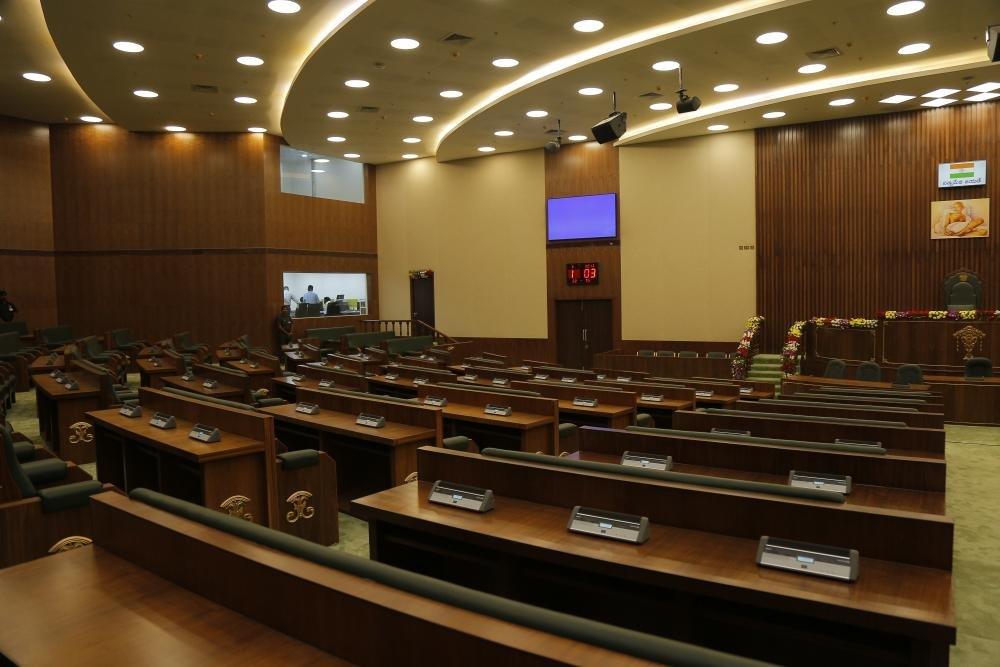
Photo: Andhra Pradesh Legislative Assembly, Kdslk, CC0

APPSC Group-I Mains 2023 · Paper III
2023 Paper III · Q14(a): model answer
Polity, Constitution, Governance, Law & Ethics · Ethics for public servants. Held in June 2023 (Notification 28/2022).
Does popular democracy breed distrust in the public towards their representatives? Discuss the scope of ethical leadership in democracy and politics.
Syllabus: Ethics for public servants · Public-service ethics: codes, leadership, corruption, Lokpal, international ethics
Popular democracyPublic trustEthical leadershipNolan principles
Popular democracy rests on mass participation and the people's mandate. When it turns populist, with short-term promises, personality cults and emotive mobilisation, a gap opens between promise and performance, and this can breed distrust of representatives, though not necessarily of democracy itself. Ethical leadership, which puts public interest above personal or party gain, is the bridge that can restore trust between the people and those they elect.
1. Why distrust arises
- Unfulfilled promises: competitive freebies and grand announcements that strain finances raise expectations that cannot be met.
- Distance from voters: weak constituency work and decisions driven by party high commands make citizens feel unheard between elections.
- Criminalisation: 46% of Lok Sabha members elected in 2024 declared criminal cases (ADR).
- Money power: costly elections and opaque funding; the Supreme Court struck down electoral bonds in 2024.
- Defections and disruptions: defections despite the Tenth Schedule (1985), "resort politics", disrupted legislatures, fewer sittings and polarising rhetoric amplified by social media.
2. Why distrust is not the whole story
- High participation: Lok Sabha 2024 turnout was about 65.8%, with women voting on par with men.
- Accountability works: peaceful transfers of power, a free media, RTI and courts keep representatives answerable.
- Faith in the ballot: frequent anti-incumbency verdicts show that voters punish poor performance through elections rather than rejecting democracy.
| Breeds distrust | Sustains trust |
|---|---|
| Unfulfilled promises and freebies | Regular, free and fair elections |
| Criminalisation of politics | Disclosure of candidates' records |
| Opaque political funding | Judicial review and RTI |
| Defections and disruptions | Peaceful transfers of power |
3. Scope of ethical leadership in democracy and politics
- Values: the Nolan principles (see diagram), plus empathy; Gandhi stressed that pure ends need pure means.
- Leading by example: Lal Bahadur Shastri resigned as Railway Minister in 1956 after a rail accident, owning moral responsibility.
- Institutional support: codes of conduct for legislators, effective Ethics Committees, inner-party democracy, decriminalisation and State funding of elections (Indrajit Gupta Committee, 1998).
- Servant leadership: listening, consensus-building and respect for opponents turn competition into cooperation for the public good.
- Long-term vision: ethical leaders explain hard choices honestly rather than promising what cannot be delivered, and protect institutions even when it costs them politically.
AP angle: Andhra Pradesh recorded turnout above 80% in the 2024 simultaneous elections, showing deep public faith in the vote; Tanguturi Prakasam, "Andhra Kesari" and first Chief Minister of Andhra State (1953), is remembered for courage and simplicity in public life.
Distrust of representatives is a warning, not a verdict against democracy. Ethical leadership converts electoral mandates into public trust, the real foundation of a mature democracy.
The other choice in Q14
Answer either one in the exam.
- Q14(b)What is meant by 'International Ethics'? Explain the significance of [illegible] international dispute resolutions and environmental cooperation among nations.
10 marks · Ethics for public servants · Public-service ethics: codes, leadership, corruption, Lokpal, international ethics
Every model answer on these pages is free to read. The Tool Kit adds four PDF books for Mains Papers I–IV: every previous question sorted by syllabus, with practice questions. It is in the ₹149 All-in-One Pass, with every previous paper of every exam on the site, practice quizzes, timed tests, mock test series and study books.
₹149 · valid for 12 months from the day you pay, on every exam · pay by UPI, card or net banking