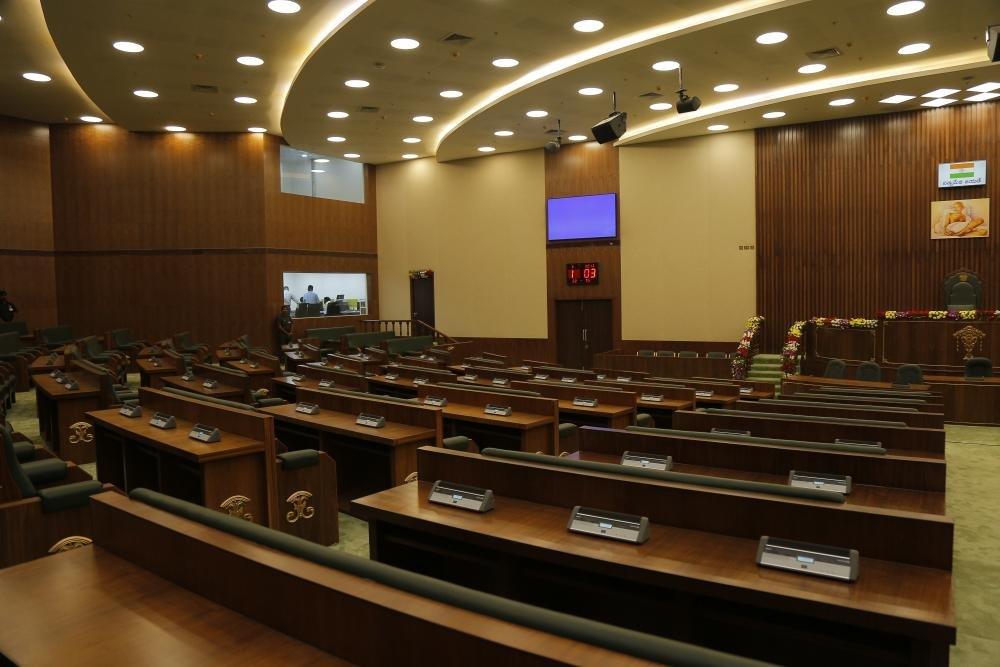
Photo: Andhra Pradesh Legislative Assembly, Kdslk, CC0

APPSC Group-I Mains 2025 · Paper III
2025 Paper III · Q9(a): model answer
Polity, Constitution, Governance, Law & Ethics · Running the government: administration, policies and civil services. Held in May 2025 (Notification 12/2023).
Under which Act was the National Commission for Women (NCW) established? Describe its main features and limitations.
Syllabus: Running the government: administration, policies and civil services · Statutory, regulatory and quasi-judicial bodies (commissions, tribunals)
National Commission for WomenNCW Act 1990Statutory bodyWomen's rights
The National Commission for Women (NCW) is a statutory body established under the National Commission for Women Act, 1990, and constituted on 31 January 1992. The need for such a body was highlighted by the Committee on the Status of Women in India in its report "Towards Equality" (1974). The NCW acts as the national watchdog for women's rights, advising the government on policy and acting on complaints.
1. Composition and status
- Members: a Chairperson committed to the cause of women, five members of ability and standing (at least one each from the Scheduled Castes and Scheduled Tribes) and a Member-Secretary, all nominated by the Central Government for up to three years.
- Funding and removal: it is financed by grants from the Central Government, and members can be removed by the Central Government on grounds laid down in the Act.
- Consultation: the Central Government must consult the Commission on all major policy matters affecting women (Section 16).
| Basis | NCW | NCSC |
|---|---|---|
| Origin | NCW Act 1990 (statutory) | Art 338 (constitutional) |
| Composition | Chairperson, five members, Member-Secretary | Chairperson, Vice-Chairperson, three members |
| Appointment | Nominated by the Central Government | By the President, by warrant under hand and seal |
| Reports | To the Central Government; laid before Parliament | To the President; laid before Parliament |
| Inquiries | Powers of a civil court | Powers of a civil court |
2. Main functions (Section 10)
- Review of safeguards: examines constitutional and legal safeguards for women, reviews laws and recommends amendments to remove gaps and discrimination.
- Complaints and suo motu action: looks into complaints and takes notice of the deprivation of women's rights and non-implementation of protective laws.
- Litigation and inspection: funds litigation on issues affecting large numbers of women, and inspects jails, remand homes and other custodial institutions for women.
- Development role: advises on planning for women's socio-economic development and evaluates progress; undertakes studies and research.
3. Powers and reporting
- Civil court powers: while investigating, it can summon persons, require documents, receive evidence on affidavit and requisition public records.
- Reports: its reports are laid before Parliament with a memorandum of action taken, so its findings are publicly debated.
- Initiatives: Parivarik Mahila Lok Adalats for quick settlement of family disputes, an NRI cell, a 24x7 helpline and online complaint registration.
4. Limitations
- Recommendatory: it cannot enforce its findings or punish; governments may ignore its advice.
- Limited autonomy: members are chosen by the Union Government without a selection committee, inviting charges of political appointments; it depends on the Ministry of Women and Child Development for funds.
- No investigating machinery of its own; it relies on the police.
- Statutory, not constitutional: unlike the National Commissions for SCs and STs (Art 338, 338A), it lacks constitutional status.
- Capacity constraints: a heavy complaint load and limited staff; it is criticised for reacting to high-profile cases rather than structural issues.
AP angle: The AP State Commission for Women handles complaints within the State, complementing the NCW in matters such as domestic violence and dowry harassment.
Constitutional status, a transparent selection process, binding force for some recommendations and stronger State Commissions can make the NCW an effective guardian of women's rights.
The other choice in Q9
Answer either one in the exam.
- Q9(b)Which constitutional provisions empower the formation of quasi-judicial authorities in India? Explain with suitable examples.
10 marks · Running the government: administration, policies and civil services · Statutory, regulatory and quasi-judicial bodies (commissions, tribunals)
Every model answer on these pages is free to read. The Tool Kit adds four PDF books for Mains Papers I–IV: every previous question sorted by syllabus, with practice questions. It is in the ₹149 All-in-One Pass, with every previous paper of every exam on the site, practice quizzes, timed tests, mock test series and study books.
₹149 · valid for 12 months from the day you pay, on every exam · pay by UPI, card or net banking