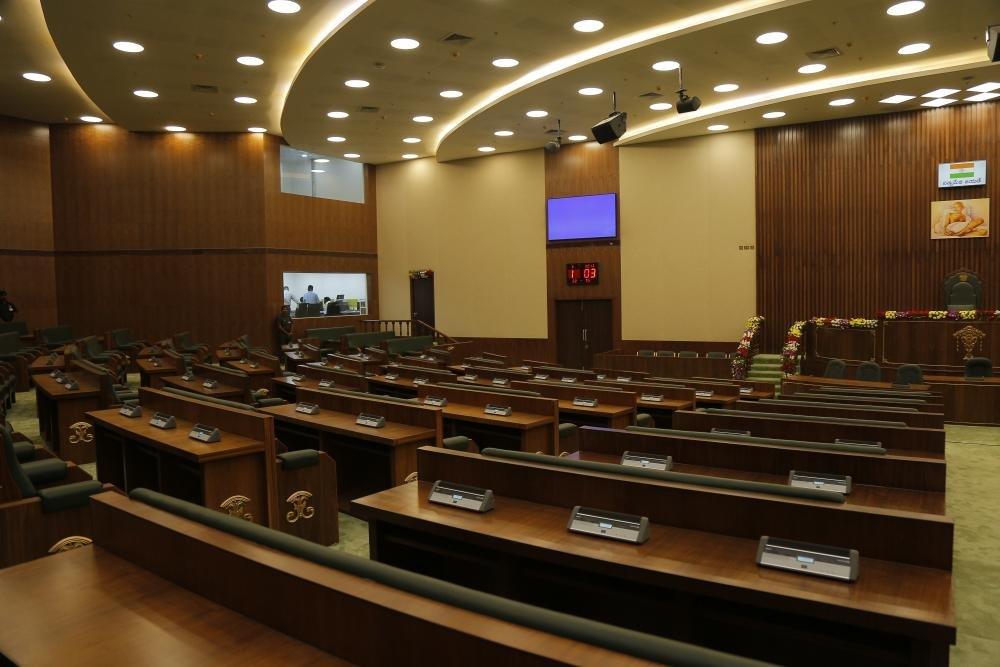
Photo: Andhra Pradesh Legislative Assembly, Kdslk, CC0

APPSC Group-I Mains 2025 · Paper III
2025 Paper III · Q12(a): model answer
Polity, Constitution, Governance, Law & Ethics · Ethics for public servants. Held in May 2025 (Notification 12/2023).
What ethical values are essential to ensure peaceful coexistence in a diverse society? Illustrate your answer with suitable examples.
Syllabus: Ethics for public servants · Human values: family, education, gender equality, great leaders
Peaceful coexistenceToleranceFraternityUnity in diversity
Peaceful coexistence means people of different religions, languages, castes, regions and beliefs living together with mutual respect and without conflict. India, with 22 scheduled languages and followers of all major world religions, depends on shared ethical values rather than uniformity. The Preamble's promise of fraternity and the ideal of unity in diversity express this.
1. Essential values, with examples
- Tolerance and mutual respect: Ashoka's Rock Edict XII urged respect for all sects, saying that one who honours his own sect by condemning others harms his own.
- Empathy and compassion: feeling others' suffering, as when neighbours of different faiths shelter each other during riots or floods.
- Fraternity and dignity: the Preamble promises "fraternity assuring the dignity of the individual"; Ambedkar saw liberty, equality and fraternity as an inseparable trinity.
- Equal respect for all faiths: Akbar's sulh-i-kul (peace with all); Art 25–30 and the fundamental duty to promote harmony (Art 51A(e)).
- Justice and fairness: equal treatment and affirmative action reduce resentment between groups (Art 14–17).
- Non-violence and dialogue: Gandhi's ahimsa; resolving disputes through discussion rather than force.
- Open-mindedness: the Jain idea of anekantavada, that truth has many aspects; Swami Vivekananda told the Chicago Parliament of Religions (1893) that India accepts all religions as true.
| Value | Constitutional anchor | Indian example |
|---|---|---|
| Tolerance | Freedom of conscience (Art 25) | Ashoka's Rock Edict XII |
| Equal respect for faiths | "Secular" in the Preamble (42nd Amendment) | Akbar's sulh-i-kul |
| Fraternity | Preamble; duty to promote harmony (Art 51A(e)) | Ambedkar's trinity of liberty, equality, fraternity |
| Composite culture | Duty to value and preserve it (Art 51A(f)) | Ameen Peer Dargah, Kadapa |
| Non-violence | Duty to abjure violence (Art 51A(i)) | Gandhi's ahimsa |
| Open-mindedness | Humanism and spirit of inquiry (Art 51A(h)) | Jain anekantavada; Vivekananda (1893) |
2. Why these values matter
- Prevent conflict: shared values defuse communal and ethnic tensions before they turn violent.
- Protect minorities: they secure the dignity of smaller groups, the true test of a democracy.
- Build social capital: trust across groups supports cooperation, investment and development.
- Constitutional vision: the framers chose secularism and fraternity partly because the violence of Partition had shown the cost of hatred.
- Changing society: migration, urbanisation and social media bring diverse people into daily contact, making these values a civic necessity.
3. Role of institutions
- Family and schools: value education teaches children to respect difference.
- Media: responsible reporting avoids stereotypes and fake news.
- Administration: impartial civil servants and district peace committees act quickly during tensions.
- Law: Section 196 of the Bharatiya Nyaya Sanhita punishes promoting enmity between groups.
AP angle: Gurajada Apparao's line "Desamante matti kadoi, desamante manushuloi" (a nation is not its soil, a nation is its people) captures this spirit. The Ameen Peer Dargah at Kadapa, visited by people of all faiths, and Vemana's verses against caste discrimination reflect Andhra's composite culture.
Peaceful coexistence is not merely the absence of conflict but active respect for difference, the essence of "unity in diversity" and of a mature democracy.
The other choice in Q12
Answer either one in the exam.
- Q12(b)How does early value education in the family influence ethical decision-making in adulthood?
10 marks · Ethics for public servants · Human values: family, education, gender equality, great leaders
Every model answer on these pages is free to read. The Tool Kit adds four PDF books for Mains Papers I–IV: every previous question sorted by syllabus, with practice questions. It is in the ₹149 All-in-One Pass, with every previous paper of every exam on the site, practice quizzes, timed tests, mock test series and study books.
₹149 · valid for 12 months from the day you pay, on every exam · pay by UPI, card or net banking