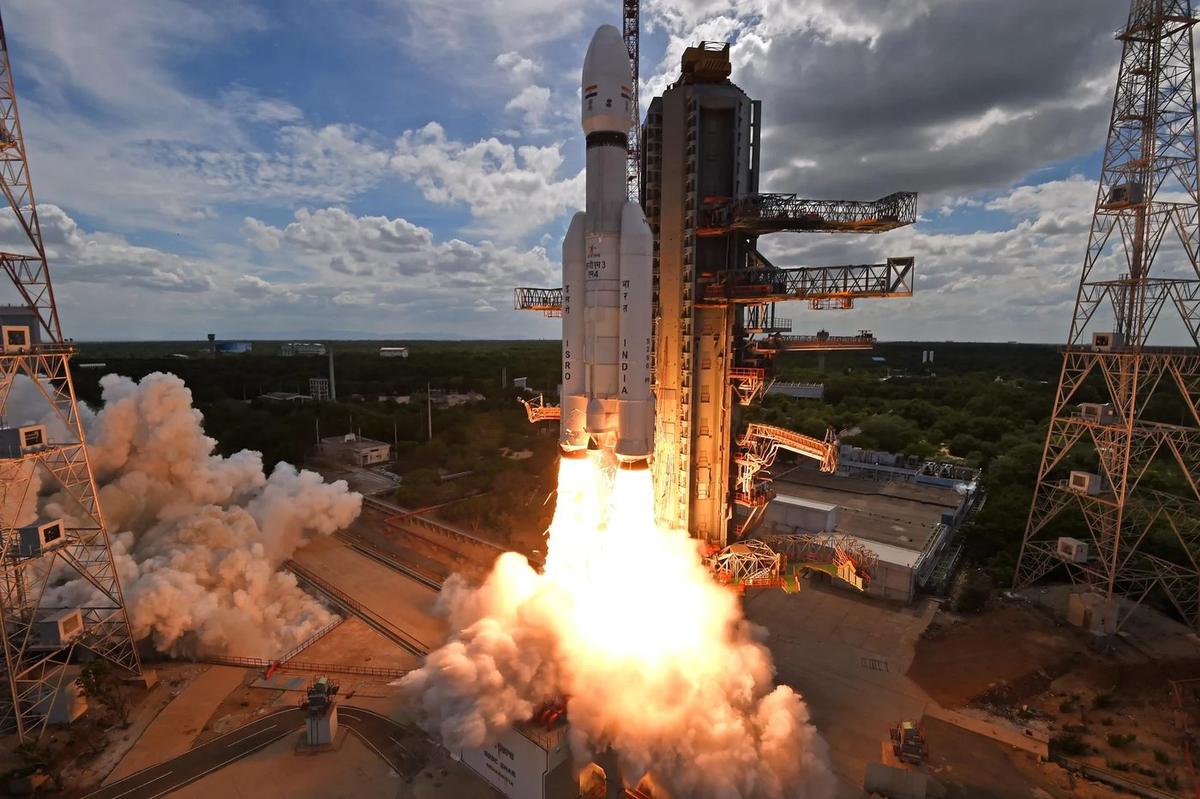
Photo: LVM3 launch, Sriharikota, ISRO, GODL-India

APPSC Group-I Mains 2025 · Paper V: Science, Technology & Environmental Issues
APPSC Group 1 Mains 2025 Paper V with model answers
Held in May 2025 (Notification 12/2023). 15 questions with an internal choice (a) or (b), 10 marks each, so 30 questions in all. Tap a question for its model answer.
Tap a question to open its model answer on its own page. Every model answer is free. Answers are by Learn with Anil (Jupudi Anil Kumar), not by APPSC; facts as of October 2026.
Paper V: Science, Technology & Environmental Issues
30 questions, 10 marks each
- Q1(a)Describe the research focus of the National Institute for Research on Commercial Agriculture (NIRCA) in Rajamahendravaram. How does it support India's agricultural sector?
10 marks · Science and technology policy, institutions and IPR · Science and technology policy and institutions
- Q1(b)Evaluate the impact of Internet of Things (IoT) technologies on the automation of household systems. Illustrate how everyday tasks have evolved due to IoT innovations.
10 marks · Emerging technologies, ICT and cyber security · Emerging technologies
- Q2(a)Discuss the discovery of Raman effect by Dr. C.V. Raman. How did his work impact the global scientific community?
10 marks · Science and technology policy, institutions and IPR · Science and technology policy and institutions
- Q2(b)Which are the major scientific institutes located in Andhra Pradesh? Discuss the role of IISER Tirupati in the scientific and educational development of the state.
10 marks · Science and technology policy, institutions and IPR · Science and technology policy and institutions
- Q3(a)Discuss the evolution of e-governance in India, highlighting key initiatives. Analyze how these initiatives have transformed public service delivery and enhanced citizen engagement.
10 marks · Emerging technologies, ICT and cyber security · ICT, e-governance and cyber security
- Q3(b)Define cybercrime. Discuss the major types of cybercrimes prevalent in India today.
10 marks · Emerging technologies, ICT and cyber security · ICT, e-governance and cyber security
- Q4(a)Discuss the key objectives and features of the National Policy on Information Technology, 2012. How does it aim to transform India into a digitally empowered society?
10 marks · Emerging technologies, ICT and cyber security · ICT, e-governance and cyber security
- Q4(b)Discuss the vision and mission of DRDO? Describe the role of DRDO in the contribution to national development.
10 marks · Space, defence and nuclear technology · Defence technology
- Q5(a)Describe the role of the Indian Remote Sensing (IRS) satellite programme. How do these satellites assist in natural resource management?
10 marks · Space, defence and nuclear technology · Space technology
- Q5(b)Provide a comprehensive overview of the primary reasons for deforestation in Andhra Pradesh in the past two decades.
10 marks · Ecology, biodiversity and natural resources · Natural resources, forests and mining
- Q6(a)Investigate the relationship between mining activities and the occurrence of earthquakes. Explain how mining operations can be regulated to minimize seismic risks.
10 marks · Ecology, biodiversity and natural resources · Natural resources, forests and mining
- Q6(b)Define sustainable development and critically evaluate its relevance in the context of modern industrialization.
10 marks · Pollution, waste and climate change · Climate change and sustainable development
- Q7(a)Describe the relationship between deforestation and the emergence of infectious diseases.
10 marks · Biotechnology and health · Health and diseases
- Q7(b)What is Environmental Impact Assessment (EIA)? Describe its key stages.
10 marks · Environmental laws, EIA and disaster management · Environmental laws, EIA and disaster management
- Q8(a)Explain the different types of natural resources in India. How are they being conserved through government initiatives?
10 marks · Ecology, biodiversity and natural resources · Natural resources, forests and mining
- Q8(b)What are the key principles of Integrated Solid Waste Management (ISWM)? Discuss the role of waste hierarchy in ISWM.
10 marks · Pollution, waste and climate change · Pollution and waste management
- Q9(a)Analyze the potential of plant-derived biopharmaceuticals in promoting sustainable healthcare. Explain how the application of green pharmacy principles can help minimize environmental harm at each stage of the pharmaceutical lifecycle.
10 marks · Biotechnology and health · Biotechnology
- Q9(b)Differentiate between conventional and non-conventional energy resources. Explain their relevance in India's energy sector.
10 marks · Energy: conventional and renewable · Energy: conventional sources and security
- Q10(a)Critically assess the effectiveness of major disaster management initiatives undertaken in India since the enactment of the Disaster Management Act, 2005.
10 marks · Environmental laws, EIA and disaster management · Environmental laws, EIA and disaster management
- Q10(b)Discuss the legislative framework for controlling air and water pollution in India. Highlight the key provisions and limitations of relevant acts.
10 marks · Environmental laws, EIA and disaster management · Environmental laws, EIA and disaster management
- Q11(a)Define global warming, and differentiate it clearly from climate change. Explain the key natural and human-induced causes of global warming and briefly discuss which factors are currently dominant in driving global temperature rise.
10 marks · Pollution, waste and climate change · Climate change and sustainable development
- Q11(b)Discuss the role of remote sensing in tracking the dispersion of environmental pollutants. Analyze its implications for human health in affected regions, highlighting limitations and future improvements.
10 marks · Pollution, waste and climate change · Pollution and waste management
- Q12(a)Explain the regulatory framework governing genetically modified organisms in India and assess its adequacy in addressing modern challenges.
10 marks · Biotechnology and health · Biotechnology
- Q12(b)Trace the evolution of India's National Biotechnology Development Strategy (NBDS) and discuss its key objectives. Critically evaluate its impact on the growth of the biotechnology sector in India.
10 marks · Biotechnology and health · Biotechnology
- Q13(a)Describe the components and functioning of a vaccine.
10 marks · Biotechnology and health · Health and diseases
- Q13(b)Define genetic engineering. Explain its applications in agriculture and medicine.
10 marks · Biotechnology and health · Biotechnology
- Q14(a)Describe the integrated strategies used in biotechnology to monitor and control outbreaks of bacterial diseases in poultry farming.
10 marks · Biotechnology and health · Biotechnology
- Q14(b)Examine how urban infrastructure influences the implementation of preventive measures during microbial disease outbreaks. Suggest technology-driven solutions.
10 marks · Biotechnology and health · Health and diseases
- Q15(a)Discuss the transmission dynamics of respiratory tract infections in densely populated urban settings. Propose effective public health strategies for their prevention.
10 marks · Biotechnology and health · Health and diseases
- Q15(b)Describe the importance of IPR in academic and industrial research collaborations.
10 marks · Science and technology policy, institutions and IPR · Intellectual property rights
All Mains PYQs, year-wise and subject-wise
Every model answer on these pages is free to read. The Tool Kit adds four PDF books for Mains Papers I–IV: every previous question sorted by syllabus, with practice questions. It is in the ₹149 All-in-One Pass, with every previous paper of every exam on the site, practice quizzes, timed tests, mock test series and study books.
₹149 · valid for 12 months from the day you pay, on every exam · pay by UPI, card or net banking