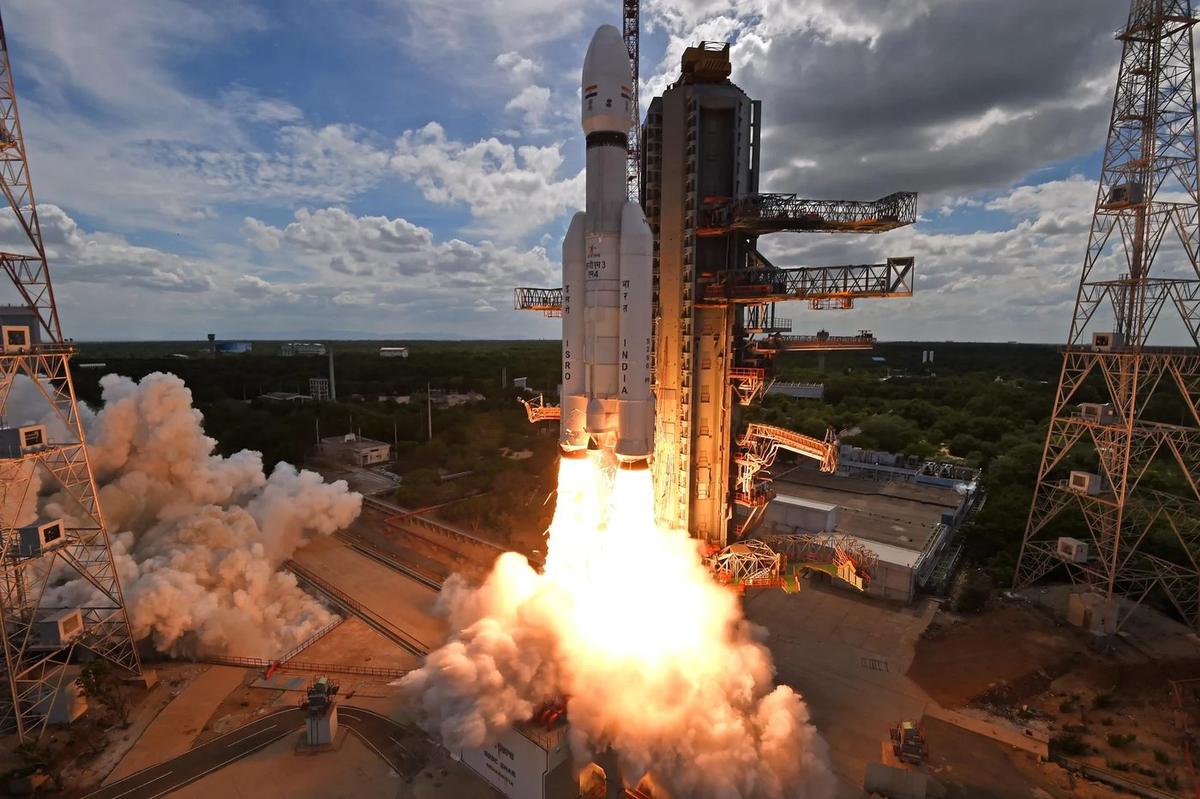
Photo: LVM3 launch, Sriharikota, ISRO, GODL-India

APPSC Group-I Mains 2020 · Paper V: Science, Technology & Environmental Issues
APPSC Group 1 Mains 2020 Paper V with model answers
Held in December 2020 (Notification 27/2018). 15 questions with an internal choice (a) or (b), 10 marks each, so 30 questions in all. Tap a question for its model answer.
Tap a question to open its model answer on its own page. Every model answer is free. Answers are by Learn with Anil (Jupudi Anil Kumar), not by APPSC; facts as of October 2026.
Paper V: Science, Technology & Environmental Issues
30 questions, 10 marks each
- Q1(a)What is "life expectancy at birth"? Data shows that the global average life expectancy has more than doubled since 1900, and is now above 70 years. Describe three to five factors which have contributed to improvement in life expectancy.
10 marks · Biotechnology and health · Health and diseases
- Q1(b)Telangana has several Central Government Institutions suitable for research funded by the Department of Science and Technology. These include BITS, CCMB, CDFD, CRIDA, DRDO, ICRISAT, IICT, NALSAR, NGRAU, and NIN. (i) How should these institutions contribute towards education of B.A./B.Com./B.Sc. students in TS? (ii) Write short notes about the mission and contributions of any two of these Institutions in Science/Technology in India.
10 marks · Science and technology policy, institutions and IPR · Science and technology policy and institutions
- Q2(a)What is the UIDAI? How has this government body harnessed IT to improve targeted delivery of government benefits (DBT)? How can the Aadhaar Card help in financial transactions?
10 marks · Emerging technologies, ICT and cyber security · ICT, e-governance and cyber security
- Q2(b)What is cybercrime? Describe with examples any two of the following and explain how the government helps victims of cybercrime: Cyber bullying; Cyber stalking; Phishing; Ransomware.
10 marks · Emerging technologies, ICT and cyber security · ICT, e-governance and cyber security
- Q3(a)Write a brief account of the history of ISRO. Name any three ISRO centers and their location. Add a note about the Mangalyaan or Chandrayaan missions of ISRO.
10 marks · Space, defence and nuclear technology · Space technology
- Q3(b)To date, ISRO has launched over 100 satellites. Explain what are GEO, LEO, MEO, and SSO. Use diagrams to illustrate your answer. Add a note on GSLV and PSLV launches.
10 marks · Space, defence and nuclear technology · Space technology
- Q4(a)What is nuclear energy? At the end of 2019, seven nuclear reactors were under construction in India, with a combined capacity of 5.4 GW. What are the advantages and disadvantages of using nuclear energy in India? What is the NPT and how does this impact India which is not a member of the NPT?
10 marks · Space, defence and nuclear technology · Nuclear technology and policy
- Q4(b)What is "Clean Energy"? List the sources of clean energy and explain how they work. Which of these sources can be used or are already widely used in India?
10 marks · Energy: conventional and renewable · Renewable energy
- Q5(a)All member states of the UN adopted 17 goals in the 2030 Agenda for Sustainable Development. Name any four of these goals and explain how India can reach them.
10 marks · Pollution, waste and climate change · Climate change and sustainable development
- Q5(b)What causes earthquakes? Can we prevent or predict where and when an earthquake will happen? What should relief agencies do after an earthquake occurs in an inland and a coastal region?
10 marks · Environmental laws, EIA and disaster management · Environmental laws, EIA and disaster management
- Q6(a)Classify solid waste in terms of source and types of solid wastes. Explain the steps to manage this waste. Add a note on advantages and disadvantages of landfills.
10 marks · Pollution, waste and climate change · Pollution and waste management
- Q6(b)What do you know about the agents, stages, and effects of soil erosion? What are the factors affecting soil erosion and measures to conserve soil?
10 marks · Ecology, biodiversity and natural resources · Natural resources, forests and mining
- Q7(a)Is there any difference between gene therapy, transgenic organisms, and gene enhancement/genome editing? With example, explain the ethical concerns in each of these approaches? When can genome editing be considered ethical?
10 marks · Biotechnology and health · Biotechnology
- Q7(b)In October 2020, the Nobel Prize for Chemistry was awarded to the CRISPR technology. Explain how CRISPR functions in nature and how it has been adapted for research and clinical applications.
10 marks · Biotechnology and health · Biotechnology
- Q8(a)Write short notes on the causes, treatment, and methods of prevention of any 3 of the following diseases: 1. Cholera; 2. Malaria; 3. Encephalitis; 4. Tuberculosis; and 5. Avian flu.
10 marks · Biotechnology and health · Health and diseases
- Q8(b)What is recombinant DNA? Draw a schematic to show the process of creating rDNA and explain the roles of restriction enzymes and vectors in this process. Give an example of rDNA technology.
10 marks · Biotechnology and health · Biotechnology
- Q9(a)What is Intellectual Property? Explain with examples the differences between copyrights, patents, and trademarks. What are the rights an inventor has on his invention, and how are these rights gained and enforced globally?
10 marks · Science and technology policy, institutions and IPR · Intellectual property rights
- Q9(b)What is a patent? Give examples of patents. What is the difference between process patents and product patents? How are GI tags related to patents?
10 marks · Science and technology policy, institutions and IPR · Intellectual property rights
- Q10(a)What is the status of utilization of Solar energy in India and the World? What are some factors hindering utilization of this green energy source?
10 marks · Energy: conventional and renewable · Renewable energy
- Q10(b)Traditional methods of in-person education have been disrupted by the Covid-19 pandemic. How can India's Space Program help in restoring and expanding access to education in India?
10 marks · Space, defence and nuclear technology · Space technology
- Q11(a)What do you know about the NeGP (National e-Governance Action Plan) operating under the aegis of Digital India? Explain about the role of any three of the following projects in this plan: 1. Jan-Dhan Yojana; 2. Digital Locker; 3. National Digital Literacy Mission; 4. E-Bhasha; and 5. BharatNet (National Optical Fibre Network).
10 marks · Emerging technologies, ICT and cyber security · ICT, e-governance and cyber security
- Q11(b)What are biofuels and why are they important to India's economy? What do you know about the Indian National Policy on Biofuels?
10 marks · Energy: conventional and renewable · Renewable energy
- Q12(a)Please interpret the following data in terms of contribution by countries to Science and Engineering publications. Identify any one factor for the state of Indian Science and recommend a relevant policy measure to address the situation.
10 marks · Science and technology policy, institutions and IPR · Science and technology policy and institutions
This question came with a table, "S&E articles in all fields, for 15 largest producing regions, countries, or economies: 2008 and 2018" (articles in 2008 → 2018; average annual growth 2008–18; share of the 2018 world total; cumulative share): World 1,755,850 → 2,555,959 (3.83%); 1. China 249,049 → 528,263 (7.81%; 20.67%; 20.67%); 2. United States 393,979 → 422,808 (0.71%; 16.54%; 37.21%); 3. India 48,998 → 135,788 (10.73%; 5.31%; 42.52%); 4. Germany 91,904 → 104,396 (1.28%; 4.08%; 46.61%); 5. Japan 108,241 → 98,793 (−0.91%; 3.87%; 50.47%). - Q12(b)Is there a difference between "forest cover" and "forest area"? What does the following graph show?
10 marks · Ecology, biodiversity and natural resources · Natural resources, forests and mining
This question came with a graph, "Total forest cover and total forest area of India in sq.km (FSI, 2001-2017)". Forest cover: 675,538 (2001), 678,333 (2003), 690,171 (2005), 690,899 (2007), 692,394 (2009), 692,027 (2011), 697,898 (2013), 701,495 (2015), 708,273 (2017). Forest area: 768,436 (2001), 774,740 (2003), 769,626 (2005), 769,512 (2007), 769,512 (2009), 769,538 (2011), 771,821 (2013), 764,566 (2015), 767,419 (2017). - Q13(a)What is Climate Justice? How is this matter covered by news media and influential publications like Time magazine? Suggest at least 2 measures that are aligned to this goal.
10 marks · Pollution, waste and climate change · Climate change and sustainable development
- Q13(b)Explain what you see in the following graphic. (a) How does human activity affect the substance shown in the graphic? (b) How does this substance affect human health?
10 marks · Pollution, waste and climate change · Climate change and sustainable development
This question came with a graphic of ozone concentration (parts per million, 0 to 9) against altitude (0 to 100 km), with the troposphere, stratosphere and mesosphere marked: ozone is very low near the ground, rises sharply above about 15 km, peaks at nearly 8 ppm at about 35 km in the stratosphere, and falls to almost nothing above about 70 km. - Q14(a)What are the most common and hazardous pollutants in outdoor and indoor air? Mention the health hazards from each of the pollutants. What is AQI (Air Quality Index)? Who monitors AQI in India? What is the contribution of PM to AQI?
10 marks · Pollution, waste and climate change · Pollution and waste management
- Q14(b)What is Covid-19 and how is it spread? How are immuno-diagnostic methods used in context of the Covid-19 pandemic?
10 marks · Biotechnology and health · Health and diseases
- Q15(a)Explain the mechanism of action of vaccines. Give two examples where vaccines have eradicated diseases in India. What do you know about the Global Vaccine Action Plan 2011-2020 and Mission Indradhanush?
10 marks · Biotechnology and health · Health and diseases
- Q15(b)The 2020 Nobel Prize for Physiology and Medicine was awarded to three scientists for their work on HCV. What do you know about this virus and the disease it causes? Is there any vaccine available for this disease?
10 marks · Biotechnology and health · Health and diseases
All Mains PYQs, year-wise and subject-wise
Every model answer on these pages is free to read. The Tool Kit adds four PDF books for Mains Papers I–IV: every previous question sorted by syllabus, with practice questions. It is in the ₹149 All-in-One Pass, with every previous paper of every exam on the site, practice quizzes, timed tests, mock test series and study books.
₹149 · valid for 12 months from the day you pay, on every exam · pay by UPI, card or net banking