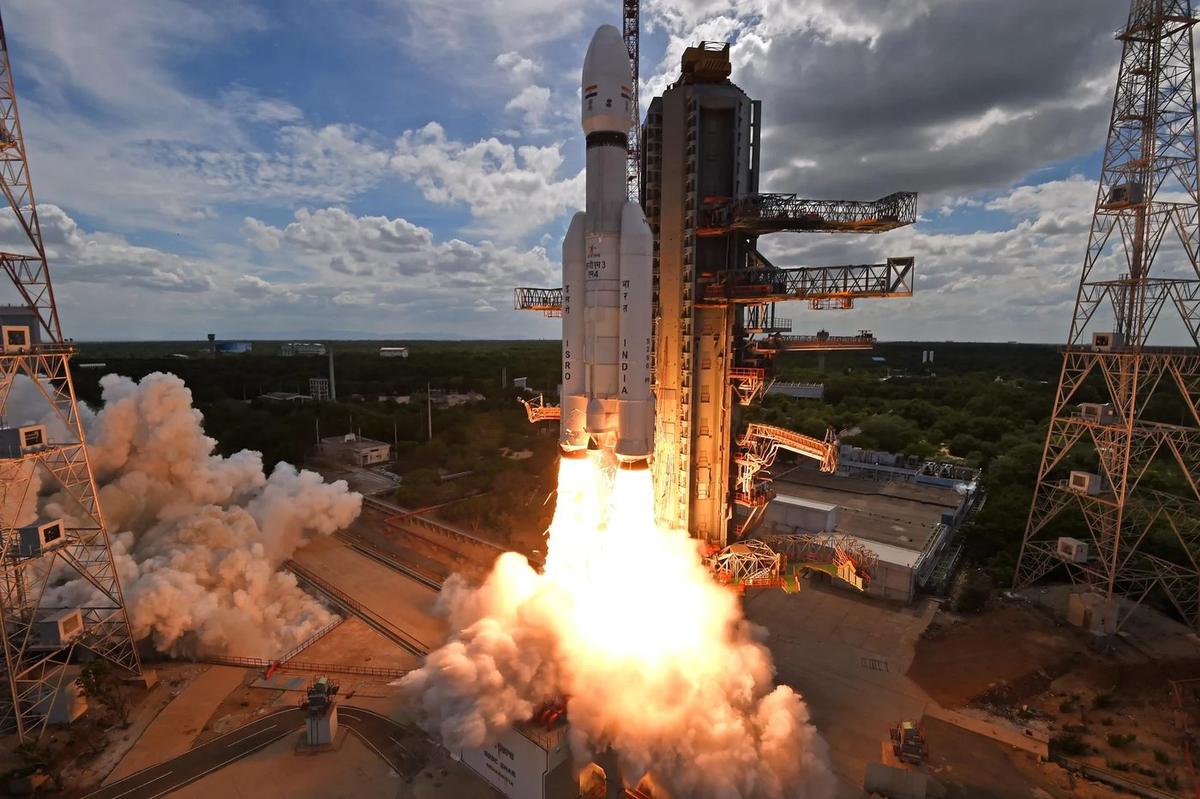
Photo: LVM3 launch, Sriharikota, ISRO, GODL-India

APPSC Group-I Mains 2020 · Paper V
2020 Paper V · Q3(b): model answer
Science, Technology & Environmental Issues · Space, defence and nuclear technology. Held in December 2020 (Notification 27/2018).
To date, ISRO has launched over 100 satellites. Explain what are GEO, LEO, MEO, and SSO. Use diagrams to illustrate your answer. Add a note on GSLV and PSLV launches.
Syllabus: Space, defence and nuclear technology · Space technology
Satellite orbitsGeostationary orbitSun-synchronous orbitPSLV and GSLV
A satellite stays in orbit because its forward speed balances Earth's gravity; the higher the orbit, the lower the speed needed and the longer the orbital period. Orbits are grouped by height and path into LEO, MEO, GEO and SSO. ISRO, which crossed 100 satellites in 2018 and has also launched over 400 foreign satellites, chooses the orbit to suit the job and the rocket to suit the orbit.
| Orbit | Height | Period | Main uses | Examples |
|---|---|---|---|---|
| LEO (low Earth) | about 200–2,000 km | about 90–128 minutes | Space stations, crew flights, broadband constellations | ISS; Gaganyaan (planned, about 400 km) |
| MEO (medium Earth) | 2,000–35,786 km | about 2 to under 24 hours | Navigation | GPS (about 20,200 km), Galileo |
| GEO (geostationary) | 35,786 km above the equator | 23 h 56 min (one rotation of Earth) | Communication, TV, weather | GSAT, INSAT-3DS |
| SSO (Sun-synchronous) | about 500–800 km, near-polar | about 95–100 minutes | Earth imaging at the same local time | Cartosat, Resourcesat, Oceansat-3 |
1. LEO and MEO
- Low Earth orbit: closest to Earth, so satellites move at about 7.8 km/s and circle Earth in roughly 90 minutes. Low height gives sharp images and quick signals, but each satellite sees only a small area, so large constellations are needed; LEO is also the most crowded with debris.
- Medium Earth orbit: suits navigation, because a few dozen satellites can cover the globe; GPS satellites take about 12 hours per orbit. India's regional NavIC instead uses geostationary and inclined geosynchronous satellites to cover India and about 1,500 km around it.
2. GEO: the "fixed" satellite
- A satellite at 35,786 km over the equator, moving eastward, takes one sidereal day to orbit and so appears fixed over one spot. Fixed dish antennas can point at it, and three such satellites can cover almost the whole Earth except the poles.
- It suits TV, DTH, VSAT banking links and weather watch (INSAT-3D series). A geosynchronous orbit with some tilt has the same period but traces a figure-of-eight; only the zero-tilt one over the equator is geostationary.
3. SSO: the imaging orbit
- A near-polar orbit (inclined about 98°) whose plane turns about one degree a day, keeping pace with Earth's motion around the Sun. The satellite therefore crosses each place at the same local solar time, giving uniform lighting for comparing images over seasons and years.
- ISRO's remote-sensing fleet (Cartosat, Resourcesat, Oceansat and the radar satellite EOS-04) uses it for crop, forest, water and disaster mapping.
4. PSLV and GSLV launches
| Feature | PSLV | GSLV Mk II | LVM3 |
|---|---|---|---|
| Stages | Solid–liquid–solid–liquid, with strap-ons | Solid core with 4 liquid strap-ons, liquid stage, cryogenic stage | Two S200 boosters, L110 core, C25 cryogenic stage |
| Capacity | About 1,750 kg to SSO | About 2,250 kg to GTO | About 4,000 kg to GTO |
| Key missions | Chandrayaan-1, Mangalyaan, Aditya-L1, 104 satellites (2017) | NavIC, NISAR (2025), EOS-05 (2026) | Chandrayaan-2 and 3, OneWeb, CMS-03 (2025) |
- PSLV became ISRO's workhorse for Sun-synchronous and low orbits, and for deep-space missions on a budget. It suffered back-to-back third-stage failures in PSLV-C61 (May 2025) and C62 (January 2026); a failure analysis committee reported in June 2026.
- GSLV carries heavier satellites to transfer orbit using a cryogenic upper stage, indigenous since 2014. GSLV-F16 launched NISAR (July 2025), and GSLV-F17 placed EOS-05 (September 2026), India's first imaging satellite in geosynchronous orbit.
AP angle: all these launches lift off from SDSC-SHAR, Sriharikota, close to the equator on the east coast, so rockets gain from Earth's eastward spin and spent stages fall into the sea.
Matching the right orbit to each mission underpins communication, navigation and Earth observation. Restoring PSLV's reliability and readying the reusable NGLV are ISRO's next priorities.
The other choice in Q3
Answer either one in the exam.
Every model answer on these pages is free to read. The Tool Kit adds four PDF books for Mains Papers I–IV: every previous question sorted by syllabus, with practice questions. It is in the ₹149 All-in-One Pass, with every previous paper of every exam on the site, practice quizzes, timed tests, mock test series and study books.
₹149 · valid for 12 months from the day you pay, on every exam · pay by UPI, card or net banking