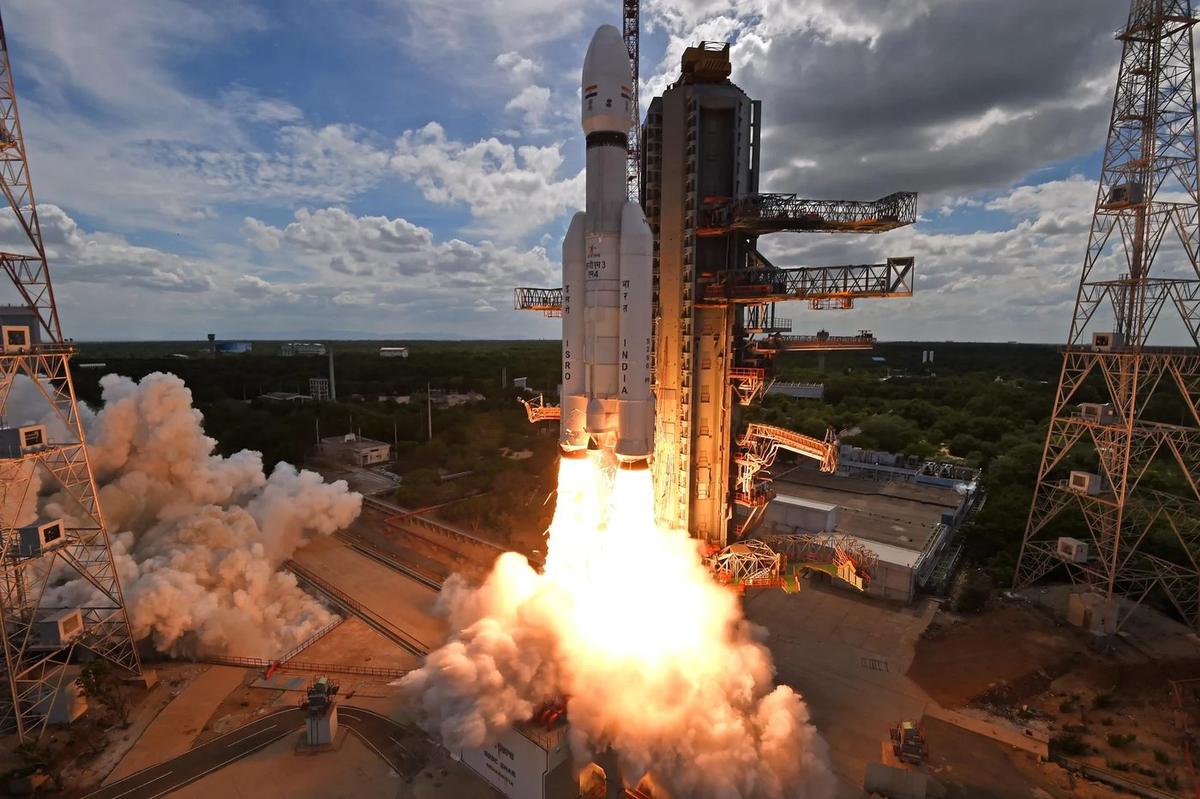
Photo: LVM3 launch, Sriharikota, ISRO, GODL-India

APPSC Group-I Mains 2020 · Paper V
2020 Paper V · Q3(a): model answer
Science, Technology & Environmental Issues · Space, defence and nuclear technology. Held in December 2020 (Notification 27/2018).
Write a brief account of the history of ISRO. Name any three ISRO centers and their location. Add a note about the Mangalyaan or Chandrayaan missions of ISRO.
Syllabus: Space, defence and nuclear technology · Space technology
ISROVikram SarabhaiMangalyaanChandrayaan-3
The Indian Space Research Organisation (ISRO), formed on 15 August 1969, is the research and development arm of the Department of Space (1972) and is headquartered in Bengaluru. Founded on Dr Vikram Sarabhai's vision of using space for national development (communication, weather and resource mapping), it has grown from working out of a church at Thumba to missions to the Moon, Mars and the Sun.
- 1962 INCOSPAR set up under Vikram Sarabhai
- 1963 First sounding rocket from Thumba, Kerala
- 1969 ISRO formed (15 August)
- 1975 Aryabhata, India's first satellite (launched by the USSR)
- 1980 SLV-3 places Rohini in orbit
- 1988 IRS-1A, first operational Indian remote-sensing satellite
- 1994 First successful PSLV flight
- 2008 Chandrayaan-1
- 2014 Mangalyaan enters Mars orbit
- 2023 Chandrayaan-3 lands near the lunar south pole; Aditya-L1 launched
- 2025 SpaDeX docking; NASA–ISRO NISAR launched
1. A brief history
- Beginnings (1962–72): the Indian National Committee for Space Research (INCOSPAR) chose Thumba, near the magnetic equator, for rocket research; ISRO followed in 1969, and the Space Commission and Department of Space in 1972.
- Building capability (1975–90): Aryabhata (1975); the SITE experiment (1975–76) beamed educational TV to about 2,400 villages; SLV-3 (1980, project director A.P.J. Abdul Kalam) made India a launching nation; the INSAT and IRS series began.
- Operational launchers (1990s–2010s): PSLV became the workhorse, GSLV flew with an indigenous cryogenic stage from 2014, and a PSLV placed 104 satellites in one flight (2017).
- Exploration and reform (2008–2026): Chandrayaan-1, Mangalyaan, Aditya-L1 and SpaDeX docking (2025); NSIL (2019), IN-SPACe (2020) and the Indian Space Policy, 2023 opened space to private firms, and Skyroot's Vikram-1 became India's first private orbital rocket (July 2026). Gaganyaan's uncrewed G1 mission had not flown by October 2026; a crewed flight is targeted for 2027.
2. Three ISRO centres and their locations
| Centre | Location | Role |
|---|---|---|
| Vikram Sarabhai Space Centre (VSSC) | Thiruvananthapuram, Kerala | Designs and builds launch vehicles |
| U R Rao Satellite Centre (URSC) | Bengaluru, Karnataka | Designs and builds satellites |
| Satish Dhawan Space Centre (SDSC-SHAR) | Sriharikota, Andhra Pradesh | India's spaceport |
| Liquid Propulsion Systems Centre (LPSC) | Valiamala (Kerala) and Bengaluru | Liquid and cryogenic engines |
| Space Applications Centre (SAC) | Ahmedabad, Gujarat | Payloads and applications |
| National Remote Sensing Centre (NRSC) | Hyderabad, Telangana | Satellite data and disaster maps |
3. Mangalyaan (Mars Orbiter Mission)
- Launched by PSLV-C25 on 5 November 2013, it entered Mars orbit on 24 September 2014, making India the first Asian country to reach Mars orbit and the first in the world to do so at the first attempt.
- It cost about ₹450 crore, far less than comparable missions. Designed for six months, it worked for about eight years until contact was lost in 2022, studying the Martian surface and atmosphere.
4. Chandrayaan missions
- Chandrayaan-1 (2008): its instruments, including NASA's Moon Mineralogy Mapper, helped find water molecules on the Moon.
- Chandrayaan-2 (2019): the orbiter still works, though the lander crashed.
- Chandrayaan-3 (2023): the Vikram lander touched down near the south pole on 23 August 2023 (Shiv Shakti point), making India the fourth country to soft-land on the Moon and the first near its south pole; the Pragyan rover confirmed sulphur in the lunar soil. 23 August is now National Space Day.
- Next: Chandrayaan-4 to bring back lunar samples (targeted for 2028) and LUPEX with Japan.
AP angle: every Indian orbital launch so far has lifted off from SDSC-SHAR, Sriharikota (Tirupati district), where a Third Launch Pad was approved in January 2025; NARL at Gadanki studies the atmosphere.
From carrying the APPLE satellite on a bullock cart (1981) to landing near the lunar south pole, ISRO shows the power of frugal innovation; reliable launchers and private partners will shape its next phase.
The other choice in Q3
Answer either one in the exam.
Every model answer on these pages is free to read. The Tool Kit adds four PDF books for Mains Papers I–IV: every previous question sorted by syllabus, with practice questions. It is in the ₹149 All-in-One Pass, with every previous paper of every exam on the site, practice quizzes, timed tests, mock test series and study books.
₹149 · valid for 12 months from the day you pay, on every exam · pay by UPI, card or net banking