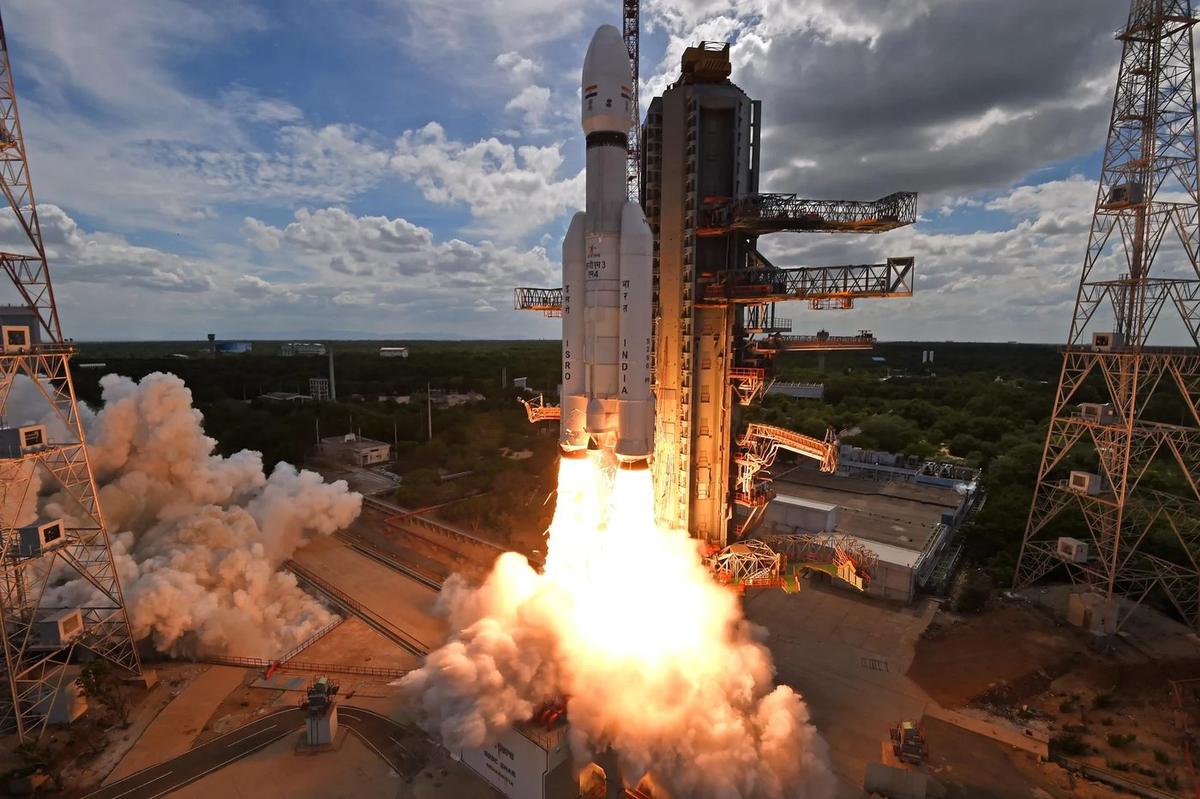
Photo: LVM3 launch, Sriharikota, ISRO, GODL-India

APPSC Group-I Mains 2020 · Paper V
2020 Paper V · Q1(b): model answer
Science, Technology & Environmental Issues · Science and technology policy, institutions and IPR. Held in December 2020 (Notification 27/2018).
Telangana has several Central Government Institutions suitable for research funded by the Department of Science and Technology. These include BITS, CCMB, CDFD, CRIDA, DRDO, ICRISAT, IICT, NALSAR, NGRAU, and NIN. (i) How should these institutions contribute towards education of B.A./B.Com./B.Sc. students in TS? (ii) Write short notes about the mission and contributions of any two of these Institutions in Science/Technology in India.
Syllabus: Science and technology policy, institutions and IPR · Science and technology policy and institutions
Research institutesScience outreachCSIR-CCMBICMR-NIN
Hyderabad is one of India's largest science clusters, though not all the bodies named are DST-funded central institutions. CCMB and IICT are CSIR laboratories, CDFD a DBT institute, NIN an ICMR institute, CRIDA an ICAR institute and ICRISAT an international centre. BITS Pilani's Hyderabad campus is a private deemed university and NALSAR a State law university, while NGRAU (ANGRAU) moved its headquarters to Lam, Guntur (AP) after 2014 and its Telangana part became PJTSAU, now Professor Jayashankar Telangana Agricultural University.
| Institution | Parent body / status | Main field |
|---|---|---|
| CCMB (1977) | CSIR laboratory | Modern biology, genomics |
| IICT | CSIR laboratory | Chemical technology, drugs, pesticides |
| CDFD | DBT autonomous institute (now under BRIC) | DNA fingerprinting, diagnostics |
| NIN (1918) | ICMR institute | Nutrition |
| CRIDA (1985) | ICAR institute | Dryland, climate-resilient farming |
| ICRISAT (1972) | International (CGIAR) | Sorghum, millets, chickpea, pigeonpea, groundnut |
| DRDO labs (DRDL, RCI) | Ministry of Defence | Missiles and avionics |
| ANGRAU (AP); Prof. Jayashankar Telangana Agricultural University | State agricultural universities | Farm education, research, extension |
| BITS Pilani Hyderabad; NALSAR | Private deemed university; State law university | Engineering and science; law and IPR |
1. Contribution to B.A., B.Com. and B.Sc. education
- Research exposure: summer internships and student projects through CSIR's Jigyasa student–scientist programme, DST's INSPIRE camps and the science academies' summer fellowships.
- Shared facilities: labs listed on the national I-STEM portal can be opened to college students and teachers; open days on National Science Day (28 February) build interest.
- Teacher training and curricula: refresher courses and faculty internships; help in designing research components of the four-year degrees under NEP 2020; ANRF's PAIR hub-and-spoke model links leading institutes with State universities.
- Beyond science students: B.Com. students can learn technology management, IPR and agribusiness (ICRISAT's agri-business incubator); B.A. students nutrition and public health (NIN), law and IPR (NALSAR) and science communication.
- Skills and online learning: certificate courses, apprenticeships and MOOCs on SWAYAM taught by scientists.
2. CSIR-Centre for Cellular and Molecular Biology (CCMB)
- Mission: frontier research in modern biology and its use in health, agriculture and conservation (founded in 1977 under P.M. Bhargava).
- DNA fingerprinting: Lalji Singh developed India's DNA fingerprinting at CCMB, used in criminal and paternity cases; CDFD grew out of this work.
- Agriculture and conservation: with ICAR-IIRR it bred bacterial-blight-resistant Improved Samba Mahsuri rice; its LaCONES laboratory conserves the genes of endangered species.
- Public health: sequenced SARS-CoV-2 variants as an INSACOG laboratory and tested sewage to track Covid-19 spread.
3. ICMR-National Institute of Nutrition (NIN)
- Mission: research on India's nutrition problems; set up at Coonoor in 1918 and moved to Hyderabad in 1958.
- Standards: the Dietary Guidelines for Indians (revised 2024), Recommended Dietary Allowances and the Indian Food Composition Tables (2017).
- Interventions: developed double-fortified salt (iodine plus iron); its studies shaped programmes against vitamin A, iodine and iron deficiency, the mid-day meal and ICDS.
AP angle: Andhra Pradesh has comparable institutions that can adopt degree colleges in the same way.
Schematic map of Andhra Pradesh (2011 census district outlines), not to scale; for study only.
Opening these laboratories to ordinary degree colleges would spread scientific temper (Article 51A(h)) beyond elite campuses and build the research workforce that a knowledge economy needs.
The other choice in Q1
Answer either one in the exam.
Every model answer on these pages is free to read. The Tool Kit adds four PDF books for Mains Papers I–IV: every previous question sorted by syllabus, with practice questions. It is in the ₹149 All-in-One Pass, with every previous paper of every exam on the site, practice quizzes, timed tests, mock test series and study books.
₹149 · valid for 12 months from the day you pay, on every exam · pay by UPI, card or net banking