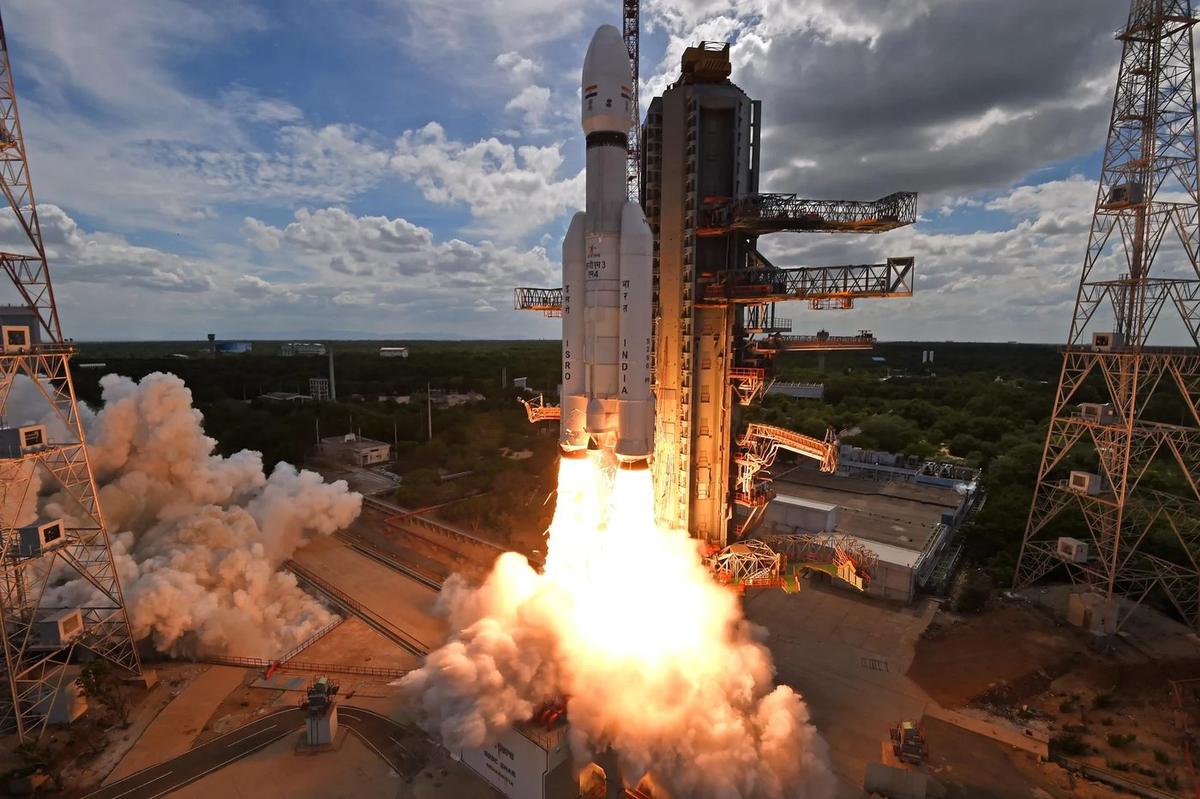
Photo: LVM3 launch, Sriharikota, ISRO, GODL-India

APPSC Group-I Mains 2025 · Paper V
2025 Paper V · Q6(b): model answer
Science, Technology & Environmental Issues · Pollution, waste and climate change. Held in May 2025 (Notification 12/2023).
Define sustainable development and critically evaluate its relevance in the context of modern industrialization.
Syllabus: Pollution, waste and climate change · Climate change and sustainable development
Sustainable developmentBrundtland ReportIndustrialisationDecoupling
The Brundtland Report (Our Common Future, 1987) defined sustainable development as "development that meets the needs of the present without compromising the ability of future generations to meet their own needs". It rests on three pillars, economic, social and environmental, and is now framed by the 17 SDGs of the 2030 Agenda (2015). Modern industrialisation drives growth and jobs but also causes much of today's pollution, resource depletion and greenhouse-gas emissions.
1. Core principles
- Equity: fair shares for future generations (intergenerational) and for the poor today (intragenerational).
- Precaution and polluter pays: prevent harm and make polluters bear its cost, both upheld by the Supreme Court in the Vellore Citizens' Welfare Forum case (1996).
- Carrying capacity: use renewable resources within their rate of regeneration.
2. Relevance to modern industrialisation
- Environmental limits: industry, power and transport drive air and water pollution and climate change; under NCAP only 14 cities met the PM10 standard in 2025-26.
- Resource security: India imports nearly 89% of its crude oil and most critical minerals, so efficiency and recycling reduce risk.
- Trade: buyers demand clean supply chains, and the EU's CBAM (definitive phase from January 2026) taxes the carbon in imported steel, aluminium and cement.
- Safety and social licence: disasters such as Bhopal (1984) and the LG Polymers leak in Visakhapatnam (2020) show the cost of ignoring safety.
- Economic gains: cheap solar power, energy efficiency and green jobs make clean growth profitable.
| Aspect | Conventional model | Sustainable model |
|---|---|---|
| Resource use | Linear: take, make, dispose | Circular: reduce, reuse, recycle |
| Energy | Coal and oil | Renewables, green hydrogen |
| Pollution | End-of-pipe treatment | Prevention, cleaner production |
| Measure of success | Output and profit | People, planet and profit |
| Accountability | Voluntary | EPR, ESG disclosure (BRSR) |
3. Critical evaluation
- Development first: India's per-capita emissions are low and developing countries need carbon space; under CBDR-RC, rich countries must lead and pay.
- A vague goal: "sustainable" is easily used for greenwashing, and GDP still ignores the loss of natural capital.
- Costs: clean technology is costly for MSMEs, and promised climate finance (US$300 billion a year by 2035) falls short of needs.
- Weak enforcement: poor EIA reports and attempts at post-facto approval; in the Vanashakti case (July 2026) the Supreme Court held that prior clearance is the rule.
- Yet decoupling is possible: India's emissions intensity of GDP fell 36% between 2005 and 2020, and non-fossil sources passed half of installed power capacity in June 2025.
4. Tools for sustainable industrialisation
PAT and the Carbon Credit Trading Scheme (2023), ZED certification for MSMEs, EPR rules for plastics, e-waste and batteries, SEBI's BRSR disclosures, the National Green Hydrogen Mission (2023) and Mission LiFE.
AP angle: the Integrated Clean Energy Policy 2024, NTPC's green hydrogen hub at Pudimadaka and the green ammonia complex at Kakinada link industrial growth with clean energy.
Sustainable development is not anti-industry; it asks industry to grow cleaner, circular and fairer, so that today's factories do not borrow from tomorrow's generations.
The other choice in Q6
Answer either one in the exam.
- Q6(a)Investigate the relationship between mining activities and the occurrence of earthquakes. Explain how mining operations can be regulated to minimize seismic risks.
10 marks · Ecology, biodiversity and natural resources · Natural resources, forests and mining
Every model answer on these pages is free to read. The Tool Kit adds four PDF books for Mains Papers I–IV: every previous question sorted by syllabus, with practice questions. It is in the ₹149 All-in-One Pass, with every previous paper of every exam on the site, practice quizzes, timed tests, mock test series and study books.
₹149 · valid for 12 months from the day you pay, on every exam · pay by UPI, card or net banking