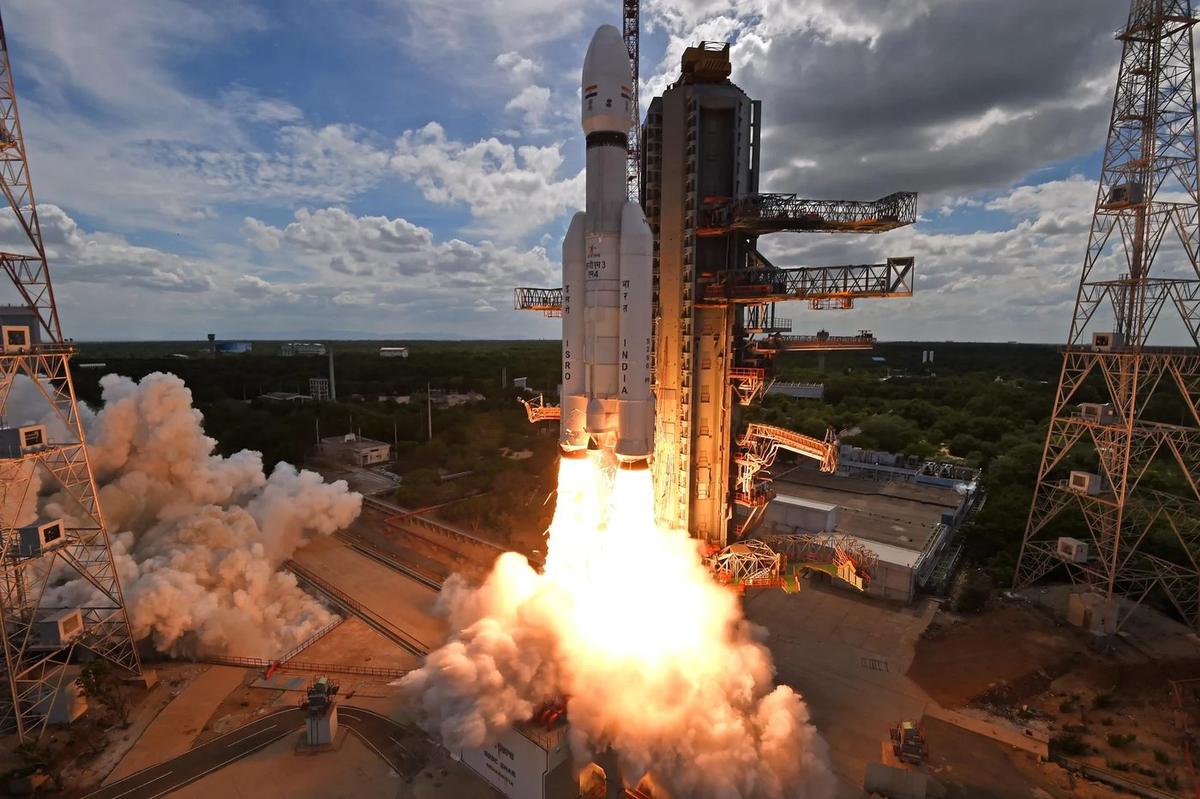
Photo: LVM3 launch, Sriharikota, ISRO, GODL-India

APPSC Group-I Mains 2025 · Paper V
2025 Paper V · Q4(b): model answer
Science, Technology & Environmental Issues · Space, defence and nuclear technology. Held in May 2025 (Notification 12/2023).
Discuss the vision and mission of DRDO? Describe the role of DRDO in the contribution to national development.
Syllabus: Space, defence and nuclear technology · Defence technology
DRDOSelf-relianceDefence technologySpin-off technologies
The Defence Research and Development Organisation (DRDO) was formed on 1 January 1958 by merging the Army's Technical Development Establishments and the Directorate of Technical Development and Production with the Defence Science Organisation. It works under the Department of Defence R&D, Ministry of Defence, through about 41 laboratories and 5 Young Scientist Laboratories, with a budget of about ₹29,100 crore (2026-27). It is the backbone of India's quest for self-reliance (Aatmanirbharta) in defence.
1. Vision and mission
- Vision: "Empowering the nation with state-of-the-art indigenous Defence and Security technologies and systems."
- Mission (design): design and develop state-of-the-art sensors, weapon systems, platforms and allied equipment for the land, air, sea, space and cyber domains.
- Mission (production): facilitate production and induction of systems developed through its R&D ecosystem, and provide technological solutions that raise the combat effectiveness of the Services.
- Mission (capacity): strengthen defence R&D in Indian industry, S&T institutions and academia, and build test facilities, design certification and skilled manpower.
2. Contribution to national security
| Domain | Systems |
|---|---|
| Missiles | Agni series (Agni-5 MIRV test, Mission Divyastra, 2024), Prithvi, Akash, Nag, Pralay; BrahMos with Russia |
| Aircraft and drones | Tejas light combat aircraft (ADA design), airborne early warning, TAPAS drone |
| Naval systems | Varunastra torpedo, sonars, underwater vehicles (NSTL) |
| Air defence and new weapons | QRSAM, VSHORADS, integrated air defence test (2025), 30 kW laser weapon, hypersonic missile (2024) |
| Space and electronics | Mission Shakti anti-satellite test (2019), electronic-warfare systems |
- Strategic deterrence: the IGMDP (1983), led by Dr A.P.J. Abdul Kalam, overcame technology denial and built the missile backbone of India's nuclear deterrent.
- Combat edge: the DRDO-developed Akash air-defence system was among the indigenous systems credited in Operation Sindoor (2025).
3. Role in national development
- Industrial base and jobs: Development-cum-Production Partners, transfer of technology and the Technology Development Fund for MSMEs and start-ups spread capability. Defence production reached a record ₹1.78 lakh crore and exports a record ₹38,424 crore in 2025-26; DRDO-designed BrahMos (Philippines) and Akash (Armenia) are among the systems exported.
- Import substitution: indigenous systems save foreign exchange and guard against supply cut-offs in war.
- Civilian spin-offs: bio-digester toilets used by Indian Railways; during COVID-19, oxygen plants based on fighter-aircraft oxygen technology and the anti-COVID drug 2-DG.
- Human capital: DRDO trains scientists and funds research in IITs and universities, building a high-technology workforce.
- Internal security and disasters: bomb-disposal and NBC-protection equipment, body armour, avalanche forecasting and high-altitude farming serve the police and civilians.
AP angle: DRDO's NSTL (Visakhapatnam) develops underwater weapons; the National Open Air Range, Kurnool, hosted the laser-weapon test of April 2025; and the foundation stone of a missile test range at Nagayalanka (Krishna district, about ₹1,460 crore) was laid in May 2025.
Challenges: delays (Tejas, the Kaveri engine), cost overruns, continued import of engines and chips, and, until recently, weak partnership with private industry.
DRDO has turned technology denial into self-reliance; focusing on frontier research while industry takes over production can make it a true engine of national development.
The other choice in Q4
Answer either one in the exam.
- Q4(a)Discuss the key objectives and features of the National Policy on Information Technology, 2012. How does it aim to transform India into a digitally empowered society?
10 marks · Emerging technologies, ICT and cyber security · ICT, e-governance and cyber security
Every model answer on these pages is free to read. The Tool Kit adds four PDF books for Mains Papers I–IV: every previous question sorted by syllabus, with practice questions. It is in the ₹149 All-in-One Pass, with every previous paper of every exam on the site, practice quizzes, timed tests, mock test series and study books.
₹149 · valid for 12 months from the day you pay, on every exam · pay by UPI, card or net banking