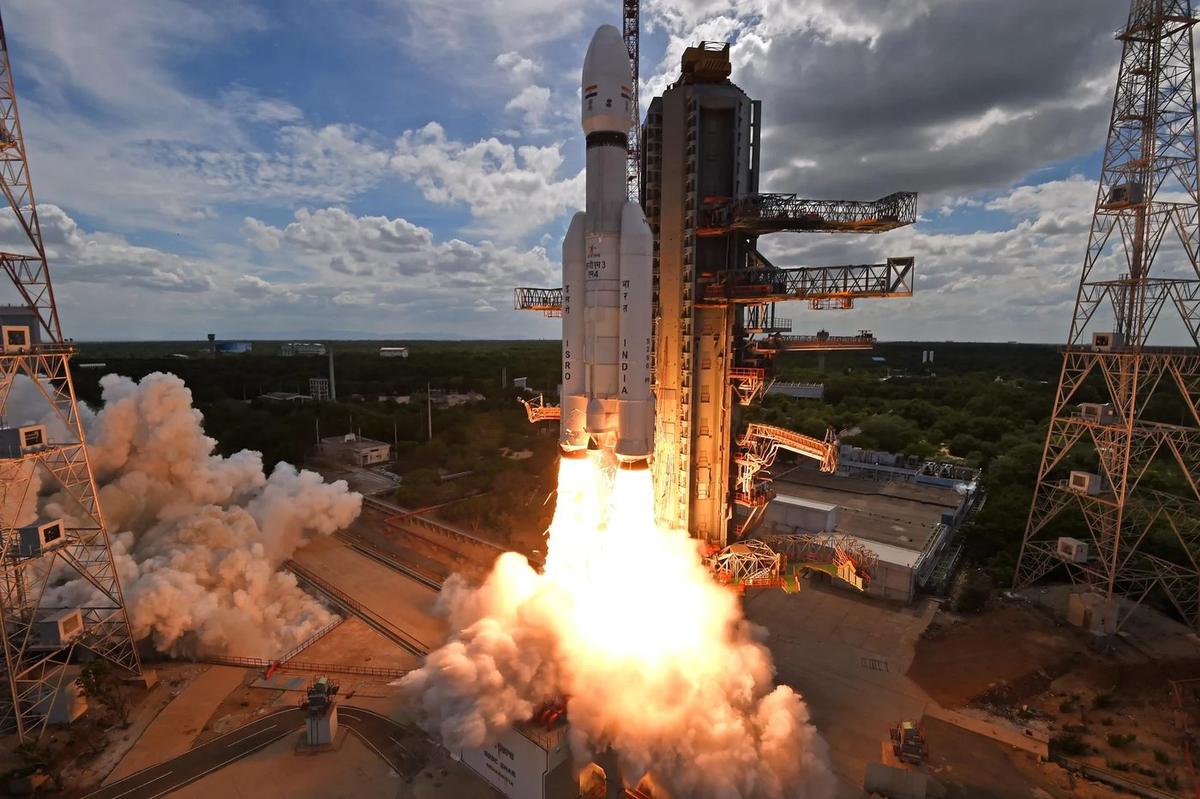
Photo: LVM3 launch, Sriharikota, ISRO, GODL-India

APPSC Group-I Mains 2025 · Paper V
2025 Paper V · Q2(b): model answer
Science, Technology & Environmental Issues · Science and technology policy, institutions and IPR. Held in May 2025 (Notification 12/2023).
Which are the major scientific institutes located in Andhra Pradesh? Discuss the role of IISER Tirupati in the scientific and educational development of the state.
Syllabus: Science and technology policy, institutions and IPR · Science and technology policy and institutions
Scientific institutes of APIISER TirupatiBasic sciencesResearch ecosystem
After bifurcation in 2014, many of the united State's premier laboratories, such as CCMB, IICT, NGRI and INCOIS, remained in Hyderabad. The AP Reorganisation Act, 2014 promised new national institutions, and together with older centres such as SDSC-SHAR and NARL they form Andhra Pradesh's new science base. IISER Tirupati (2015) is its flagship institute for basic sciences.
1. Major scientific institutes
- Space and atmosphere: SDSC-SHAR, Sriharikota, India's spaceport (first launch 1971); NARL, Gadanki, the Department of Space laboratory for atmospheric science with its MST radar.
- Defence and energy: DRDO's NSTL, Visakhapatnam (1969), for torpedoes and underwater systems; the Indian Institute of Petroleum and Energy (IIPE), Visakhapatnam.
- Agriculture: ICAR-NIRCA, Rajamahendravaram, for commercial crops, and ICAR-IIOPR, Pedavegi, for oil palm.
- Higher education and health: IIT Tirupati, IISER Tirupati, NIT Andhra Pradesh (Tadepalligudem), IIITDM Kurnool and AIIMS Mangalagiri; the AP MedTech Zone, Visakhapatnam, India's first medical-devices park (2016).
- Emerging: the Amaravati Quantum Valley (foundation stone 7 February 2026).
Schematic map of Andhra Pradesh (2011 census district outlines), not to scale; for study only.
2. IISER Tirupati: profile
- Origin: set up in 2015 by the Union Education Ministry (then MHRD) under the AP Reorganisation Act as the sixth IISER, with IISER Pune as mentor; the Union Cabinet approved its operation in April 2016 (₹137.30 crore for 2015–18).
- Status and campus: an Institute of National Importance; it began in a transit campus in Tirupati and now runs from its permanent campus at Srinivasapuram–Panguru, Yerpedu mandal, near IIT Tirupati, on about 244 acres earmarked by the State.
- Programmes: a five-year BS-MS, PhD (from 2017), integrated PhD (2018), MS (Research), and a four-year BS in Economics and Statistical Science (from 2025), with joint PhDs with the University of Melbourne and BITS Pilani.
3. Role in the State's scientific development
- A basic-research base: departments of physics, chemistry, biology, mathematics, and earth and climate sciences rebuild the basic-science capacity AP lost with Hyderabad.
- A Tirupati knowledge cluster: IIT Tirupati, NARL and SDSC-SHAR nearby open the way to joint work in atmospheric and climate science, materials and data science.
- Funding and talent: competitive national grants (ANRF, DST, DBT) and faculty recruited from India and abroad bring research money and skills into the State.
4. Role in educational development
- Research-led teaching: students do laboratory work and projects from the early years, producing scientists, teachers and data professionals.
- Access and balance: a premier national institute in Rayalaseema widens opportunities for AP students and spreads development beyond the coastal cities.
- Outreach: science programmes for school students and teachers spread scientific temper (Article 51A(h)).
Challenges: completing campus facilities, attracting and keeping faculty, and building industry links, for example with the Tirupati–Sri City industrial belt.
From SHAR to the Quantum Valley, Andhra Pradesh's institutes give it a base for a knowledge economy; IISER Tirupati's research-integrated model can make the State a producer, not just a consumer, of science.
The other choice in Q2
Answer either one in the exam.
- Q2(a)Discuss the discovery of Raman effect by Dr. C.V. Raman. How did his work impact the global scientific community?
10 marks · Science and technology policy, institutions and IPR · Science and technology policy and institutions
Every model answer on these pages is free to read. The Tool Kit adds four PDF books for Mains Papers I–IV: every previous question sorted by syllabus, with practice questions. It is in the ₹149 All-in-One Pass, with every previous paper of every exam on the site, practice quizzes, timed tests, mock test series and study books.
₹149 · valid for 12 months from the day you pay, on every exam · pay by UPI, card or net banking