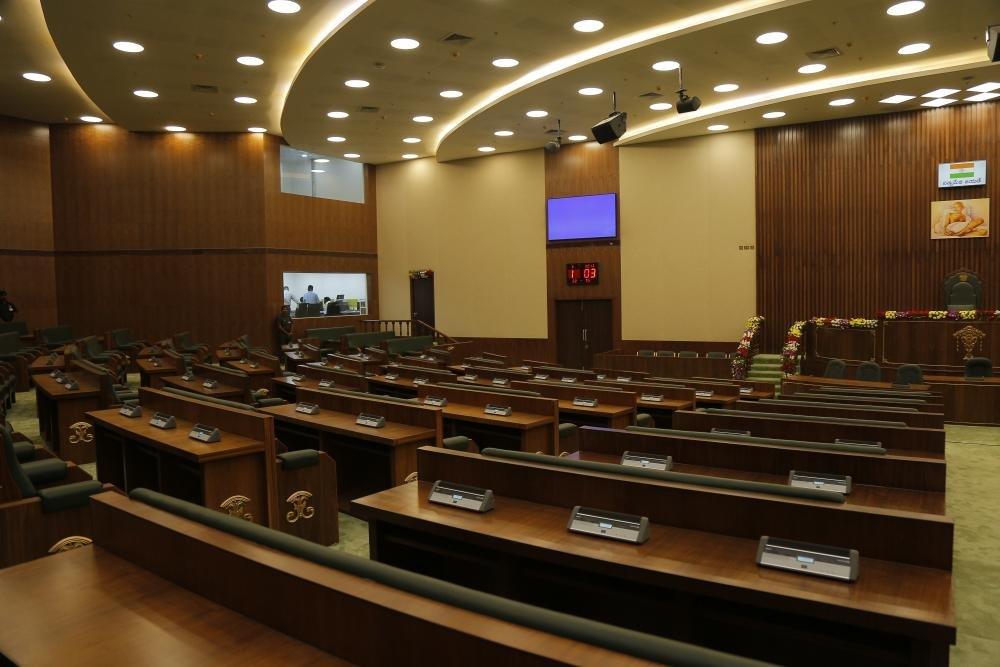
Photo: Andhra Pradesh Legislative Assembly, Kdslk, CC0

APPSC Group-I Mains 2020 · Paper III
2020 Paper III · Q7(b): model answer
Polity, Constitution, Governance, Law & Ethics · Running the government: administration, policies and civil services. Held in December 2020 (Notification 27/2018).
Describe the role of NGOs and Civil Services in Democracy.
Syllabus: Running the government: administration, policies and civil services · Civil services: role, reforms and integrity
Permanent executiveSteel frameCivil societyParticipatory democracy
Democracy needs both a competent, neutral state machinery and an active citizenry. Civil services are the permanent executive that advises elected governments and implements their policies; NGOs are voluntary, non-profit bodies outside the state that voice citizens' concerns, deliver services and hold power to account. Together they link the ballot box to everyday governance.
1. Role of civil services
- Continuity and stability: they provide continuity amid changing governments; Sardar Patel called the All-India Services the "steel frame".
- Policy advice and implementation: they give expert advice to ministers and implement laws and schemes down to the village.
- Rule of law and neutrality: they uphold constitutional values impartially, supported by Article 311 safeguards and the conduct rules.
- Welfare and crisis management: they deliver welfare and lead disaster response, as in AP's handling of Cyclone Hudhud (2014).
- Elections: district collectors serve as District Election Officers, conducting free and fair elections.
- Impartial service: recruitment on merit by the UPSC and State PSCs lets officers treat all citizens equally, whichever party is in power.
- Example: S.R. Sankaran, an AP-cadre IAS officer, is remembered for his work on bonded labour and SC/ST welfare.
2. Role of NGOs
- Advocacy: the MKSS campaign in Rajasthan led to the RTI Act, 2005.
- Watchdog: ADR's petitions secured disclosure of candidates' criminal and financial records; NGOs also support social audits.
- Last-mile service delivery: the Rural Development Trust (Anantapur, 1969) works in health, education and drought relief.
- Empowerment and social capital: SEWA and women's self-help groups give voice to the poor and to women.
- Policy innovation: NGO experiments are often scaled up by government; MYRADA's self-help groups grew into NABARD's SHG–bank linkage programme (1992).
| Basis | Civil services | NGOs |
|---|---|---|
| Source of authority | Constitution and law | Voluntary association of citizens |
| Accountability | To ministers, legislature and courts | To members, donors and the public |
| Main strength | Scale, continuity, legal power | Flexibility, trust, grassroots reach |
| Main weakness | Red tape, politicisation | Donor dependence, weak accountability |
3. Challenges
- Civil services: politicisation, red tape, frequent transfers and resistance to change.
- NGOs: weak internal accountability, donor dependence and misuse of foreign funds, regulated under the FCRA, 2010.
- Mutual distrust: officials may see NGOs as obstructive and NGOs may see officials as unresponsive; regular consultation bridges this gap.
4. Partnership: AP's Society for Elimination of Rural Poverty (SERP, 2000) shows how government and community institutions can together build strong women's SHG federations.
In conclusion, a healthy democracy needs an accountable, people-oriented civil service working in partnership with a responsible, transparent NGO sector.
The other choice in Q7
Answer either one in the exam.
- Q7(a)Define ‘developmentʼ as explained by Prof. Amartya Sen. Explain the characteristics of the new development thinking, and also mention the four areas where the government has to play a crucial role.
10 marks · Running the government: administration, policies and civil services · Government development policies and why implementation falls short
Every model answer on these pages is free to read. The Tool Kit adds four PDF books for Mains Papers I–IV: every previous question sorted by syllabus, with practice questions. It is in the ₹149 All-in-One Pass, with every previous paper of every exam on the site, practice quizzes, timed tests, mock test series and study books.
₹149 · valid for 12 months from the day you pay, on every exam · pay by UPI, card or net banking