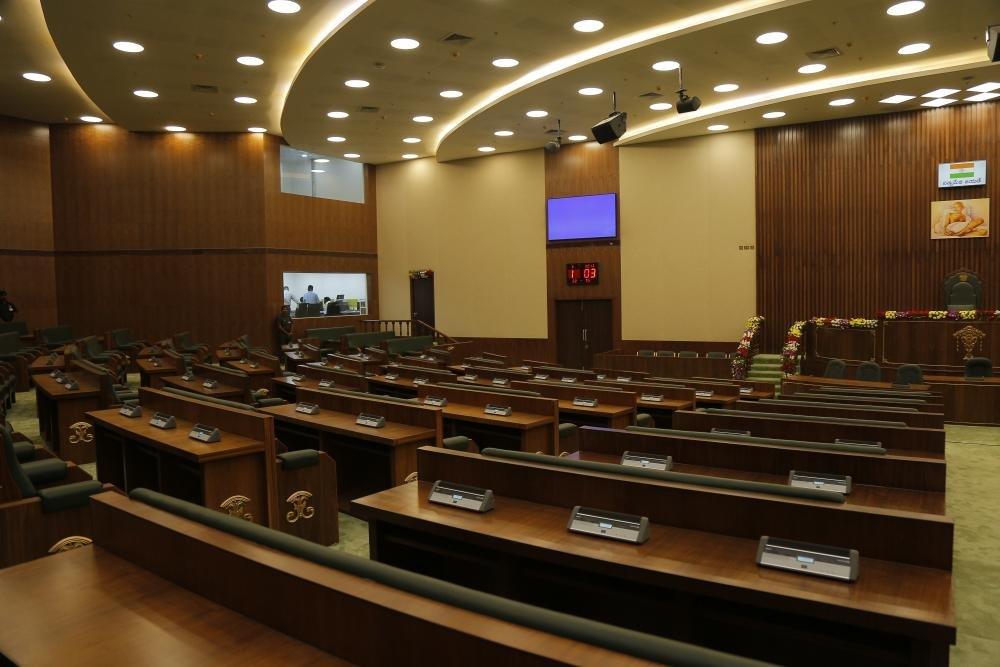
Photo: Andhra Pradesh Legislative Assembly, Kdslk, CC0

APPSC Group-I Mains 2020 · Paper III
2020 Paper III · Q6(a): model answer
Polity, Constitution, Governance, Law & Ethics · Running the government: administration, policies and civil services. Held in December 2020 (Notification 27/2018).
Define public administration and explain its evolution in India.
Syllabus: Running the government: administration, policies and civil services · What public administration is and its history (Kautilya to British rule)
Public administrationPOSDCORBSteel frameCitizen-centric governance
Public administration is the organisation and management of the government machinery to implement public policy and deliver public services. Woodrow Wilson ("The Study of Administration", 1887) called it the "detailed and systematic execution of public law", and L.D. White defined it as all operations aimed at the fulfilment or enforcement of public policy. Luther Gulick's POSDCORB (1937) summed up its managerial tasks. In India it has evolved over two thousand years from royal administration to a constitutional, welfare-oriented system.
1. Nature of public administration
- Integral and managerial views: the integral view includes all activities, from manual to managerial; the managerial view (Gulick, Simon) counts only planning, organising, directing and controlling.
- Public character: unlike business, it works under political direction, the rule of law and public accountability, and must treat all citizens equally rather than seek profit.
- Mauryan era Kautilya's Arthashastra describes a salaried bureaucracy
- 16th century Mughal mansabdari system and Todar Mal's revenue settlement
- 1773 Regulating Act begins Parliament's control over the Company
- 1855 First open competitive examination for the ICS
- 1882 Ripon's resolution on local self-government
- 1926 Public Service Commission set up
- 1950 Constitution: All-India Services; Planning Commission
- 2005 Second Administrative Reforms Commission; RTI Act
- 2019–25 AP village and ward secretariats; Mana Mitra WhatsApp governance
2. Ancient and medieval period
- Mauryan administration: Kautilya's Arthashastra described ministers, salaried adhyakshas (superintendents), a revenue system and espionage; Ashoka appointed dhamma-mahamattas for public welfare.
- Local self-rule: Chola inscriptions at Uttaramerur describe elected village assemblies; the Guptas allowed greater provincial autonomy.
- Medieval period: the Delhi Sultanate used the iqta system; the Mughals built a centralised structure of mansabdars, subas, sarkars and parganas, with Todar Mal's zabti revenue system.
- South India: Vijayanagara had the nayankara system and ayagars (village functionaries); Krishnadevaraya's Amuktamalyada discusses statecraft.
3. British period
- Civil service: Cornwallis, "father of civil services in India", organised the service; open competition for the ICS began in 1855 after the Macaulay Committee (1854).
- District administration: the district collector became the pivot. Thomas Munro, Collector of the Ceded Districts (Rayalaseema), developed the ryotwari system.
- Institutions: Ripon's resolution (1882) promoted local self-government, and the Government of India Acts of 1919 and 1935 provided for Public Service Commissions.
4. Post-independence period
- Constitutional basis: Articles 308–323 provide for the services and Public Service Commissions; the All-India Services (Art 312) became Sardar Patel's "steel frame".
- Development administration: the Planning Commission (1950) and the Community Development Programme (1952) turned administration towards development.
- Reforms: two Administrative Reforms Commissions (1966, 2005), the RTI Act (2005), NITI Aayog (2015) and Mission Karmayogi (2020).
- AP angle: village and ward secretariats (2019) and "Mana Mitra" WhatsApp governance (2025) show the shift to doorstep and digital delivery.
In conclusion, Indian administration has moved from a revenue-and-order state to a welfare and development state; its future lies in citizen-centric, accountable and technology-enabled governance.
The other choice in Q6
Answer either one in the exam.
- Q6(b)Differentiate between the administrative ideas in Kautilya's Arthashashtra and the Mughal administration.
10 marks · Running the government: administration, policies and civil services · What public administration is and its history (Kautilya to British rule)
Every model answer on these pages is free to read. The Tool Kit adds four PDF books for Mains Papers I–IV: every previous question sorted by syllabus, with practice questions. It is in the ₹149 All-in-One Pass, with every previous paper of every exam on the site, practice quizzes, timed tests, mock test series and study books.
₹149 · valid for 12 months from the day you pay, on every exam · pay by UPI, card or net banking