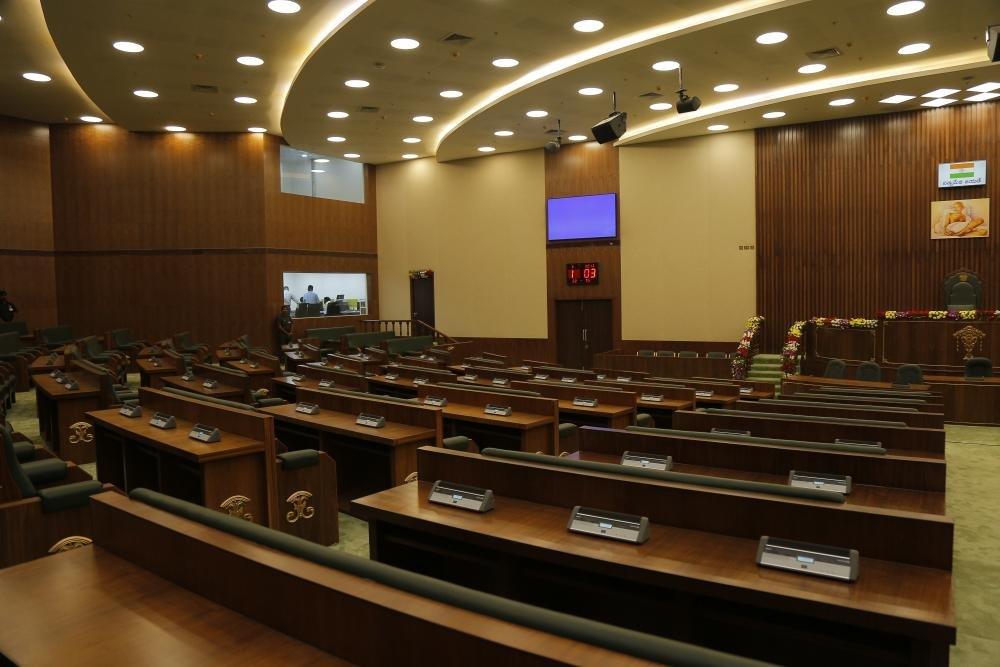
Photo: Andhra Pradesh Legislative Assembly, Kdslk, CC0

APPSC Group-I Mains 2020 · Paper III
2020 Paper III · Q5(b): model answer
Polity, Constitution, Governance, Law & Ethics · Panchayats and municipalities. Held in December 2020 (Notification 27/2018).
Describe the salient features of the Rural and Urban Local Governance under the 73rd and 74th Constitutional Amendment Act.
Syllabus: Panchayats and municipalities · 73rd and 74th Amendments: what panchayats and municipalities get
Gram SabhaPanchayati RajUrban local bodiesDevolution
The 73rd and 74th Amendment Acts, 1992 turned local bodies from creatures of State law into constitutionally mandated "institutions of self-government", giving effect to Article 40 (DPSP). Part IX deals with rural local governance (panchayats) and Part IXA with urban local governance (municipalities); both share common democratic features while reflecting the different needs of villages and towns.
| Feature | Rural (73rd, Part IX) | Urban (74th, Part IXA) |
|---|---|---|
| Basic unit | Gram Sabha of all village voters (Art 243A) | Ward committees in municipalities of 3 lakh+ (Art 243S) |
| Structure | Village, intermediate and district panchayats | Nagar panchayat, municipal council, municipal corporation (Art 243Q) |
| Functions | 29 subjects, Eleventh Schedule (Art 243G) | 18 subjects, Twelfth Schedule (Art 243W) |
| Planning | District Planning Committee (Art 243ZD) | Metropolitan Planning Committee for 10 lakh+ (Art 243ZE) |
| Chairpersons | Upper two tiers elected indirectly | Mode left to State law |
1. Rural local governance (Part IX)
- Gram Sabha: the assembly of all registered voters of a village is the base of direct democracy; it approves plans, selects beneficiaries and conducts social audits.
- Three tiers: gram panchayat, intermediate (block or mandal) and district panchayat; all members are directly elected, while the chairpersons of the upper two tiers are elected indirectly.
- Functions: plans for "economic development and social justice" on subjects such as agriculture, drinking water, primary education, health and poverty alleviation.
- Tribal areas: PESA, 1996 gives Gram Sabhas in Fifth Schedule areas control over minor forest produce and protection against land alienation.
2. Urban local governance (Part IXA)
- Three types: a nagar panchayat for an area in transition from rural to urban, a municipal council for a smaller and a municipal corporation for a larger urban area.
- Functions: urban planning, water supply, public health, slum improvement and fire services (Art 243W).
- Metropolitan planning: Metropolitan Planning Committees prepare development plans for large cities.
- Finance: States may authorise municipalities to levy taxes, duties, tolls and fees (Art 243X), and the State Finance Commission reviews their finances.
3. Common features
- Democratic base: direct elections, a five-year term and fresh elections within six months of dissolution.
- Social inclusion: at least one-third of seats for women and SC/ST reservation in proportion to population.
- Independent institutions: a State Election Commission and a State Finance Commission every five years.
4. Andhra Pradesh angle
- Early start: AP was the second State after Rajasthan to adopt Panchayati Raj (1959), and in 1986 replaced panchayat samitis with Mandal Praja Parishads.
- Present law: the AP Panchayat Raj Act, 1994 provides the three tiers below, and the AP Municipalities Act, 1965 governs towns.
5. Challenges: limited devolution of funds and staff, dependence on State grants, parallel bodies and delayed elections.
In conclusion, effective local governance needs genuine devolution of funds, functions and functionaries, timely elections and capacity building of elected representatives.
The other choice in Q5
Answer either one in the exam.
- Q5(a)Define judicial activism with special reference to PIL and SAL. Judicial activism has had manifold impact on the political system. Justify the statement adding suitable arguments.
10 marks · Courts and judicial review · Public Interest Litigation (PIL) and judicial activism
Every model answer on these pages is free to read. The Tool Kit adds four PDF books for Mains Papers I–IV: every previous question sorted by syllabus, with practice questions. It is in the ₹149 All-in-One Pass, with every previous paper of every exam on the site, practice quizzes, timed tests, mock test series and study books.
₹149 · valid for 12 months from the day you pay, on every exam · pay by UPI, card or net banking