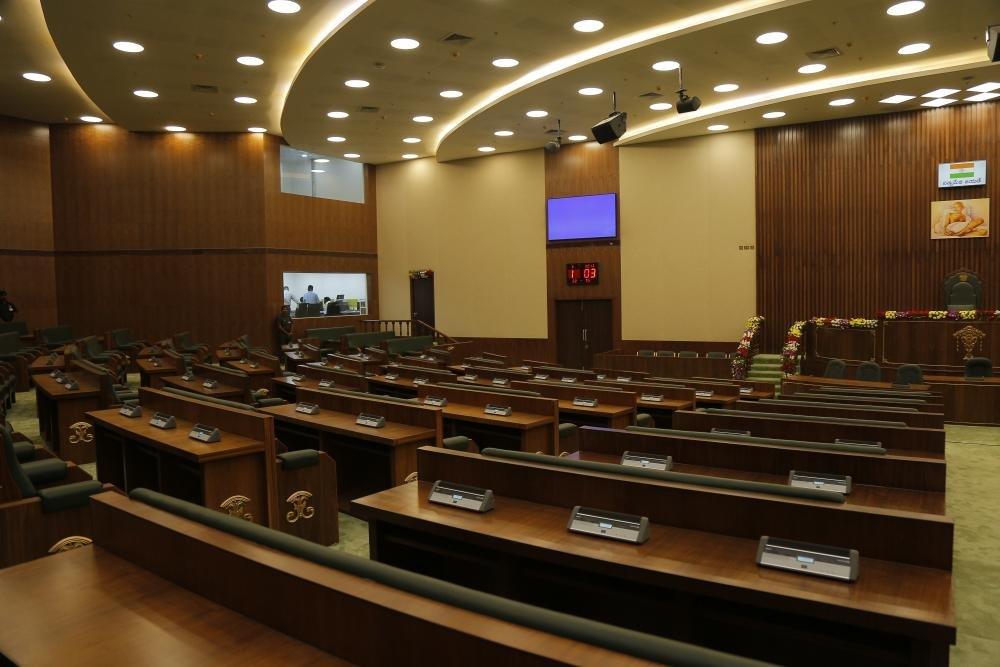
Photo: Andhra Pradesh Legislative Assembly, Kdslk, CC0

APPSC Group-I Mains 2020 · Paper III
2020 Paper III · Q5(a): model answer
Polity, Constitution, Governance, Law & Ethics · Courts and judicial review. Held in December 2020 (Notification 27/2018).
Define judicial activism with special reference to PIL and SAL. Judicial activism has had manifold impact on the political system. Justify the statement adding suitable arguments.
Syllabus: Courts and judicial review · Public Interest Litigation (PIL) and judicial activism
Judicial activismPIL and SALLocus standiJudicial overreach
Judicial activism is the proactive role of the judiciary in protecting rights and promoting justice, compelling the other organs to perform their constitutional duties. The term was coined by Arthur Schlesinger Jr. (USA, 1947); in India it grew from the late 1970s through Justices V.R. Krishna Iyer and P.N. Bhagwati, mainly through Public Interest Litigation (PIL).
1. PIL and SAL
- Relaxed locus standi: any public-spirited person can approach the court on behalf of those who cannot, such as the poor and prisoners (Hussainara Khatoon, 1979; S.P. Gupta, 1981).
- Epistolary jurisdiction: even letters and newspaper reports are treated as writ petitions, as in letters from prisoners about custodial torture.
- New remedies: court-appointed commissions, continuing mandamus and compensation for violation of rights.
- Constitutional basis: the writ jurisdiction under Articles 32 and 226, the power to do "complete justice" (Art 142) and a wide reading of Article 21 after Maneka Gandhi (1978) gave courts the tools.
- Social Action Litigation: Prof. Upendra Baxi called it SAL because, unlike American PIL, it seeks social justice for the poor and deprived.
2. Positive impact on the political system
| Area | Landmark case | Impact |
|---|---|---|
| Accountability | Vineet Narain (1997); Prakash Singh (2006) | CBI and CVC independence; police reform directions |
| Elections | ADR (2002); Lily Thomas (2013); PUCL (2013); electoral bonds (2024) | Candidate disclosures; disqualification of convicted legislators; NOTA; transparency in funding |
| Rights | Vishaka (1997); PUCL right to food (2001) | POSH Act, 2013; cooked mid-day meals |
| Environment | M.C. Mehta (CNG); T.N. Godavarman (forests) | Cleaner air; forest protection |
| Federalism | S.R. Bommai (1994) | Limits on the misuse of Article 356 |
- Accountability: continuing mandamus in Vineet Narain kept investigating agencies under judicial watch, insulating them from political pressure.
- Cleaner politics: disclosure of candidates' criminal, financial and educational records gave voters informed choices.
- Rights and welfare: the right-to-food orders made cooked mid-day meals universal, served in AP today as Dokka Seethamma Madhyahna Badi Bhojanam.
- Federal balance: Bommai made the floor test compulsory and checked arbitrary dismissal of State governments.
3. Concerns
- Judicial overreach: strains the separation of powers, as in the friction over the NJAC verdict (2015); in the Aravali Golf Course case the Supreme Court itself warned judges not to try to run the government.
- Lack of expertise and enforcement capacity: courts cannot monitor complex policies indefinitely.
- Accountability gap: judges are not answerable to voters, so policy-making by courts raises questions of democratic legitimacy.
- Misuse of PIL: frivolous "publicity" PILs add to pendency; State of Uttaranchal v. Balwant Singh Chaufal (2010) laid down guidelines to curb them.
In conclusion, judicial activism has deepened democracy, rights and accountability, which justifies the statement; its legitimacy depends on judicial restraint and respect for the domain of the elected branches.
The other choice in Q5
Answer either one in the exam.
- Q5(b)Describe the salient features of the Rural and Urban Local Governance under the 73rd and 74th Constitutional Amendment Act.
10 marks · Panchayats and municipalities · 73rd and 74th Amendments: what panchayats and municipalities get
Every model answer on these pages is free to read. The Tool Kit adds four PDF books for Mains Papers I–IV: every previous question sorted by syllabus, with practice questions. It is in the ₹149 All-in-One Pass, with every previous paper of every exam on the site, practice quizzes, timed tests, mock test series and study books.
₹149 · valid for 12 months from the day you pay, on every exam · pay by UPI, card or net banking