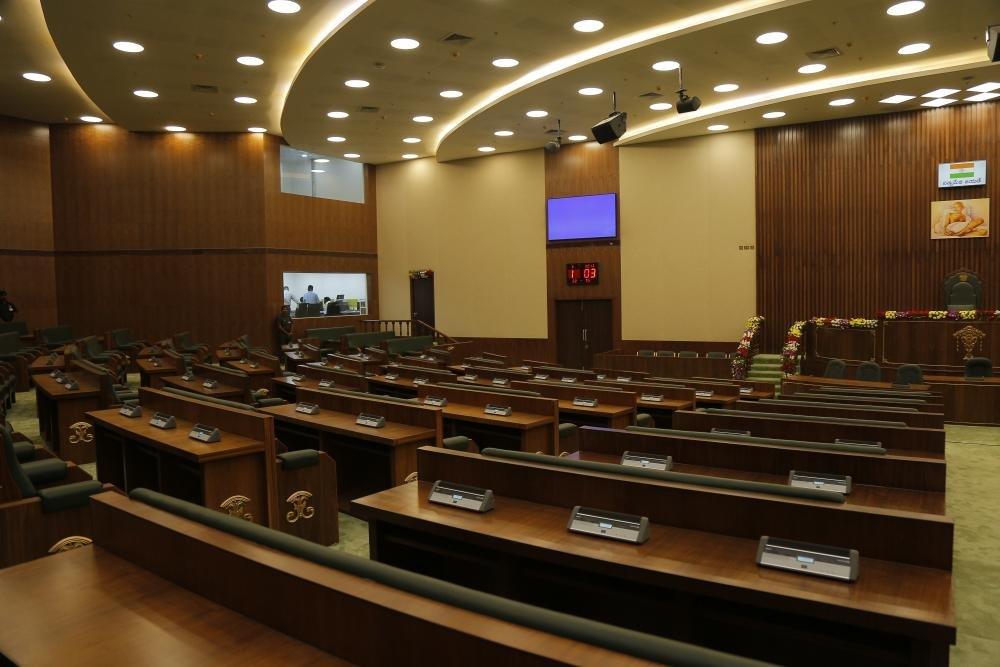
Photo: Andhra Pradesh Legislative Assembly, Kdslk, CC0

APPSC Group-I Mains 2020 · Paper III
2020 Paper III · Q4(b): model answer
Polity, Constitution, Governance, Law & Ethics · The Constitution and our rights. Held in December 2020 (Notification 27/2018).
Explain any five salient features of the Indian Constitution
Syllabus: The Constitution and our rights · How the Constitution was made and its main features
Salient featuresFederalism with unitary biasParliamentary governmentBasic structure
The Constitution of India, adopted on 26 November 1949 and in force from 26 January 1950, is the supreme law of the land. Dr Ambedkar described it as "workable, flexible and strong enough to hold the country together". It blends features borrowed from many constitutions with Indian needs; five salient features stand out.
| Feature | Borrowed from | Key provisions |
|---|---|---|
| Parliamentary government | United Kingdom | Arts 74–75, 163–164 |
| Fundamental Rights, judicial review | USA | Part III (Arts 12–35) |
| Directive Principles | Ireland | Part IV (Arts 36–51) |
| Federation with a strong Centre | Canada | Residuary powers with the Centre (Art 248) |
| Suspension of Fundamental Rights during an Emergency | Germany (Weimar) | Arts 358–359 |
| Fundamental Duties | former USSR | Art 51A |
1. Lengthiest written Constitution
- Size: originally 395 articles, 22 Parts and 8 Schedules; now about 470 articles, 25 Parts and 12 Schedules.
- Reasons: India's vast diversity, a single Constitution for the Centre and the States, special provisions for regions and groups, and the influence of the Government of India Act, 1935.
2. Blend of rigidity and flexibility
- Three methods of amendment: some provisions, such as creating new States (Arts 3–4), need only a simple majority, as with Andhra State (1953) and Andhra Pradesh (1956); most need a special majority (Art 368).
- Federal provisions: these also need ratification by half the States, as with GST (101st Amendment, 2016).
- Limit on amendment: the basic structure doctrine (Kesavananda Bharati, 1973) protects core features.
3. Federal system with a unitary bias
- Federal features: two levels of government, a division of powers in the Seventh Schedule, a written Constitution and an independent judiciary.
- Unitary features: a strong Centre, single citizenship, All-India Services and emergency provisions. The 73rd and 74th Amendments (1992) added a third tier.
4. Parliamentary form of government
- Nominal and real executive: on the Westminster model, the President and the Governors are nominal heads, while the Council of Ministers is the real executive.
- Collective responsibility: ministers are responsible to the lower House (Arts 75, 164), and the Prime Minister or Chief Minister leads the government.
5. Rights, Directives and Duties
- Fundamental Rights (Part III): justiciable and enforceable through Article 32.
- Directive Principles (Part IV): non-justiciable but "fundamental in the governance of the country" (Art 37).
- Fundamental Duties (Art 51A): eleven, added by the 42nd (1976) and 86th (2002) Amendments.
- Harmony: Minerva Mills (1980) held the balance between Parts III and IV to be part of the basic structure.
Other features include universal adult franchise (voting age lowered to 18 by the 61st Amendment, 1988), secularism, an integrated judiciary and independent bodies such as the Election Commission and the CAG.
In conclusion, these features make the Constitution a living document: borrowed in form but Indian in spirit, it has held a diverse nation together through constitutional democracy.
The other choice in Q4
Answer either one in the exam.
- Q4(a)Differentiate between the powers of the Lok Sabha and the Rajya Sabha on the basis of the following parameters: functions and control over election. Explain, with reasons, the powers that are exercised only by the Lok Sabha.
10 marks · Parliament and State Legislatures · Lok Sabha and Rajya Sabha: make-up and powers
Every model answer on these pages is free to read. The Tool Kit adds four PDF books for Mains Papers I–IV: every previous question sorted by syllabus, with practice questions. It is in the ₹149 All-in-One Pass, with every previous paper of every exam on the site, practice quizzes, timed tests, mock test series and study books.
₹149 · valid for 12 months from the day you pay, on every exam · pay by UPI, card or net banking