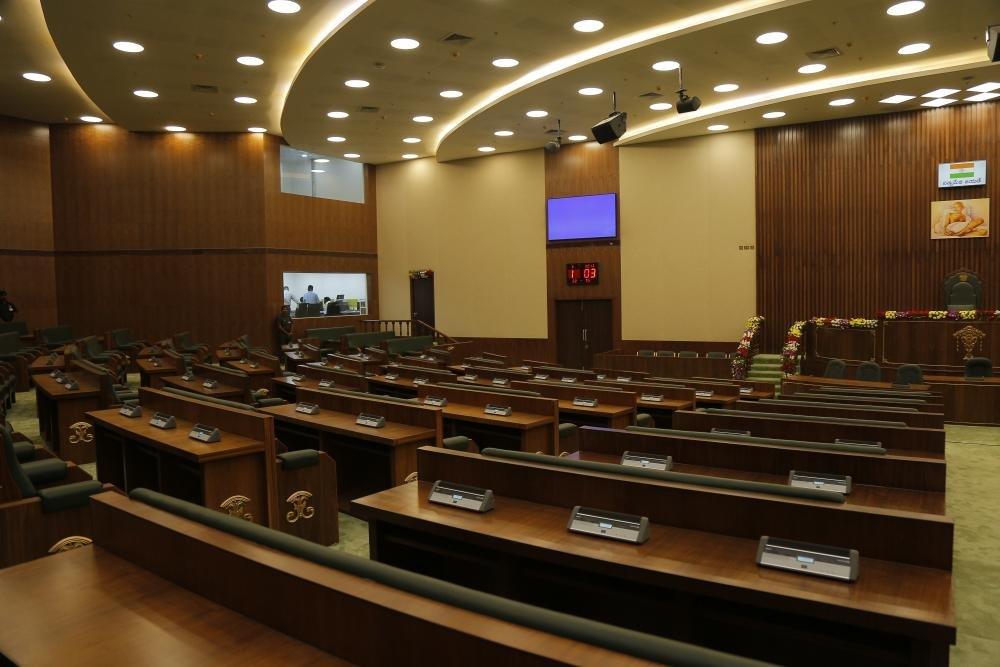
Photo: Andhra Pradesh Legislative Assembly, Kdslk, CC0

APPSC Group-I Mains 2020 · Paper III
2020 Paper III · Q10(b): model answer
Polity, Constitution, Governance, Law & Ethics · Running the government: administration, policies and civil services. Held in December 2020 (Notification 27/2018).
Explain the major governmental interventions in the social sector with special reference to Health and education.
Syllabus: Running the government: administration, policies and civil services · Government development policies and why implementation falls short
Human capitalNational Health MissionRTE ActNEP 2020
The social sector, especially health and education, builds human capital, the foundation of growth and of the capabilities that Amartya Sen stresses. Public health is a State subject, while education was moved to the Concurrent List by the 42nd Amendment (1976), so both the Centre and the States act. Their interventions are guided by Articles 21, 21A, 41, 45 and 47.
| Type | Health | Education |
|---|---|---|
| Rights and law | Right to health read into Art 21 | RTE Act, 2009 (Art 21A) |
| Flagship schemes | National Health Mission; Ayushman Bharat | Samagra Shiksha; PM POSHAN |
| Quality and outcomes | Mission Indradhanush; POSHAN Abhiyaan | NIPUN Bharat; PM SHRI schools |
| Policy | National Health Policy, 2017 | National Education Policy, 2020 |
| Andhra Pradesh | Dr NTR Vaidya Seva | Thalliki Vandanam; Dokka Seethamma meals |
1. Health interventions
- National Health Mission (NRHM 2005, NUHM 2013): ASHA workers, the Janani Suraksha Yojana for institutional deliveries, and free drugs and diagnostics.
- Ayushman Bharat (2018): Ayushman Arogya Mandirs (formerly Health and Wellness Centres) provide primary care, and PM-JAY gives ₹5 lakh per family per year for hospital care, extended in 2024 to all citizens aged 70 and above.
- Prevention and nutrition: Mission Indradhanush (2014) for immunisation and POSHAN Abhiyaan (2018) against malnutrition.
- Digital health and policy: the Ayushman Bharat Digital Mission (2021); the National Health Policy, 2017 targeted public health spending of 2.5% of GDP by 2025.
2. Education interventions
- RTE Act, 2009 (Art 21A, 86th Amendment): free and compulsory education for children aged 6–14, with 25% of entry-level seats in private schools for disadvantaged children.
- Samagra Shiksha (2018): an integrated scheme from pre-school to Class 12.
- Nutrition and learning: PM POSHAN (2021, formerly the Mid-Day Meal Scheme), NIPUN Bharat (2021) for foundational literacy and numeracy, and PM SHRI schools (2022).
- Inclusion: scholarships for SC, ST, OBC and minority students, and Kasturba Gandhi Balika Vidyalayas (residential schools for girls from disadvantaged groups).
- NEP 2020: a 5+3+3+4 structure, mother-tongue instruction in the early years and public spending of 6% of GDP.
3. Andhra Pradesh angle
- Health: Dr NTR Vaidya Seva (formerly Dr YSR Aarogyasri) provides cashless treatment.
- Education: Thalliki Vandanam (2025, replacing Amma Vodi) gives ₹15,000 a year per school-going child from Class 1 to Intermediate (₹2,000 of it for school upkeep); the Dokka Seethamma mid-day meal was extended to 475 government junior colleges in January 2025; Sarvepalli Radhakrishnan Vidyarthi Mitra provides school kits.
4. Gaps
- Health: low public spending and high out-of-pocket costs, and shortages of doctors in rural areas.
- Education: poor learning outcomes, teacher vacancies and dropouts at the secondary level.
In conclusion, higher public spending, a focus on outcomes rather than outlays, and Centre–State convergence are the way forward.
The other choice in Q10
Answer either one in the exam.
- Q10(a)Why does the Indian Government make use of the e-governance strategy? Mention the several initiatives in the journey from e-governance vision to implementation. How can we say that the Indian government is accountable, responsive and legitimate government?
10 marks · Good governance and the citizen's voice · Good governance, e-governance and Citizen's Charter
Every model answer on these pages is free to read. The Tool Kit adds four PDF books for Mains Papers I–IV: every previous question sorted by syllabus, with practice questions. It is in the ₹149 All-in-One Pass, with every previous paper of every exam on the site, practice quizzes, timed tests, mock test series and study books.
₹149 · valid for 12 months from the day you pay, on every exam · pay by UPI, card or net banking