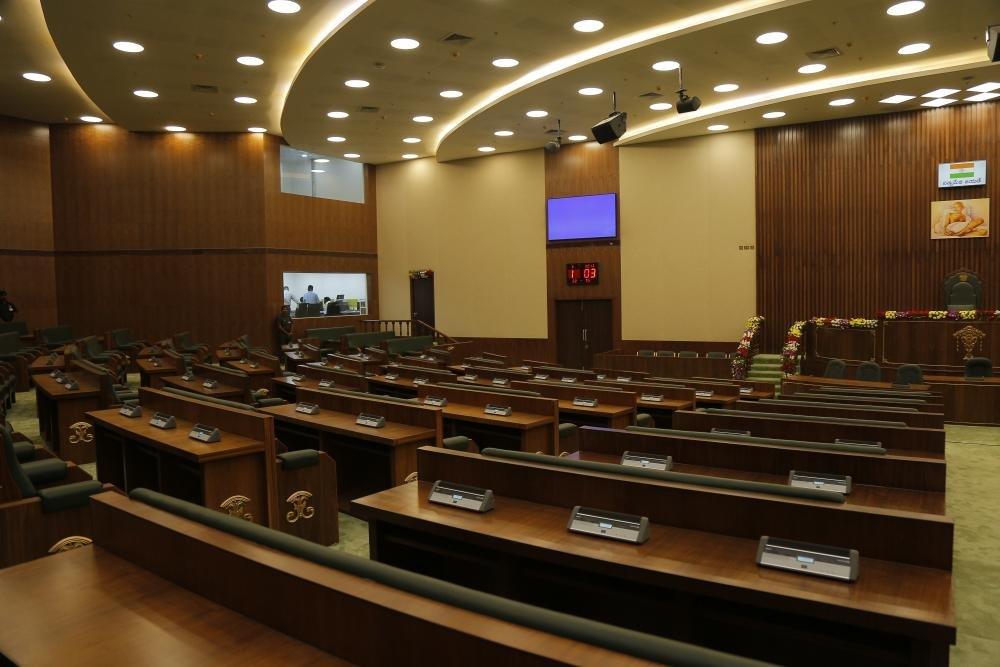
Photo: Andhra Pradesh Legislative Assembly, Kdslk, CC0

APPSC Group-I Mains 2020 · Paper III
2020 Paper III · Q2(b): model answer
Polity, Constitution, Governance, Law & Ethics · Parliament and State Legislatures. Held in December 2020 (Notification 27/2018).
Define Privileges of state legislature and classify it into two broad categories.
Syllabus: Parliament and State Legislatures · State Legislatures, Legislative Councils and privileges
Article 194Collective privilegesIndividual privilegesBreach of privilege
Legislative privileges are special rights, immunities and exemptions enjoyed by the Houses of a State Legislature, their committees and members, without which they cannot perform their functions freely. They are provided by Article 194 (Article 105 for Parliament) and extend to persons entitled to speak in the House, such as ministers and the Advocate-General, but not to the Governor, though he is part of the legislature. As no law has yet codified them, they remain as they stood when the 44th Amendment (1978) came into force.
| Collective privileges (of the House) | Individual privileges (of members) |
|---|---|
| Publish its reports, debates and proceedings, and bar others from publishing them | Freedom of speech: no court proceedings for anything said or any vote given (Art 194(2)) |
| Exclude strangers and hold secret sittings | Freedom from arrest in civil cases during a session and 40 days before and after it |
| Make rules for its procedure and conduct of business (Art 208) | Exemption from jury service |
| Punish members and outsiders for breach of privilege or contempt | Exemption from appearing as a witness while the House is in session |
| Courts cannot inquire into its proceedings (Art 212) | No liability for publications made under the House's authority (Art 194(2)) |
1. Collective privileges (of the House as a whole)
- Control over publication: the House can publish its proceedings and prohibit others from doing so; Article 361A protects the media's substantially true reports of proceedings.
- Internal autonomy: it makes its own rules (Art 208), can hold secret sittings, and courts cannot question the validity of its proceedings on grounds of irregular procedure (Art 212).
- Penal power: it can punish members and outsiders for breach of privilege or contempt by admonition, reprimand or imprisonment, and members also by suspension or expulsion.
- Information and inquiry: it must be told immediately of the arrest, detention, conviction or release of a member; it can summon witnesses and papers; and no one can be arrested within its precincts without the presiding officer's permission.
2. Individual privileges (of members)
- Freedom of speech: absolute within the House, subject only to its rules and to Article 211, which bars discussion of a judge's conduct.
- Freedom from arrest: only in civil cases, not in criminal cases or preventive detention.
- Exemptions: from jury service and from attending court as a witness while the House is in session.
3. Judicial limits
- M.S.M. Sharma (1959): privileges prevailed over the press's freedom of speech, but remain subject to Article 21.
- Keshav Singh (1964): courts can examine the legality of a legislature's committal of a person for contempt.
- Raja Ram Pal (2007) and Amarinder Singh (2010): expulsions are open to judicial review for illegality.
- Sita Soren (2024): a seven-judge bench held that bribery by legislators is not protected by privilege.
AP angle: In Andhra Pradesh both the Legislative Assembly and the Legislative Council (revived in 2007) enjoy these privileges through their Committees of Privileges.
In conclusion, privileges protect the independence of the legislature, but uncodified powers can be used against critics and the press; codification would balance them with Fundamental Rights.
The other choice in Q2
Answer either one in the exam.
- Q2(a)Why did we adopt federalism with a strong central government? Explain the important provisions that create a strong central government.
10 marks · Centre and States: sharing power and money · Federalism: a strong Centre, Centre–State friction and cooperation
Every model answer on these pages is free to read. The Tool Kit adds four PDF books for Mains Papers I–IV: every previous question sorted by syllabus, with practice questions. It is in the ₹149 All-in-One Pass, with every previous paper of every exam on the site, practice quizzes, timed tests, mock test series and study books.
₹149 · valid for 12 months from the day you pay, on every exam · pay by UPI, card or net banking