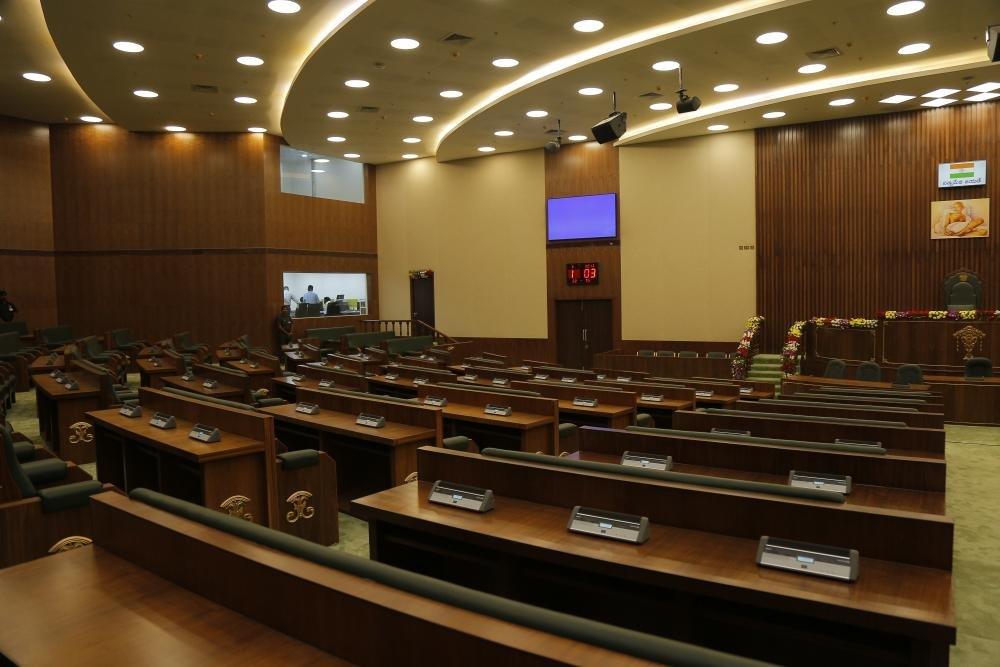
Photo: Andhra Pradesh Legislative Assembly, Kdslk, CC0

APPSC Group-I Mains 2020 · Paper III
2020 Paper III · Q2(a): model answer
Polity, Constitution, Governance, Law & Ethics · Centre and States: sharing power and money. Held in December 2020 (Notification 27/2018).
Why did we adopt federalism with a strong central government? Explain the important provisions that create a strong central government.
Syllabus: Centre and States: sharing power and money · Federalism: a strong Centre, Centre–State friction and cooperation
Quasi-federalismUnion of StatesUnitary biasCooperative federalism
India is a federation with a strong Centre. Article 1 calls India a "Union of States", which, as Dr Ambedkar explained, means the federation is indestructible and no State can secede from it. K.C. Wheare described the Constitution as "quasi-federal". The framers deliberately tilted the balance towards the Centre, while keeping a dual polity with a constitutional division of powers.
1. Why a strong central government?
- Partition and unity: once Partition was announced in June 1947, the Union Powers Committee under Nehru gave up the Cabinet Mission's weak-Centre scheme and recommended a strong Centre with residuary powers.
- Integration of princely states: over 550 princely states had to be merged into the Union, which needed a firm central authority.
- Diversity: vast linguistic, religious and regional diversity raised fears of fissiparous and secessionist tendencies.
- Planned development: removing regional imbalances and building a national economy needed central coordination.
- Security and legacy: the war in Kashmir (1947–48) and the administrative continuity of the Government of India Act, 1935.
2. Provisions that create a strong Centre
- Territorial power (Art 3): Parliament can alter the area, boundaries or names of States by a simple majority; the State Legislature's views are not binding. The AP Reorganisation Act, 2014 was passed though the AP Legislative Assembly had rejected the draft Bill in January 2014.
- Legislative dominance: the Union List is the largest, residuary powers lie with Parliament (Art 248) and Union law prevails in Concurrent List conflicts (Art 254). Parliament can also legislate on State subjects under Articles 249 (Rajya Sabha resolution), 250 (national emergency) and 253 (international agreements).
- Administrative control: States must comply with Union laws and directions (Arts 256–257), and failure can attract Article 365. The Governor is appointed by the President (Art 155) and can reserve State Bills (Art 200).
- Emergency provisions: Articles 352, 356 and 360 can make the system virtually unitary.
- Financial dependence: the most buoyant taxes lie with the Centre, so States depend on Finance Commission devolution (Art 280) and grants (Arts 275, 282).
- Unified institutions: single citizenship, an integrated judiciary, All-India Services (Art 312), the CAG and the Election Commission; most of the Constitution can be amended by Parliament alone.
| Federal features | Unitary features |
|---|---|
| Dual polity: Union and States | Strong Centre with residuary powers |
| Written Constitution, division of powers | Union law prevails in the Concurrent List |
| Supremacy of the Constitution | Most provisions amended by Parliament alone |
| Independent judiciary | Integrated judiciary and All-India Services |
| Bicameral Parliament with a Rajya Sabha | States unequally represented in the Rajya Sabha |
3. The balance today
- Judicial safeguards: S.R. Bommai (1994) declared federalism part of the basic structure and limited the misuse of Article 356.
- Cooperative institutions: the GST Council (Art 279A), NITI Aayog (2015) and the Inter-State Council (Art 263) promote shared decision-making.
In conclusion, the strong Centre has kept India united through Partition, wars and reorganisation of States; the task now is to balance national unity with State autonomy through genuine cooperative federalism.
The other choice in Q2
Answer either one in the exam.
- Q2(b)Define Privileges of state legislature and classify it into two broad categories.
10 marks · Parliament and State Legislatures · State Legislatures, Legislative Councils and privileges
Every model answer on these pages is free to read. The Tool Kit adds four PDF books for Mains Papers I–IV: every previous question sorted by syllabus, with practice questions. It is in the ₹149 All-in-One Pass, with every previous paper of every exam on the site, practice quizzes, timed tests, mock test series and study books.
₹149 · valid for 12 months from the day you pay, on every exam · pay by UPI, card or net banking