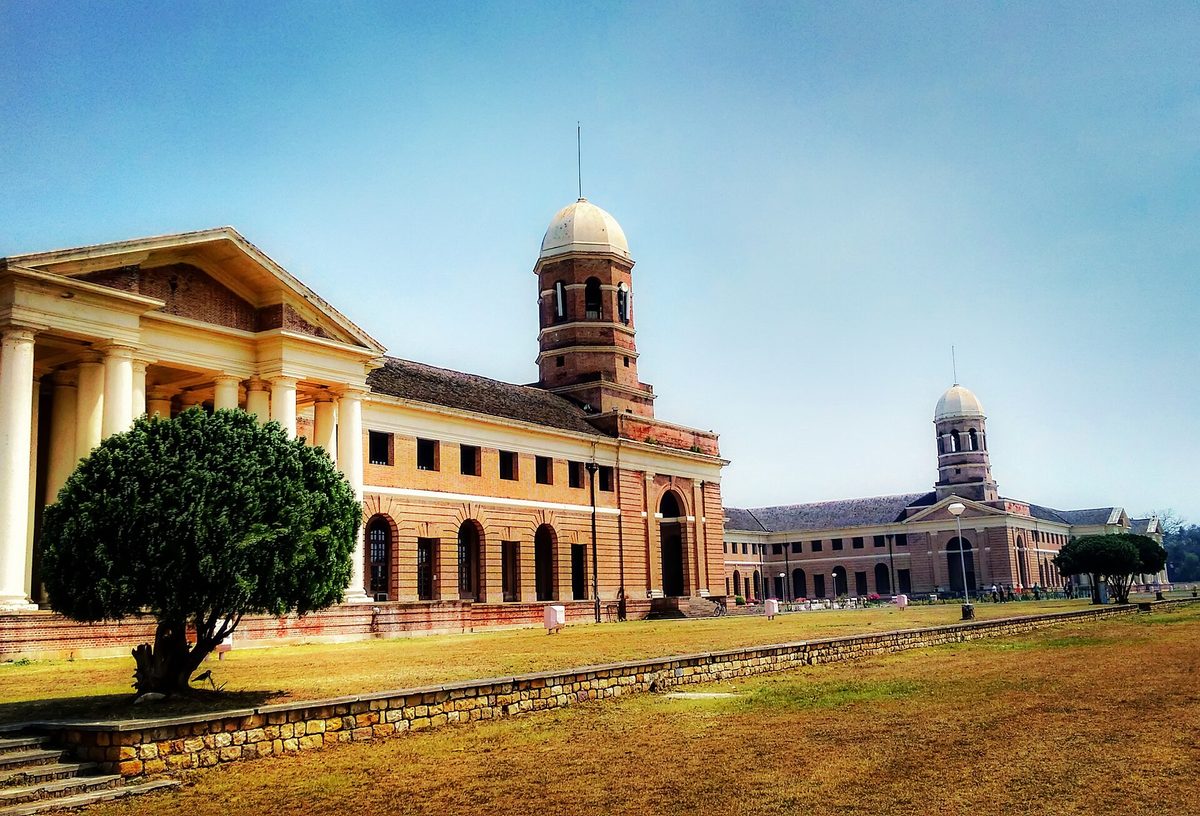
Photo: Forest Research Institute, Dehradun, Mrigank Das, CC BY-SA 4.0

UPSC Indian Forest Service (Main) 2022 · General English
UPSC IFoS Mains 2022 General English paper with model answers
UPSC Indian Forest Service (Main) Examination 2022, General English: Essay, Letter or Report, Précis, Comprehension and Grammar. 18 questions, 300 marks. Tap a question for its model answer.
Tap a question to open its model answer on its own page. Every model answer is free. The model answers are fuller than UPSC's word limits so that you learn the content; write within the limit in the exam. Model answers are ready for every paper. Answers are by Learn with Anil (Jupudi Anil Kumar), not by UPSC.
Essay, Letter or Report, Précis, Comprehension and Grammar
18 questions · 300 marks
- Q1(a)Write an essay, in about 800 - 1000 words, on any one of the following topics : Ethical Dilemmas and Artificial Intelligence
100 marks · 1000 words · Essay · Essay
- Q1(b)Write an essay, in about 800 - 1000 words, on any one of the following topics : The Revival of Traditional Indian Sports
100 marks · 1000 words · Essay · Essay
- Q1(c)Write an essay, in about 800 - 1000 words, on any one of the following topics : Liberal Education is not Antithetical to Technical Education
100 marks · 1000 words · Essay · Essay
- Q1(d)Write an essay, in about 800 - 1000 words, on any one of the following topics : To Reap the Demographic Dividend, Investment in Human Capital is Crucial for India
100 marks · 1000 words · Essay · Essay
- Q2(a)Write a letter to the MLA of your area requesting him/her to address the issue of waste management in your locality. (Do not write your name or address or any other information revealing identity. Use only ABC/XYZ for your name and that of the MLA and the constituency.)
25 marks · Letter, Report and Paragraph · Letter
- Q2(b)Write a report on the challenges of learning in the rural schools that you visited recently. (Do not write your name or address anywhere in the answer. Instead use ABC/XYZ for your name/name of the schools.)
25 marks · Letter, Report and Paragraph · Report
Passage for Q3
Air pollutants have caused great damage to art objects throughout the industrialized world. Some excellent monuments of antiquity have been silently eaten away by pollutants. This can be clearly seen in many works of art like sculptures and carvings on historic buildings and cathedrals.
The Taj Mahal, a miracle in marble and a historical monument, is facing grave danger from pollution created by existing foundries, power houses, railway yards and other industrial units. According to some environmentalists, the problem now seems to have been aggravated because of the commissioning of the Mathura Oil Refinery, about 40 km from the priceless monument. Whether the monument is going to be affected by the pollutants emitted from the refinery or not has created a controversy which is now being debated. Many reports on this have appeared in noted newspapers and journals. However, it is to be hoped that certain anti-pollution safeguards built into the refinery will minimise the effect of pollutants on the monument.
According to some reports, pollutants from existing foundries, power houses and railway yards are already affecting the Taj Mahal. Black and brown patches are disfiguring the shiny white surface of the Taj. Reports in newspapers also speak of the formation of gypsum, scaling and flaking effects.
Sulphur dioxide from the various sources mentioned, mixes with the atmospheric moisture and gets converted into sulphuric acid which settles down on the exterior of the Taj Mahal. The acid reacts with the marble (calcium carbonate) and corrosion and discolouration of the monument is the ultimate result.
It looks as though more money will have to be spent on protecting the Taj Mahal from the effects of pollution than it took Shah Jehan to construct it. Perhaps the immediate solution to save the Taj Mahal lies in shifting the foundries and power houses from Agra, and in effectively supervising anti-pollution measures adopted by the refinery. Further, the coal locomotives being used by the railways in that region can be replaced by diesel engines. In addition to these steps, a dense green belt of suitable tree species should be created around the Taj Mahal to absorb atmospheric pollutants as trees can act as effective air scrubbers.
The renowned temple of Sri Chennakeshava at Belur (Hassan district, Karnataka state), is threatened with a similar hazard. A plywood factory located close to the temple emits soot-laden fumes, which get deposited on the sculptures in the temple and discolour the surface, inside and outside. This pollution effect is under investigation.
- Q3Write a précis of the following passage in about one-third of its original length. Do not give it any title.
50 marks · 138 words · Précis · Précis
Passage for Q4
'Psyche' is the Greek word for mind. Psychology, psychotherapy, psychoanalysis and psychiatry — all these four terms describe different approaches to understanding and helping individuals with psychological and emotional (mental) problems. There is lots of overlap, and sometimes the work done by the same highly qualified individual can be described by several of these terms, so it is not surprising that people confuse them. However, there are differences and getting them clear will help clarify what psychiatry is.
Psychology is the study of human thought and behaviour. It originated just over a century ago from a tradition of introspective philosophy (trying to understand the minds of others by understanding our own) and is now a firmly established science. Psychology is studied at school and as an undergraduate course at university. It encompasses the study and understanding of mental processes in all their aspects and it has many branches. Experimental psychologists conduct experiments to explore the very basics of mental functioning (perception, memory, arousal, risk-taking, etc.). Indeed experimental psychologists do not restrict themselves exclusively to humans but study animals, both in their own right and as models to understand human behaviour. Experimental psychology is generally considered a 'hard science' which follows the same scientific principles of investigation as physics or chemistry.
There are several professions stemming from psychology (eg. educational psychologists, industrial psychologists, forensic psychologists). Clinical psychologists have postgraduate training in abnormal psychology and use this understanding to help people deal with their problems. The most obvious early example of this approach was the application of learning theory (ie. consistent rewards and punishments to shape behaviour) in behaviour therapy. Behaviour therapy has been particularly successful in helping disturbed children or those with learning difficulties to modify their behaviour. It works without requiring a detailed understanding of the issues by the patient. Psychological treatments have, of course, become much more sophisticated and currently one of the most successful and widely practised psychotherapies (cognitive behaviour therapy) has been developed by clinical psychologists and is provided mainly by them. Clinical psychologists are essential members of all modern mental health ('psychiatric') services.
Psychoanalysis is the method of treating neurotic disorders developed by Sigmund Freud towards the end of the 19th century in Vienna. In psychoanalysis the patient is encouraged to relax and say the first thing that comes into their mind ('free association') and to pay attention to their dreams and to the irrational aspects of their thinking. Freud was convinced that his patients suffered because they tried to keep unconscious (repress) thoughts and feelings that were unacceptable to them and that doing so caused their neurotic symptoms. The analyst listens carefully to what is said and over time begins to detect patterns and clues to these 'conflicts'. By sharing these insights he helps the patient confront and resolve them. Psychoanalysis is intensive and very long with patients traditionally coming for an hour a day up to five times a week for several years. Psychoanalysis is the origin of the cartoon image of the bearded psychiatrist sitting behind the patient lying on the couch.
There are several schools of psychoanalysis developed by disciples of Freud (e.g. Jung, Adler, Klein) and some have become quite remote from the original model (e.g. Reich, Lacan). Psychoanalysis has had enormous influence beyond psychiatry, particularly in literature and the arts. Terms like 'Freudian' and 'Freudian slip' are part of everyday speech. However, because psychoanalysis lacks firm scientific evidence of its efficacy, it is increasingly marginalized in modern psychiatric practice.
- Q4(a)What are the four terms related to psyche and why are they confusing?
10 marks · Comprehension · Comprehension
- Q4(b)What do experimental psychologists do?
10 marks · Comprehension · Comprehension
- Q4(c)What is the importance of behaviour therapy?
10 marks · Comprehension · Comprehension
- Q4(d)How is the patient treated in psychoanalysis?
10 marks · Comprehension · Comprehension
- Q4(e)Identify the schools of psychoanalysis and their influence beyond psychiatry.
10 marks · Comprehension · Comprehension
- Q5(a)Rewrite the following sentences after correcting the grammatical errors in each : (i) We arrived at a decision after discussing about all the aspects. (ii) The flood victims were provided shelter. (iii) We have built this house twenty years ago. (iv) She stays in the campus. (v) Let's go for a walk, do we? (vi) Have you read each of the following instruction? (vii) Do you know…
10 marks · Grammar and Usage · Correcting sentences
- Q5(b)Make sentences using the following words so that the meaning of each word is clear. Make a single sentence with each word. (i) Metal, Mettle (ii) Troop, Troupe (iii) Yolk, Yoke (iv) College, Collage (v) Sole, Soul
10 marks · Grammar and Usage · Confusable words
- Q5(c)Use the following idiomatic expressions in sentences bringing out their meaning : (i) Draw the line (ii) Bite the bullet (iii) To turn over a new leaf (iv) To pay off old scores (v) Hand in glove
10 marks · Grammar and Usage · Idioms
- Q5(d)Write adjectival forms of the following words : (i) Gold (ii) Health (iii) Talk (iv) Mystery (v) Ceremony
5 marks · Grammar and Usage · Word forms
- Q5(e)Write the noun forms of the following words : (i) Write (ii) Occur (iii) Responsible (iv) Jubilate (v) Define
5 marks · Grammar and Usage · Word forms
- Q5(f)Rewrite the following as directed : (i) He is too weak to walk. (Rewrite using so ... that instead of too ... to) (ii) If you study well, you will pass. (Rewrite using 'unless') (iii) He says, "I am sorry." (Change to Indirect Speech) (iv) He writes poems. (Change to Passive Voice) (v) There is no tree which is not known by its fruit. (Change to Positive Sentence)
10 marks · Grammar and Usage · Transformation of sentences
All UPSC IFoS Mains PYQs, year-wise and subject-wise
The ₹149 All-in-One Pass opens the rest of the site for 12 months: UPSC Prelims GS Paper I and CSAT with explanations, practice quizzes and timed tests, UPSC CAPF and EPFO, the previous papers of every APPSC, TSPSC, police and SSC exam, every mock test series and the study books.
₹149 · valid for 12 months from the day you pay, on every exam · pay by UPI, card or net banking