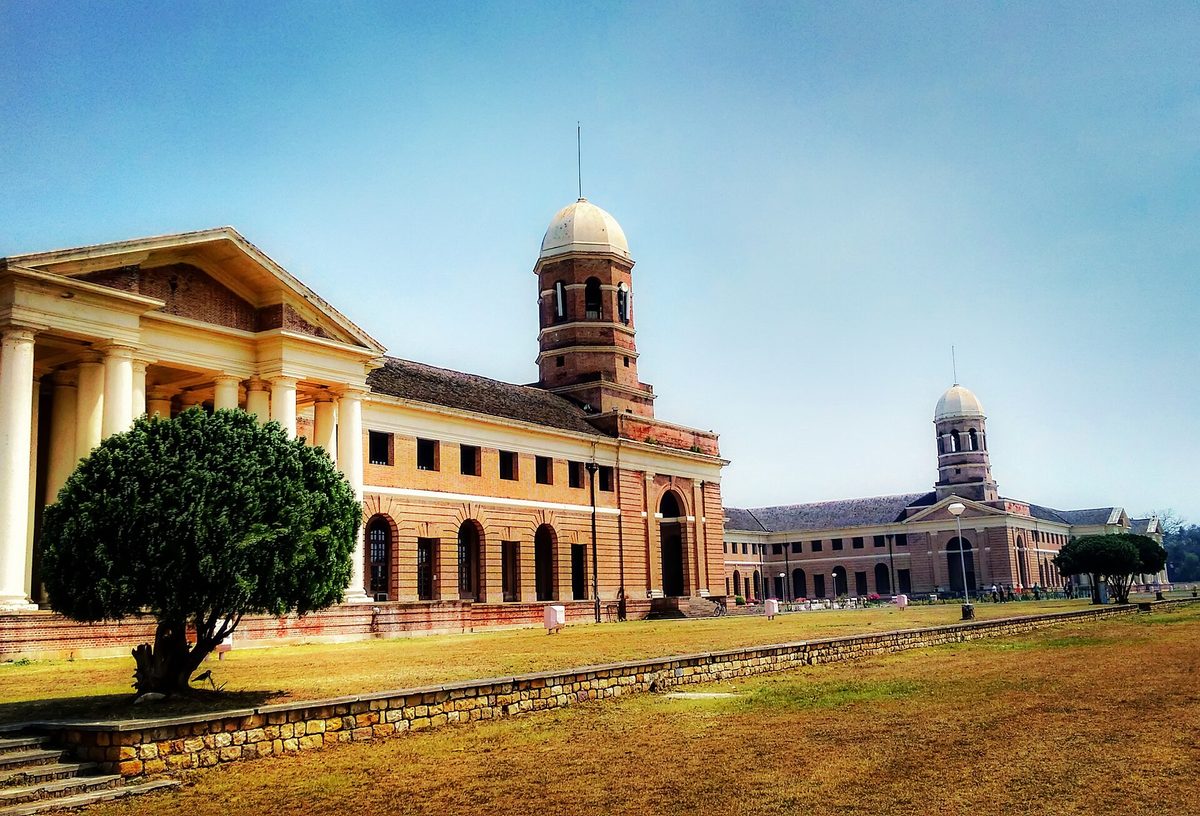
Photo: Forest Research Institute, Dehradun, Mrigank Das, CC BY-SA 4.0

UPSC Indian Forest Service (Main) 2022 · General English
UPSC IFoS Mains 2022 General English · Q1(c): model answer
General English: Essay, Letter or Report, Précis, Comprehension and Grammar · Essay.
Write an essay, in about 800 - 1000 words, on any one of the following topics : Liberal Education is not Antithetical to Technical Education
Syllabus: Essay · Essay
NEP 2020Holistic educationEthics of technologyInnovation
Liberal Education is not Antithetical to Technical Education
In India, the choice between "arts" and "science" has often felt like a choice between a dream and a job. Engineering and medicine were seen as respectable, secure careers; history, philosophy or literature as subjects for those who could not get into technical courses. This division assumes that liberal education and technical education are opposites. In truth, they are partners. The best engineers, doctors and scientists are those who can also think, question, communicate and care — and these are precisely the gifts of a liberal education.
What each offers
Technical education provides specialised knowledge and skills — how to design a bridge, write software, cure a disease or run a power plant. It is essential for economic growth and national development. Liberal education, which includes the humanities, social sciences, arts and basic sciences, aims at developing the whole person: critical thinking, ethical reasoning, communication, creativity, an understanding of society and history, and the ability to learn throughout life.
Why they need each other
First, technology does not exist in a social vacuum. An engineer designing a dam must understand the people who will be displaced; a software developer creating an app must consider privacy and addiction; a doctor must communicate with patients and respect their dignity. Without the insights of ethics, economics and sociology, technology can cause harm.
Second, innovation thrives at the meeting point of disciplines. Many of the most successful technology companies were built by people who combined technical skill with design, psychology and storytelling. User-friendly products, from the smartphone to India's UPI, succeed because their creators understood human behaviour.
Third, the job market is changing rapidly. Specific technical skills become outdated quickly; the ability to learn, adapt, collaborate and solve new problems endures. Employers increasingly complain that graduates are technically trained but lack communication, teamwork and critical thinking.
Fourth, ethical challenges of new technology — artificial intelligence, genetic engineering, climate engineering — require technologists who can think about values and consequences, not only about efficiency.
Fifth, democracy needs informed citizens. Technical experts are also voters and leaders; they must understand constitutional values, history and the diversity of society.
India's tradition and policy
Ancient Indian universities such as Nalanda and Takshashila taught medicine, logic, grammar, astronomy and the arts together, and the idea of the "64 kalas" combined practical skills with fine arts. Rabindranath Tagore's Visva-Bharati sought an education in which science, art and life were one.
The National Education Policy 2020 revives this vision. It calls for a holistic and multidisciplinary education, ending hard separations between arts and sciences and between curricular and vocational subjects. Students can now combine majors and minors across streams, and IITs and other technical institutes have expanded departments of humanities, social sciences and design. Many engineering curricula include courses on ethics, economics and communication.
Avoiding the extremes
Integration does not mean diluting either. Technical education must remain rigorous, and liberal education must not become a set of superficial "soft skill" modules. The aim is for every student to have depth in one field and breadth across others — the so-called "T-shaped" professional.
Conclusion
Science tells us how to do things; the humanities help us ask whether and why we should do them. A nation that produces brilliant technologists without wisdom risks building powerful tools without direction, while one that produces thinkers without technical capacity cannot turn ideas into reality. Liberal and technical education are not rivals but two wings of the same bird. India's future depends on graduates who can build machines and also understand the human beings they are meant to serve.
The other parts of Q1
- Q1(a)Write an essay, in about 800 - 1000 words, on any one of the following topics : Ethical Dilemmas and Artificial Intelligence
100 marks · 1000 words · Essay · Essay
- Q1(b)Write an essay, in about 800 - 1000 words, on any one of the following topics : The Revival of Traditional Indian Sports
100 marks · 1000 words · Essay · Essay
- Q1(d)Write an essay, in about 800 - 1000 words, on any one of the following topics : To Reap the Demographic Dividend, Investment in Human Capital is Crucial for India
100 marks · 1000 words · Essay · Essay
The ₹149 All-in-One Pass opens the rest of the site for 12 months: UPSC Prelims GS Paper I and CSAT with explanations, practice quizzes and timed tests, UPSC CAPF and EPFO, the previous papers of every APPSC, TSPSC, police and SSC exam, every mock test series and the study books.
₹149 · valid for 12 months from the day you pay, on every exam · pay by UPI, card or net banking