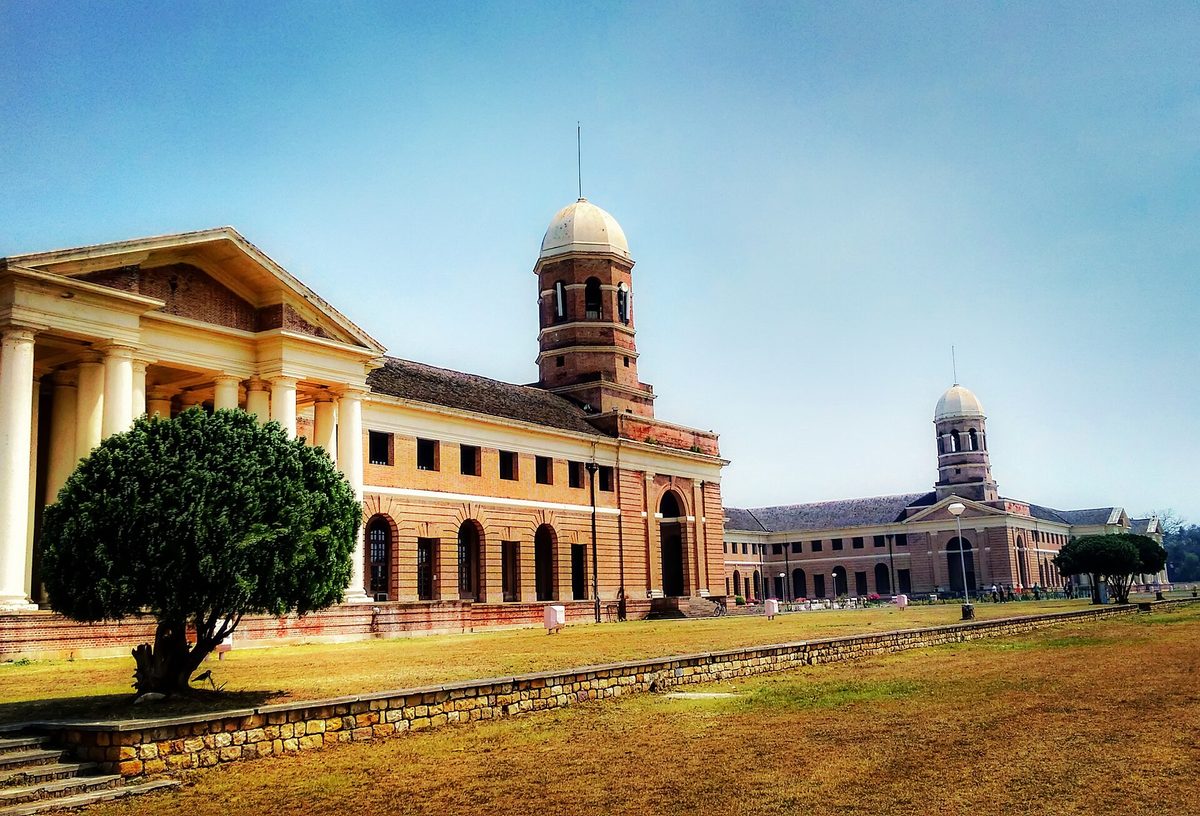
Photo: Forest Research Institute, Dehradun, Mrigank Das, CC BY-SA 4.0

UPSC Indian Forest Service (Main) 2020 · General English
UPSC IFoS Mains 2020 General English paper with model answers
UPSC Indian Forest Service (Main) Examination 2020, General English: Essay, Letter or Report, Précis, Comprehension and Grammar. 18 questions, 300 marks. Tap a question for its model answer.
Tap a question to open its model answer on its own page. Every model answer is free. The model answers are fuller than UPSC's word limits so that you learn the content; write within the limit in the exam. Model answers are ready for every paper. Answers are by Learn with Anil (Jupudi Anil Kumar), not by UPSC.
Essay, Letter or Report, Précis, Comprehension and Grammar
18 questions · 300 marks
- Q1(a)Write an essay, in say 800-1000 words, on any one of the following topics : Depletion of Natural Resources : A Threat to Humanity
100 marks · 1000 words · Essay · Essay
- Q1(b)Write an essay, in say 800-1000 words, on any one of the following topics : Impact of Agricultural Reforms on India's Economic Future
100 marks · 1000 words · Essay · Essay
- Q1(c)Write an essay, in say 800-1000 words, on any one of the following topics : Virtual Teaching and the Crisis of Primary Education
100 marks · 1000 words · Essay · Essay
- Q1(d)Write an essay, in say 800-1000 words, on any one of the following topics : New Education Policy and the Future of India's Youth
100 marks · 1000 words · Essay · Essay
- Q2(a)Write a letter to the Editor of an English daily, reporting the growing incidence of rowdyism in your locality. (Kindly do not write your name or address anywhere in your answer. Use ABC or XYZ for your name or that of the newspaper.)
25 marks · Letter, Report and Paragraph · Letter
- Q2(b)Write a report on Covid awareness camp organized by your NGO for the benefit of citizens in general. (Please do not write your name or address anywhere in your answer. Use ABC or XYZ for your name or that of the NGO.)
25 marks · Letter, Report and Paragraph · Report
Passage for Q3
A good harvest is impossible without good seed. For agriculture to prosper, farmers must have a reliable supply of high-quality seeds and seedlings, at an affordable price. Fortunately, recent advances in the technology of seed and seedling production are helping to improve both the quality and range of planting materials. Seed is the most important determinant of agricultural production potential, on which the efficacy of other agriculture inputs is dependent. Seeds of appropriate characteristics are required to meet the demand of diverse agro-climatic conditions and intensive cropping systems. Sustained increase in agriculture production and productivity is dependent, to a large extent, on development of new and improved varieties of crops and an efficient system for timely supply of quality seeds to farmers. The seed sector has made impressive progress over the last three decades. In traditional agriculture, farmers saved the seed from their own crops to use in the following year. Now that most farmers are producing for commercial production, they are buying seed of improved varieties. New technological developments are helping produce better seed at a lower cost.
Agricultural research and development on seed has often been guided by its pressing domestic needs. It has successfully overcome the problems of food grain shortage and importing edible oils. Strategies for control of drought and famine are available; improved varieties to overcome such natural calamities have been evolved under the well-organized National Agriculture Research System (NARS). Farmers' ready acceptance to adopt quality seeds of improved varieties and realization of their yield potential under conditions of intensive agronomic management based on use of fertilizers, pesticides and other input secured a place of respect in the eyes of many in the developed world. Indian agriculture has made enormous strides in the past 50 years, raising food grains production from 50 mt to over 212 mt. In the process, the country has progressed from a situation of food shortages and imports to one of surpluses and exports. Having achieved food sufficiency, the aim now is to achieve food and nutritional security at the household level. The increase in agricultural production, however, has brought in its wake, uneven development, across regions, crops, and also across different sections of farming community. In the decade of the 'nineties', a marked slackening in the pace of growth has occurred, pointing to the need for infusing a new vitality in the agricultural sector.
Biotechnology plays a vital role in the development of the agriculture sector. Genetic engineering/gene pyramiding technology holds enormous promise in developing crop varieties with a higher level of tolerance to biotic and abiotic stresses and also to improve productivity and nutritional quality of food. A conducive atmosphere for application of frontier sciences in varietal development and for enhanced investments in research and development is a pressing requirement. At the same time, concerns relating to possible harm to human and animal health and biosafety, as well as interests of farmers, must be addressed.
Globalization and economic liberalization have opened up new opportunities as well as challenges. The main objectives of the National Seeds Policy, therefore, are the provision of an appropriate climate for the seed industry to utilize available and prospective opportunities, safeguarding of the interests of Indian farmers and the conservation of agro-biodiversity. While unnecessary regulation needs to be dismantled, it must be ensured that gullible farmers are not exploited by unscrupulous elements. A regulatory system of a new genre is, therefore, needed, which will encompass quality assurance mechanisms coupled with facilitation of a vibrant and responsible seed industry.
- Q3Write a précis of the following passage in about one-third of its original length. Do not assign any title to it :
50 marks · 194 words · Précis · Précis
Passage for Q4
An ingrained idea in the minds of Western scholars is that any Western borrowings must be equated with a loss of identity. Indeed, it is predicated upon a sort of general theory of Indian development loaded with Western clichés about modern India. It draws heavily on the fashionable Western view that Indian intellectuals, Jawaharlal Nehru included, are elitist, ape the West and have no sense of the truly Indian. Implied in this is also the thought that the West must tell us how to be true Indians. None of these westerners or expatriate Indians, it is clear, have seen the vast rural concourses that assembled to hear Nehru and have no idea of the degree of his rapport with them. In discussing economic planning, they lose sight of India's goal of real independence, free from manipulation and economic imperialism, to be found only in a substantial industrial-agricultural self-sufficiency. They set up a dramatic opposition between Gandhi and Nehru, painting one Indian and the other Western, forgetting the Western influence on the former and the Indianness of the latter—both of which ran equally deep. What is also forgotten is that despite their differences Gandhi did nominate Nehru as his successor. The Nehruvian policy of non-alignment is an extension of non-violence and the doctrine of import substitution an extension of the Charkha (spinning wheel), the Gandhian symbol of individual self-sufficiency in the pre-Independence period.
There is a lack of understanding here about the reversal process that so-called 'Westernization' brings in at the creative, intellectual level in an ancient civilization. Macaulay's educational policy sought to generate a tribe of 'brown Englishmen' and partly succeeded in doing so, but he never foresaw that they would in fact turn into a great force to liberate Indians from the British and to engage in a discovery of India. Indeed, it can be shown from the history of the nineteenth and early twentieth centuries that in virtually all fields of creative endeavour, it is the so-called westernized segment which led a great movement for Indianization. It is they who turned from a European philosophy, literature and art to a rediscovery of their roots in Indian tradition. It can also be shown that those who did not go through the process of reversal became victims of cheap Western mores and are today celebrating a macabre marriage of consumerism and fundamentalism that is threatening the very integrity and unity of India, creating a new divisiveness on religious, linguistic and regional axes. Few Western scholars understand the vital need in developing countries for a successful synthesis of tradition and modernity that would trigger progress without loss of identity. An unchanged, unmediated continuity would destroy itself by its very unawareness and its consequent imitation of the most superficial aspects of Western society.
- Q4(a)What, according to the writer, are the main prejudices Western scholars nurture about India?
10 marks · Comprehension · Comprehension
- Q4(b)In what different ways did Nehru incorporate Gandhian ideas in his vision of India?
10 marks · Comprehension · Comprehension
- Q4(c)What is known as the 'reversal process'? Explain with the help of examples the writer has given.
10 marks · Comprehension · Comprehension
- Q4(d)Discuss the implications of the paradox between Western elite and Indianization, as outlined by the writer.
10 marks · Comprehension · Comprehension
- Q4(e)Why is it important for the developing countries to find the synthesis of tradition and modernity?
10 marks · Comprehension · Comprehension
- Q5(a)Rewrite the following sentences after correcting the grammatical errors in each : (i) What is the time in your watch? (ii) I am understanding the lesson. (iii) The man standing in a corner was trembling from cold. (iv) It is a much interesting film. (v) Although it was past mid-night, yet the shops were still open. (vi) The coolie refused to carry her heavy luggages to the…
10 marks · Grammar and Usage · Correcting sentences
- Q5(b)Make sentences using the following words in such a way that the meaning of each word is clear from the context : (i) Profit, Prophet (ii) Addition, Edition (iii) Insight, Incite (iv) Censor, Sensor (v) Heel, Heal
10 marks · Grammar and Usage · Confusable words
- Q5(c)Use the following idiomatic expressions in sentences in order to bring out their meaning : (i) Fish out of water (ii) To kick the bucket (iii) A blessing in disguise (iv) To smell a rat (v) To miss the bus
10 marks · Grammar and Usage · Idioms
- Q5(d)Make adjectives from the following words : (i) Fool (ii) Venture (iii) Sense (iv) Industry (v) Virtue
5 marks · Grammar and Usage · Word forms
- Q5(e)Make nouns using the following words : (i) Recommend (ii) Decay (iii) Imply (iv) Fly (v) Disclose
5 marks · Grammar and Usage · Word forms
- Q5(f)Rewrite the following sentences as directed : (i) He will be late. It is certain. (Combine the sentences using 'that') (ii) He was doubtful if he could walk so far. (Change it into a 'negative sentence') (iii) The speaker said, "We tried to control the prices last year." (Change it into 'indirect speech') (iv) He remarked on the boy's impudence. (Change it into a 'complex…
10 marks · Grammar and Usage · Transformation of sentences
All UPSC IFoS Mains PYQs, year-wise and subject-wise
The ₹149 All-in-One Pass opens the rest of the site for 12 months: UPSC Prelims GS Paper I and CSAT with explanations, practice quizzes and timed tests, UPSC CAPF and EPFO, the previous papers of every APPSC, TSPSC, police and SSC exam, every mock test series and the study books.
₹149 · valid for 12 months from the day you pay, on every exam · pay by UPI, card or net banking