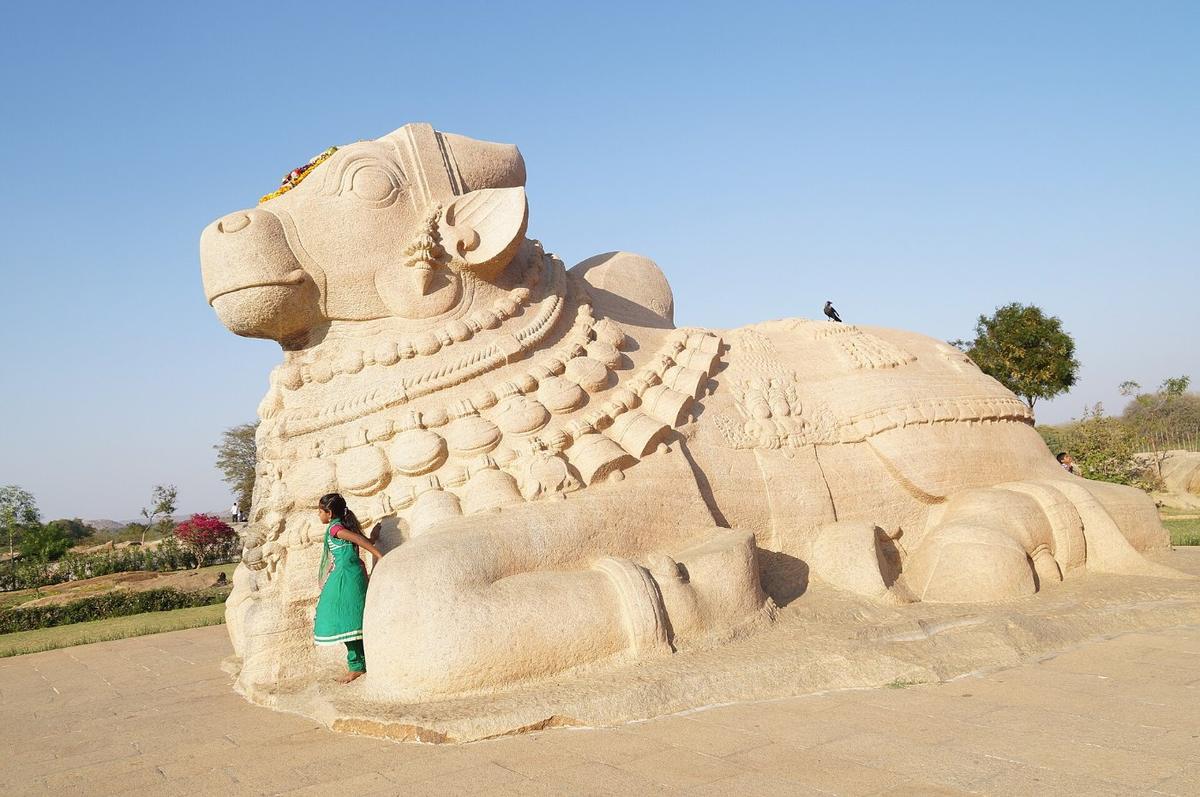
Photo: Lepakshi Nandi, Rahmanuddin, CC BY-SA 4.0

APPSC Group-I Mains 2025 · Paper II
2025 Paper II · Q7(b): model answer
History, Culture & Geography of India and Andhra Pradesh · Ancient and Medieval Andhra. Held in May 2025 (Notification 12/2023).
How did far trade routes contribute to the exchange of Buddhist ideas in ancient Andhra?
Syllabus: Ancient and Medieval Andhra · Early Andhra kingdoms (Satavahanas to Vishnukundins)
DakshinapathaKrishna–Godavari portsMerchant patronageBuddhist diffusion
Between the 3rd century BCE and the 4th century CE, the Krishna–Godavari region under the Satavahanas and Ikshvakus stood at the meeting point of inland and overseas trade routes. Buddhism, whose ethics of thrift, non-violence and fellowship across castes suited merchants and artisans, spread along these routes. Monks travelled with caravans and ships, and trade wealth paid for stupas and monasteries at Amaravati, Nagarjunakonda and along the coast.
1. The trade routes
- Dakshinapatha: the great southern overland route linking the Gangetic valley and Ujjain to Pratishthana (Paithan) and on to the Krishna valley brought monks and traders from the north.
- River routes: the Krishna and Godavari connected inland centres such as Amaravati (Dhanyakataka) and Nagarjunakonda (Vijayapuri) with the coast.
- Sea routes: ports such as Ghantasala, the Masulipatnam region ("Masalia" of the Periplus) and Kalingapatnam linked Andhra with Sri Lanka, Southeast Asia and the Roman world; Satavahana ship-type coins and Roman coins found in Andhra attest this trade.
- Goods exchanged: textiles, beads, spices and other goods went out, while Roman gold and silver came in, enriching coastal towns.
Schematic map of Andhra Pradesh (2011 census district outlines), not to scale; for study only.
2. How trade spread Buddhist ideas
- Merchant patronage: inscriptions at Amaravati, Bhattiprolu and Jaggayyapeta record gifts by merchants, guild members and artisans.
- Monasteries on routes: stupas and viharas stood at ports and route junctions — Salihundam near Kalingapatnam, Thotlakonda, Bavikonda and Pavurallakonda near Visakhapatnam, Ghantasala and Bhattiprolu — offering shelter to travellers.
- International links: a Nagarjunakonda inscription records a shrine for Sri Lankan monks who had spread the faith in Kashmir, Gandhara, China, Vanga and other lands.
- Royal and women donors: Ikshvaku queens and princesses, such as Chamtisri, built and endowed monuments at Nagarjunakonda alongside merchant donors.
- Schools of thought: Andhra became home to Mahasanghika schools such as the Purvasailas and Aparasailas, whose ideas travelled with monks along the same routes.
- Art: Amaravati-style sculpture influenced the art of Sri Lanka and Southeast Asia.
- Thought: Acharya Nagarjuna's Madhyamika philosophy spread widely in Asia, and the Chinese pilgrim Xuanzang visited Dhanyakataka in the 7th century.
Trade gave Andhra Buddhism wealth, patrons and an international audience, making the region a bridge of Buddhist culture between India and Asia, a heritage AP now promotes through its Buddhist circuit.
The other choice in Q7
Answer either one in the exam.
- Q7(a)What are the various stories about the origins of Andhra people and the Andhra language?
10 marks · Ancient and Medieval Andhra · Eastern Chalukyas; origins of Telugu people and language
Every model answer on these pages is free to read. The Tool Kit adds four PDF books for Mains Papers I–IV: every previous question sorted by syllabus, with practice questions. It is in the ₹149 All-in-One Pass, with every previous paper of every exam on the site, practice quizzes, timed tests, mock test series and study books.
₹149 · valid for 12 months from the day you pay, on every exam · pay by UPI, card or net banking