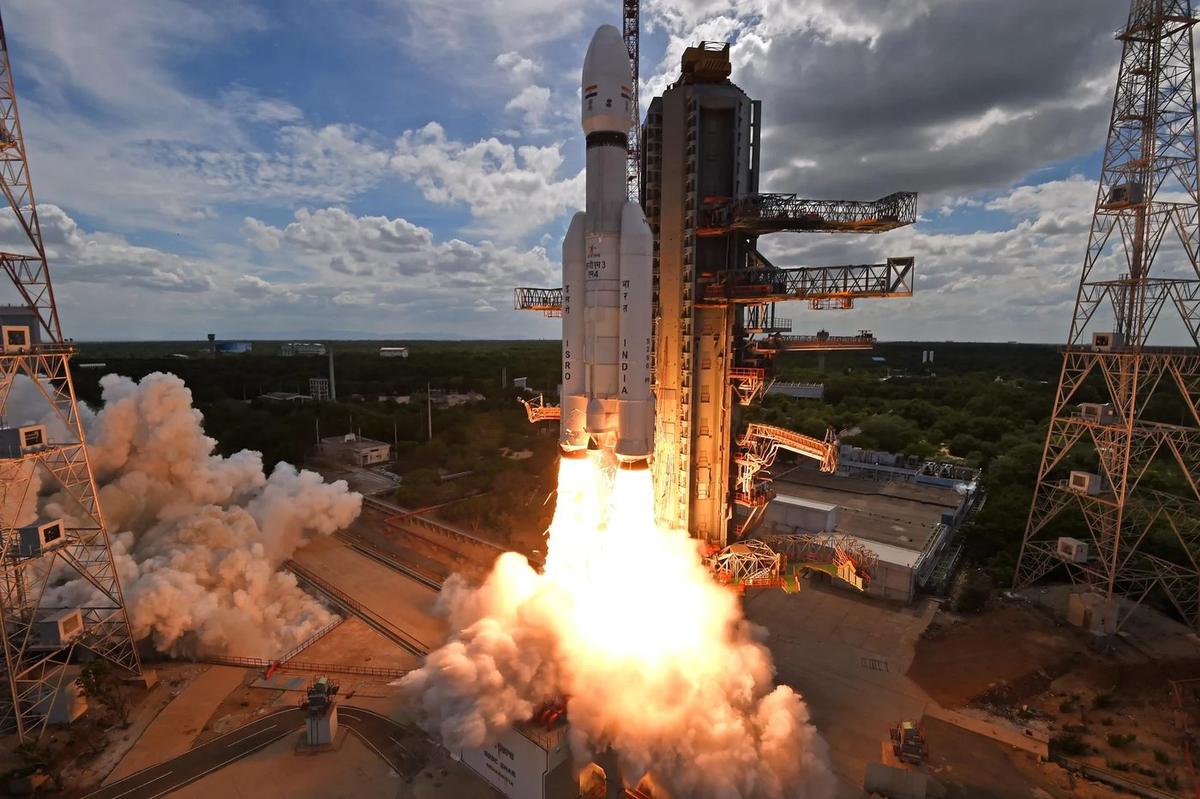
Photo: LVM3 launch, Sriharikota, ISRO, GODL-India

APPSC Group-I Mains 2023 · Paper V
2023 Paper V · Q4(a): model answer
Science, Technology & Environmental Issues · Space, defence and nuclear technology. Held in June 2023 (Notification 28/2022).
Though circumstances are strongly insisting for India to overturn decades of 'No first use' nuclear doctrine, still India is committed to No first use of nuclear weapons - Comment.
Syllabus: Space, defence and nuclear technology · Nuclear technology and policy
No First UseCredible minimum deterrenceAssured second strikeNuclear doctrine 2003
India's nuclear doctrine, adopted on 4 January 2003 after Pokhran-II, rests on credible minimum deterrence and No First Use (NFU): nuclear weapons will be used only in retaliation against a nuclear attack on Indian territory or Indian forces anywhere, and that retaliation will be massive enough to inflict unacceptable damage. A hostile two-front environment has revived calls to drop NFU, yet India has kept it, for sound strategic reasons.
1. Circumstances pressing for a review
- Two nuclear neighbours: China's fast-growing arsenal and China–Pakistan collusion raise the risk of a two-front crisis.
- Pakistan's first-use posture: Pakistan rejects NFU and has built short-range "tactical" weapons such as Nasr to deter Indian conventional action; critics ask whether massive retaliation against a small tactical strike is credible.
- Nuclear signalling in crises: Pakistan's threats around Operation Sindoor (May 2025) led India to declare that it would not tolerate "nuclear blackmail".
- Official remarks: in 2019 the Defence Minister said NFU holds "till today" but that the future "depends on circumstances"; some strategists prefer deliberate ambiguity.
- Erosion of global arms control: treaties are lapsing and some powers are lowering their nuclear thresholds, as Russia did in its 2024 doctrine.
2. Why India remains committed to NFU
- Deterrence does not need first use: the nuclear triad of Agni missiles (Agni-5 tested with MIRV in 2024), aircraft and submarines (INS Arihant and INS Arighaat) assures a survivable second strike.
- Conventional options: India can respond below the nuclear threshold, as at Balakot (2019) and in Operation Sindoor (2025).
- Stability and cost: NFU avoids a costly arms race, hair-trigger alerts and accidental war, keeping the arsenal truly "minimum".
- Diplomatic capital: restraint and a clean record earned the 2008 NSG waiver, the Indo-US 123 Agreement and membership of the MTCR, Wassenaar Arrangement and Australia Group.
- Consistency and flexibility: NFU fits India's call for universal, non-discriminatory disarmament (1988 Action Plan), and the doctrine already keeps the nuclear option against a major biological or chemical attack.
| Arguments to abandon NFU | Arguments to retain NFU |
|---|---|
| Two-front nuclear threat from China and Pakistan | The triad assures a second strike against both |
| Pakistan's tactical weapons and threats | Conventional options exist below the threshold |
| Ambiguity may deter more | Ambiguity raises the risk of miscalculation and pre-emption |
| Fear of a disarming first strike | Mobile canister missiles and submarines survive a first strike |
| Global norms are eroding | NFU earns trust and avoids an arms race |
- 1974 Pokhran-I
- 1998 Pokhran-II; No First Use declared; testing moratorium
- 2003 Nuclear doctrine; Nuclear Command Authority
- 2016 INS Arihant commissioned
- 2018 Nuclear triad declared complete
- 2024 Agni-5 MIRV test (Mission Divyastra); INS Arighaat
- 2025 Operation Sindoor: no to "nuclear blackmail"
3. Way forward
- Survivability: more ballistic-missile submarines, longer-range K-series missiles, and robust command, control and early warning under the Nuclear Command Authority.
- Clarity, not ambiguity: review the doctrine periodically in private, while keeping the public message consistent.
- Risk reduction: hotlines and confidence-building measures with Pakistan and China, and support for a global NFU treaty.
AP angle: the Arihant-class submarines, the sea leg that makes NFU credible, are built at the Ship Building Centre in Visakhapatnam, home of the Eastern Naval Command.
NFU is not weakness but confidence in a survivable second strike. Backed by credible capabilities and clear political will, it keeps India a responsible nuclear power while deterring both adversaries.
The other choice in Q4
Answer either one in the exam.
- Q4(b)What is Green Energy? Discuss about the Green Energy corridors and their need in India.
10 marks · Energy: conventional and renewable · Renewable energy
Every model answer on these pages is free to read. The Tool Kit adds four PDF books for Mains Papers I–IV: every previous question sorted by syllabus, with practice questions. It is in the ₹149 All-in-One Pass, with every previous paper of every exam on the site, practice quizzes, timed tests, mock test series and study books.
₹149 · valid for 12 months from the day you pay, on every exam · pay by UPI, card or net banking