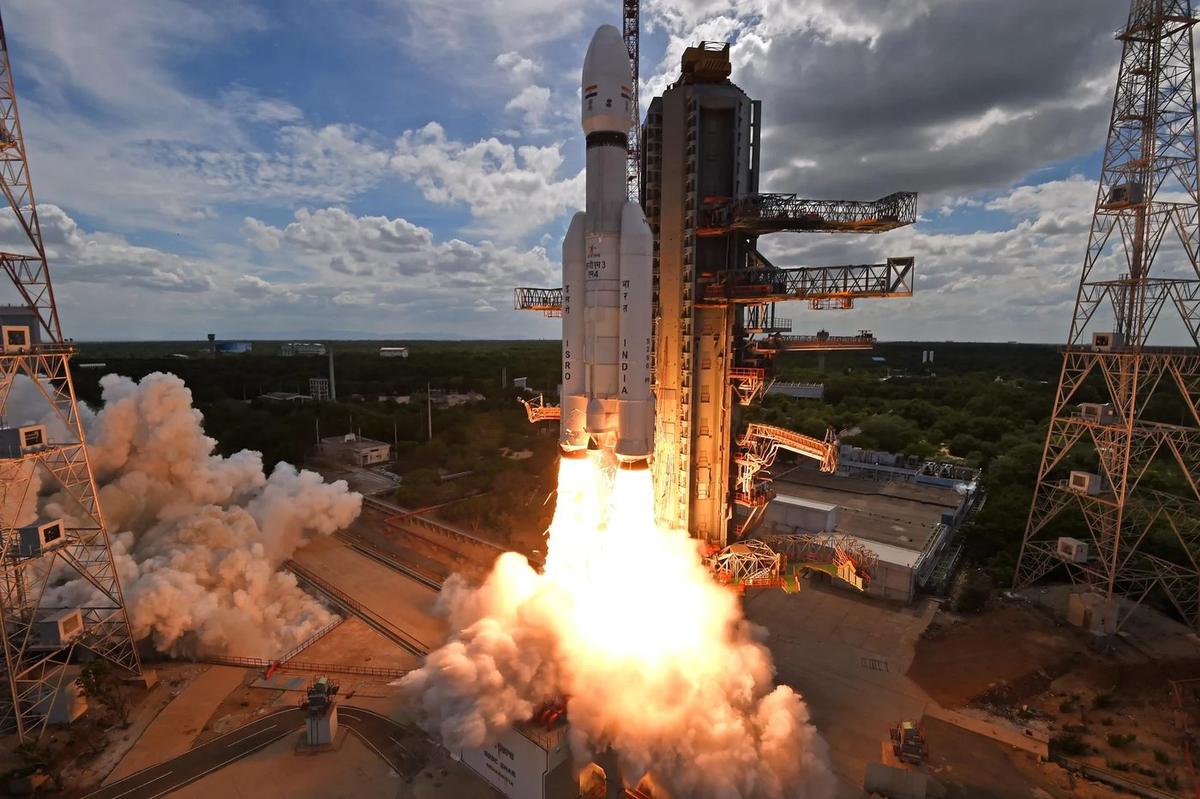
Photo: LVM3 launch, Sriharikota, ISRO, GODL-India

APPSC Group-I Mains 2023 · Paper V
2023 Paper V · Q3(b): model answer
Science, Technology & Environmental Issues · Space, defence and nuclear technology. Held in June 2023 (Notification 28/2022).
Why is India's space industry looking for private sector investments even though ISRO is a successfully performing PSU?
Syllabus: Space, defence and nuclear technology · Space technology
Space sector reformsIN-SPACePrivate investmentSpace economy
The question's premise needs a correction: ISRO is a government research agency under the Department of Space, not a PSU; its commercial arms, Antrix (1992) and NewSpace India Ltd (NSIL, 2019), are the public sector companies. ISRO has performed brilliantly, from Mangalyaan to Chandrayaan-3 (2023), yet India holds only about 2% of the global space economy (about US$8 billion). The 2020 reforms invite private investment to grow it to US$44 billion by 2033.
1. Why private investment is needed despite ISRO's success
- Demand beyond one agency's capacity: demand for launches, broadband and earth-observation data is soaring, but ISRO's launch rate is limited; after PSLV failures in May 2025 and January 2026, GSLV-F17 (September 2026) was ISRO's only successful launch of 2026 up to mid-October.
- Budget limits: public funds cannot build all the rockets, satellites, ground stations and applications a US$44 billion economy needs; private and foreign capital can.
- Let ISRO focus on frontier science: Gaganyaan (crewed flight planned for 2027), the Bharatiya Antariksh Station (first module 2028), the reusable NGLV and a crewed Moon landing by 2040 need ISRO's full attention, while routine production moves to industry.
- Innovation and lower costs: start-ups bring 3D-printed engines, small satellites and launch-on-demand, as the global "NewSpace" wave has shown.
- Jobs and exports: a wider supply chain creates skilled jobs and earns foreign exchange.
2. Reforms that opened the sector
| Body | Role |
|---|---|
| ISRO | Research, advanced technology, human spaceflight |
| NSIL (PSU, 2019) | Commercial launches and satellite services, demand-driven |
| IN-SPACe (2020) | Authorises and promotes private firms; opens ISRO facilities to them |
| Department of Space | Policy (Indian Space Policy 2023) |
| Private industry | Rockets, satellites, ground systems and applications |
- Indian Space Policy 2023 opened every space activity to private firms.
- Liberal FDI (2024): automatic route up to 74% for satellites, 49% for launch vehicles and 100% for components, plus a ₹1,000 crore venture fund (2024).
- Technology transfer: about 75 ISRO technologies were transferred through IN-SPACe by 2024, and an HAL–L&T consortium is building PSLVs under an NSIL contract.
3. Early results
- 2022 Vikram-S (Skyroot): first private rocket, suborbital
- 2024 Agnibaan SOrTeD (Agnikul): 3D-printed semi-cryogenic engine
- 2026 Vikram-1 (Skyroot, 18 July): first private orbital launch
- A growing ecosystem: about 440 space start-ups were active in 2026.
- Global customers: NSIL launched 72 OneWeb satellites (2022–23) and AST SpaceMobile's BlueBird (December 2025).
4. Concerns to manage
- Safety and liability: clear licensing, insurance and liability rules for private launches.
- Security and debris: control over sensitive data and responsible use of crowded orbits.
AP angle: SDSC-SHAR, Sriharikota hosts Agnikul's private launch pad and launched Vikram-1; a Third Launch Pad (₹3,984.86 crore) is coming up, and AP Space Policy 4.0 (2025) plans space cities at Lepakshi and near Tirupati.
Private investment does not replace ISRO; it multiplies it. With ISRO as the scientific anchor and industry as the workhorse, India can turn its space success into a large, globally competitive space economy.
The other choice in Q3
Answer either one in the exam.
Every model answer on these pages is free to read. The Tool Kit adds four PDF books for Mains Papers I–IV: every previous question sorted by syllabus, with practice questions. It is in the ₹149 All-in-One Pass, with every previous paper of every exam on the site, practice quizzes, timed tests, mock test series and study books.
₹149 · valid for 12 months from the day you pay, on every exam · pay by UPI, card or net banking