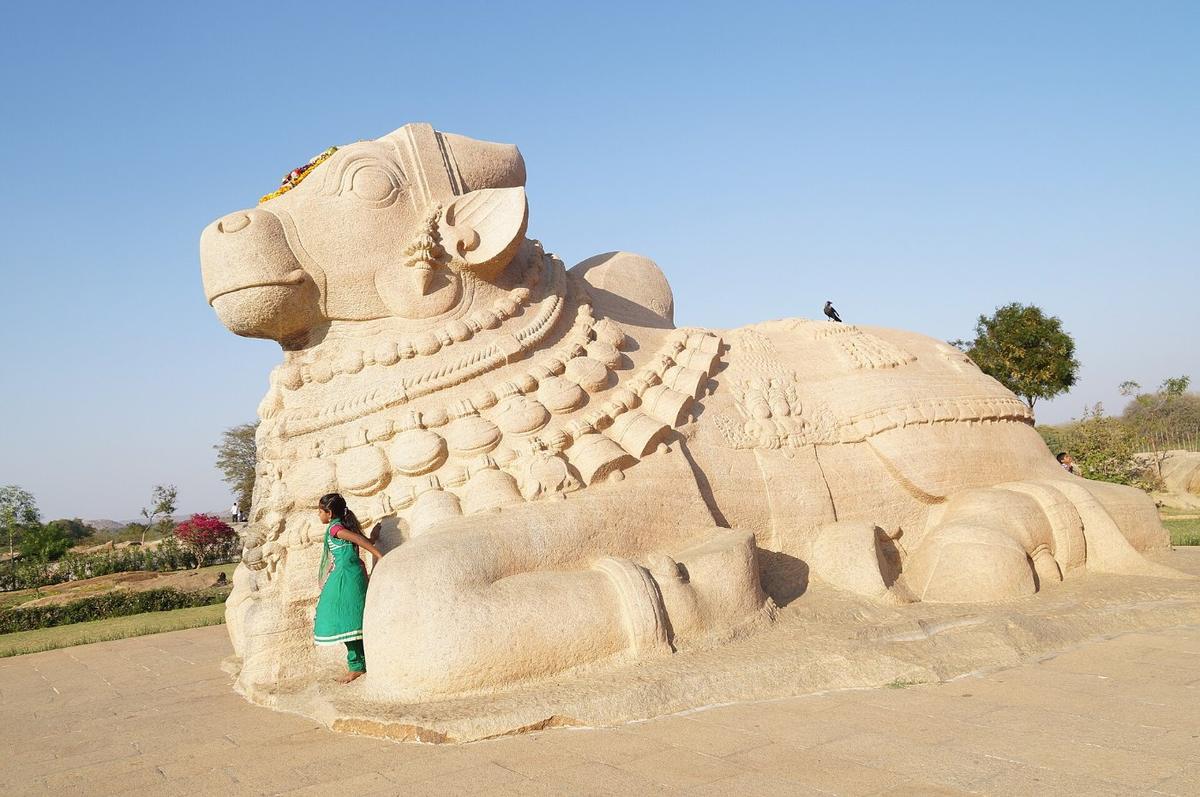
Photo: Lepakshi Nandi, Rahmanuddin, CC BY-SA 4.0

APPSC Group-I Mains 2023 · Paper II
2023 Paper II · Q7(a): model answer
History, Culture & Geography of India and Andhra Pradesh · Ancient and Medieval Andhra. Held in June 2023 (Notification 28/2022).
Examine the socio-religious and cultural life of the Vijayanagara kingdom with respect to the writings of foreign travellers such as Nicolo Conti, Abdur Razzak, Duarte Barbosa and Domingo Paes.
Syllabus: Ancient and Medieval Andhra · Kakatiyas, Reddis, Gajapatis and Vijayanagara
VijayanagaraForeign travellersMahanavamiReligious tolerance
The Vijayanagara kingdom, founded in 1336 by Harihara and Bukka, was among the richest states of its time. Italian, Persian and Portuguese visitors, Nicolo Conti, Abdur Razzak, Duarte Barbosa and Domingo Paes, left vivid eyewitness accounts of its capital, festivals, temples and customs. Their writings complement inscriptions and Telugu, Kannada and Sanskrit literature in reconstructing Vijayanagara society.
| Traveller | Visit and ruler | Key observations |
|---|---|---|
| Nicolo Conti (Italian) | c. 1420; Devaraya I | City about 60 miles round; huge royal harem; sati; temple-car processions |
| Abdur Razzak (envoy of the Timurid Shah Rukh) | 1442–43; Devaraya II | Seven concentric fortifications; jewel bazaars; Mahanavami; tax on prostitution paid the police |
| Duarte Barbosa (Portuguese) | Early 16th century | Freedom of religion; trade in horses and diamonds; Brahmana dominance; sati |
| Domingo Paes (Portuguese) | c. 1520–22; Krishnadevaraya | City 'as large as Rome'; the king's personality; Mahanavami; temple dancers |
1. Religious life
- Temple-centred Hinduism: Vaishnava (Vitthala, Venkateswara) and Shaiva (Virupaksha) worship flourished; Conti describes temple-car processions in which some devotees threw themselves under the wheels.
- Mahanavami: Abdur Razzak and Paes describe the grand nine-day festival, with the king reviewing troops, music, dance and sacrifices, watched from a great platform (the Mahanavami Dibba).
- Tolerance: Barbosa wrote that every man 'may come and go and live according to his own creed'; Muslims served in the army, and according to Ferishta, Devaraya II placed a Quran before his throne so that his Muslim soldiers could salute him without offending their faith.
2. Social life
- Prosperity: Abdur Razzak wrote that 'the pupil of the eye has never seen a place like it'; Paes called it 'the best provided city in the world', with bazaars full of jewels, grain and fruit.
- Social evils: sati among royal wives (Conti, Barbosa), polygamy and the devadasi system; prostitution was regulated, and its tax paid the city police (Razzak).
- Hierarchy: Barbosa noted the honoured position of Brahmanas, and caste ranking remained strong.
- Women of the elite: queens and palace women enjoyed wealth, and temple dancers held a recognised place in festivals.
3. Cultural life
- Architecture: Raya gopurams, kalyana mandapas and pillared halls, as in the Vitthala and Hazara Rama temples.
- Kingship and learning: Paes describes Krishnadevaraya as learned, just and physically disciplined, exercising daily.
- Languages: the court patronised Telugu, Kannada, Tamil and Sanskrit.
AP angle: Krishnadevaraya's Amuktamalyada ('Desa bhashalandu Telugu lessa') and the Ashtadiggajas, led by Allasani Peddana (Manucharitra), made his reign a golden age of Telugu. The Lepakshi murals, Tirumala patronage, his campaigns to Udayagiri, Kondaveedu and Simhachalam, and the later capitals Penukonda and Chandragiri all lie in Andhra Pradesh.
Schematic map of Andhra Pradesh (2011 census district outlines), not to scale; for study only.
4. Limitations of the accounts
- Narrow view: they describe mainly the capital and the court, not villages.
- Outsiders' lens: language barriers, exaggeration and cultural misunderstanding colour their judgements.
Though impressionistic and confined mostly to the capital, these accounts confirm Vijayanagara's splendour and its composite culture.
The other choice in Q7
Answer either one in the exam.
- Q7(b)Examine the socio-cultural and religious conditions of the Reddi kingdoms with specific reference to the development of Telugu literature.
10 marks · Ancient and Medieval Andhra · Kakatiyas, Reddis, Gajapatis and Vijayanagara
Every model answer on these pages is free to read. The Tool Kit adds four PDF books for Mains Papers I–IV: every previous question sorted by syllabus, with practice questions. It is in the ₹149 All-in-One Pass, with every previous paper of every exam on the site, practice quizzes, timed tests, mock test series and study books.
₹149 · valid for 12 months from the day you pay, on every exam · pay by UPI, card or net banking