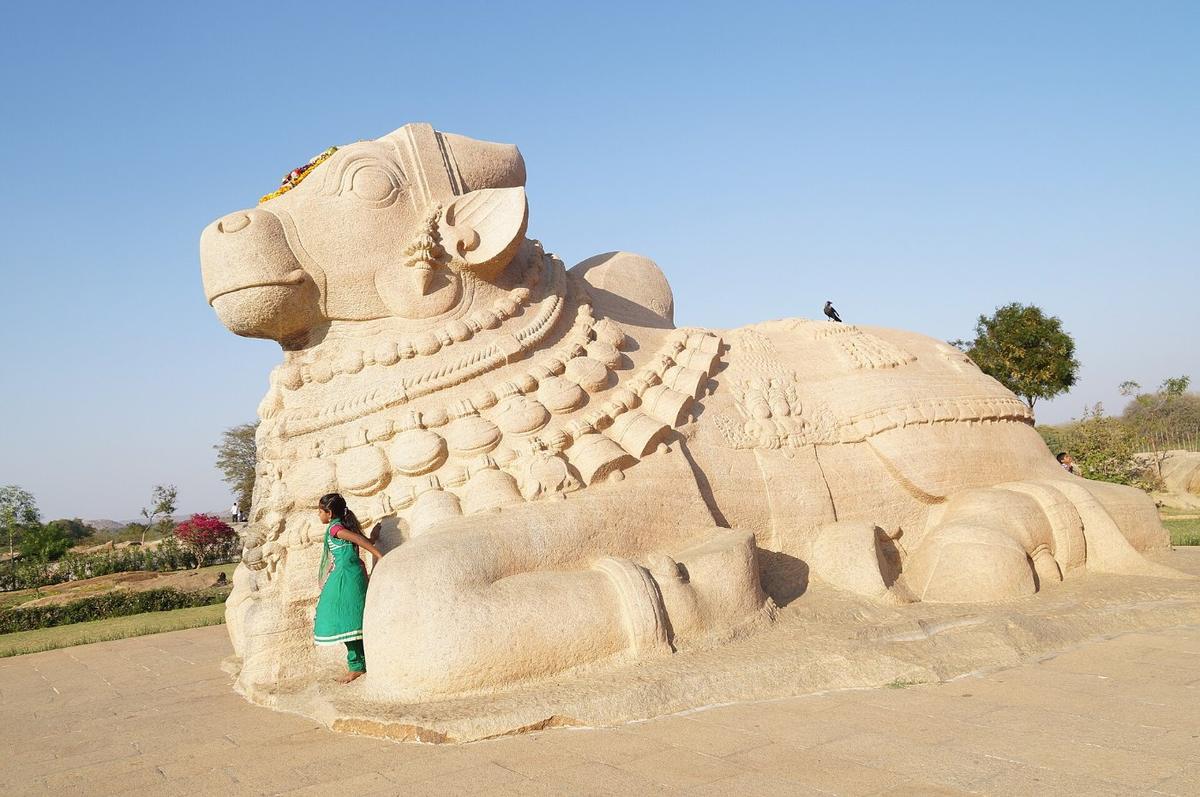
Photo: Lepakshi Nandi, Rahmanuddin, CC BY-SA 4.0

APPSC Group-I Mains 2023 · Paper II
2023 Paper II · Q7(b): model answer
History, Culture & Geography of India and Andhra Pradesh · Ancient and Medieval Andhra. Held in June 2023 (Notification 28/2022).
Examine the socio-cultural and religious conditions of the Reddi kingdoms with specific reference to the development of Telugu literature.
Syllabus: Ancient and Medieval Andhra · Kakatiyas, Reddis, Gajapatis and Vijayanagara
Reddi kingdomsKondaveeduSrinatha and ErranaTelugu literature
After the fall of the Kakatiyas (1323), Prolaya Vema Reddi founded the Reddi kingdom in 1325 with Addanki as capital, later shifted to Kondaveedu; a branch ruled from Rajahmundry. Lasting until the mid-15th century, the Reddi age revived temples and agraharas after the Delhi Sultanate's raids and saw a remarkable flowering of Telugu literature.
Schematic map of Andhra Pradesh (2011 census district outlines), not to scale; for study only.
1. Socio-religious conditions
- Brahmanical revival: agraharas were restored and land granted to Brahmanas and temples after the Sultanate's raids; Prolaya Vema Reddi is credited with building flights of steps to Srisailam and Ahobilam.
- Shaivism and Vaishnavism: both flourished at Srisailam, Ahobilam and Draksharama; festivals were celebrated lavishly, such as the Vasantotsavams of Kumaragiri Reddi, whose court dancer Lakuma Devi was famous.
- Social mobility: society retained the varna order, but the rise of the Reddis, a cultivating community, to kingship showed social mobility.
- Pilgrimage and temple culture: Srinatha's Bhimakhandam (on Draksharama) and Kasikhandam (on Varanasi) show the importance of pilgrimage and temple-centred devotion.
- Economy and forts: prosperity rested on agriculture, textiles and maritime trade through Motupalli; forts such as Kondaveedu and Kondapalli were built.
2. Development of Telugu literature
- Errapragada (Errana): court poet of Prolaya Vema Reddi, he completed the Aranya Parva left unfinished by Nannaya, thus finishing the Kavitrayam's Andhra Mahabharatam; he also wrote Harivamsam and Nrisimha Puranam and was called Prabandha Parameswara.
- Srinatha: Vidyadhikari (education minister) under Pedakomati Vema Reddi, he wrote Srungara Naishadham, Kasikhandam, Bhimakhandam, Haravilasam and Palnati Veera Charitra; called Kavi Sarvabhauma, he defeated Gauda Dindima Bhatta at Devaraya II's court and was honoured with a bath of gold coins (kanakabhishekam).
- Royal scholars: Kumaragiri Reddi wrote Vasantarajiyam, a treatise on dance; Pedakomati Vema Reddi wrote Sangita Chintamani and Sahitya Chintamani; Vamana Bhatta Bana wrote Vemabhupalacharitam in Sanskrit.
- Vemana: his satakas attacking caste and ritualism are traditionally placed in this age, though his date is disputed.
| Writer | Patron or role | Major works |
|---|---|---|
| Errana | Prolaya Vema Reddi | Aranya Parva (completion), Harivamsam, Nrisimha Puranam |
| Srinatha | Vidyadhikari of Pedakomati Vema Reddi | Srungara Naishadham, Kasikhandam, Bhimakhandam, Haravilasam |
| Kumaragiri Reddi | King | Vasantarajiyam (dance) |
| Pedakomati Vema Reddi | King | Sangita Chintamani, Sahitya Chintamani |
| Vamana Bhatta Bana | Court poet | Vemabhupalacharitam (Sanskrit) |
3. Significance
- Completion of the Mahabharatam: Errana's work gave Telugu its great epic in full, the shared heritage of all Telugu readers.
- New genres: Srinatha's prabandha-style elaboration and Puranic translations enriched the language, while his descriptions of Palnadu and village life brought realism into poetry.
- Bridge to Vijayanagara: royal scholarship and court patronage prepared the ground for the golden age under Krishnadevaraya.
The Reddi period thus combined Hindu revival, social mobility and a flowering of Telugu letters.
The other choice in Q7
Answer either one in the exam.
- Q7(a)Examine the socio-religious and cultural life of the Vijayanagara kingdom with respect to the writings of foreign travellers such as Nicolo Conti, Abdur Razzak, Duarte Barbosa and Domingo Paes.
10 marks · Ancient and Medieval Andhra · Kakatiyas, Reddis, Gajapatis and Vijayanagara
Every model answer on these pages is free to read. The Tool Kit adds four PDF books for Mains Papers I–IV: every previous question sorted by syllabus, with practice questions. It is in the ₹149 All-in-One Pass, with every previous paper of every exam on the site, practice quizzes, timed tests, mock test series and study books.
₹149 · valid for 12 months from the day you pay, on every exam · pay by UPI, card or net banking